Architectural Record
search
cart
facebook twitter linkedin youtube
  • Sign In
  • Subscribe
  • Sign Out
  • My Account
Architectural Record
  • NEWS
    • Latest News
    • Awards
    • Interviews
    • Obituaries
    • Podcasts
      • Design:Ed Podcast
      • Sponsored Podcasts
  • OPINION
    • Book Reviews / Excerpts
    • Exhibition Reviews
    • Forum
  • EXCLUSIVES
    • Videos
    • Design Vanguard
    • Top 300 Firms
    • Sponsored Content
    • Sponsored eBooks
    • From the Archives
  • CONTINUING ED
    • Editorial Continuing Ed
    • CE Center
    • CE Academies
  • PROJECTS
    • Buildings By Type
    • Reuse & Renovation
    • Museums & Arts Centers
    • Colleges & Universities
    • Multifamily Housing
    • Interiors
    • Lighting
    • Kitchen & Bath
  • HOUSES
    • Record Houses
    • House of the Month
    • Featured Houses
  • PRODUCTS
    • Products by Category
    • Record Products of the Year
    • Latest Products
  • EVENTS
    • Dates & Events
    • Record on the Road
    • Innovation Conference
    • Sustainability in Practice
    • Women In Architecture
    • Webinars
    • Ad Excellence Awards
    • Submit an Event
  • CONNECT
    • Ask RECORD AI
    • Newsletters
    • Contact
    • Advertise
    • Editorial Calendar
    • Store
    • Customer Service
  • SUBMIT
    • Submission Guidelines
    • RECORD Competitions
  • MAGAZINE
    • Subscribe
    • My Account
    • Digital Edition
    • Current Issue
    • Firm Pass
    • Historic Archive
ExclusivesFrom the Archives

From the RECORD Archives: 'A Radical Alternative'
By RECORD Editors
Architectural Record, December 1972
Image © Architectural Record, December 1972
March 30, 2026
✕
Image in modal.
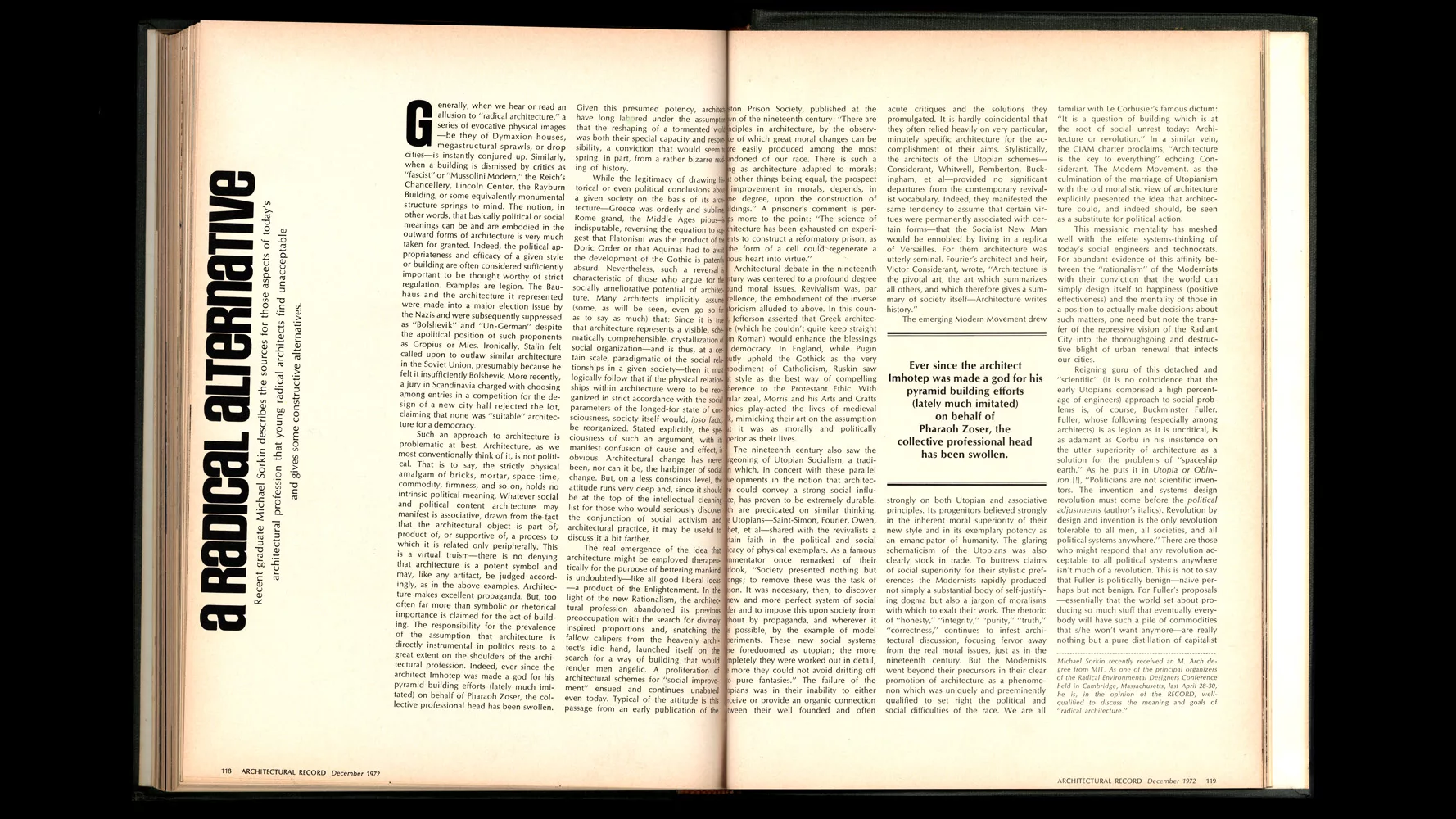
RECORD was among the first to publish Michael Sorkin, the celebrated critic known for his sharp wit and candor. Having studied architecture at MIT, Sorkin was just 24 years old at the time the magazine featured his essay, “A Radical Alternative,” on the political dilemma faced by an emerging generation of socially minded architects. It appeared in the December 1972 issue titled The Young Architects, which showcased work by and essays about emerging talent, their relationship to the profession, and the future of education. “What you will find, I think is evolution; careful thought; some good design; and some (appropriately) fresh ideas,” reads the issue’s introduction by then editor in chief Walter F. Wagner, Jr.  Several years later, Sorkin became the in-house architecture critic for the Village Voice, where he penned diatribes that were often scathing, yet humorous, on the moneyed interests influencing New York City’s development. After leaving the Village Voice in 1988, he wrote for outlets including the Nation and RECORD while maintaining a design studio, teaching, and running a nonprofit and publishing imprint. In March 2020, at the age of 71, Sorkin died of Covid. The exhibition People Cross Against the Light: Michael Sorkin’s New York, currently on view at the Temple Hoyne Buell Center for the Study of American Architecture at Columbia University, pairs Sorkin’s unbuilt designs for the city with excerpts of his writings, including a passage from “A Radical Alternative.”


“A Radical Alternative" 
by Michael Sorkin
Architectural Record, December 1972

Recent graduate Michael Sorkin describes the sources for those aspects of today’s architectural profession that young radical architects find unacceptable and gives some constructive alternatives. 

Architectural Record, December 1972

Image © Architectural Record, December 1972
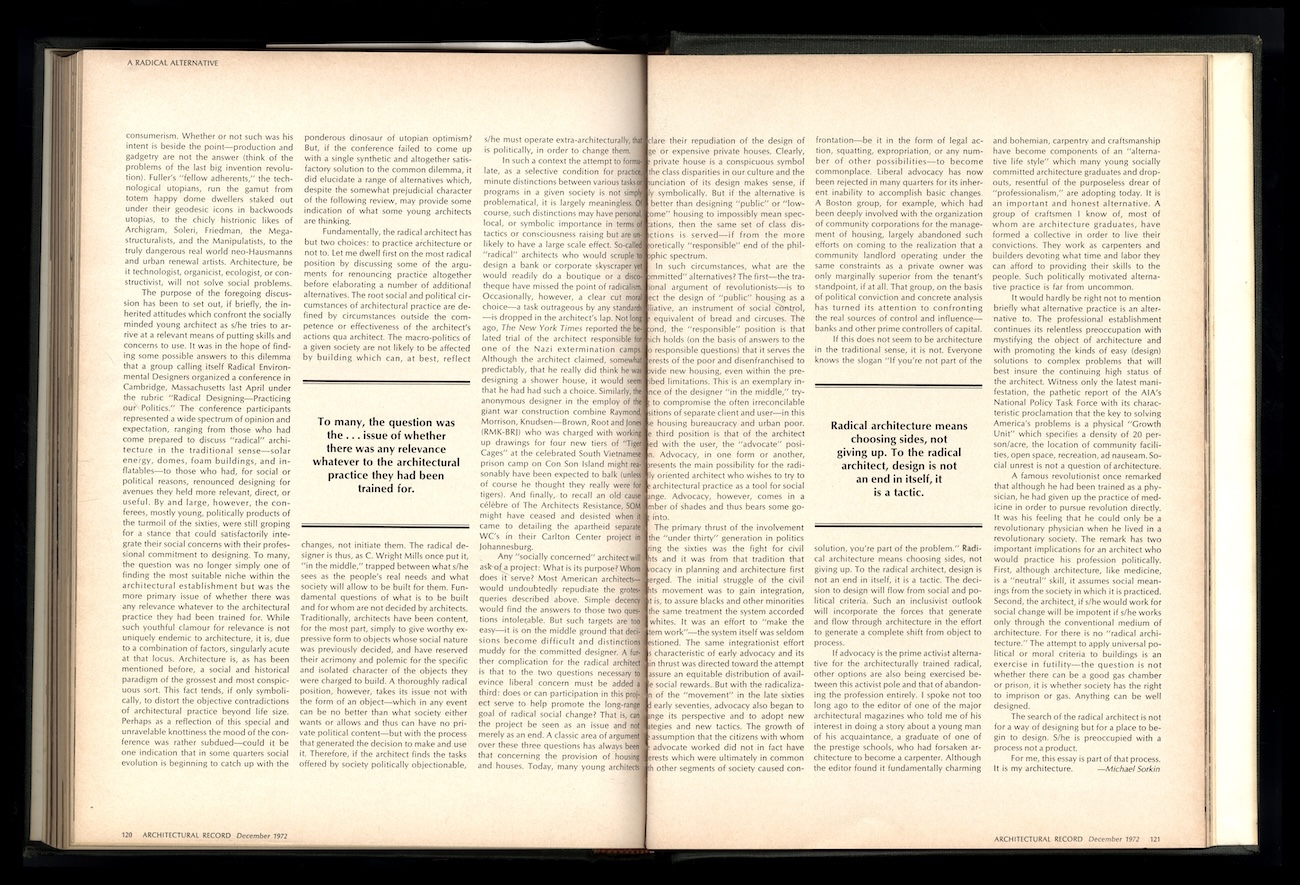
Generally, when we hear or read an allusion to “radical architecture,” a series of evocative physical images—be they of Dymaxion houses, megastructural sprawls, or drop cities—is instantly conjured up. Similarly, when a building is dismissed by critics as “fascist” or “Mussolini Modern,” the Reich’s Chancellery, Lincoln Center, the Rayburn Building, or some equivalently monumental structure springs to mind. The notion, in other words, that basically political or social meanings can be and are embodied in the outward forms of architecture is very much taken for granted. Indeed, the political appropriateness and efficacy of a given style or building are often considered sufficiently important to be thought worthy of strict regulation. Examples are legion. The Bauhaus and the architecture it represented were made into a major election issue by the Nazis and were subsequently suppressed as “Bolshevik” and “Un-German” despite the apolitical position of such proponents as Gropius or Mies. Ironically, Stalin felt called upon to outlaw similar architecture in the Soviet Union, presumably because he felt it insufficiently Bolshevik. More recently, a jury in Scandinavia charged with choosing among entries in a competition for the design of a new city hall rejected the lot, claiming that none was “suitable” architecture for a democracy.

Such an approach to architecture is problematic at best. Architecture, as we most conventionally think of it, is not political. That is to say, the strictly physical amalgam of bricks, mortar, space-time, commodity, firmness, and so on, holds no intrinsic political meaning. Whatever social and political content architecture may manifest is associative, drawn from the fact that the architectural object is part of, product of, or supportive of, a process to which it is related only peripherally. This is a virtual truism—there is no denying that architecture is a potent symbol and may, like any artifact, be judged accordingly, as in the above examples. Architecture makes excellent propaganda. But, too often far more than symbolic or rhetorical importance is claimed for the act of building. The responsibility for the prevalence of the assumption is that architecture is directly instrumental in politics rests to a great extent on the shoulders of the architectural profession. Indeed, ever since the architect Imhotep was made a god for his pyramid building efforts (lately much imitated) on behalf of Pharaoh Zoser, the collective professional head has been swollen.

Given this presumed potency, architects have long labored under the assumption that the reshaping of a tormented world was both their special capacity and responsibility, a conviction that would seem to spring, in part, from a rather bizarre reading of history.

While the legitimacy of drawing historical or even political conclusions about a given society on the basis of its architecture—Greece was orderly and sublime, Rome grand, the Middle Ages pious—is indisputable, reversing the equation to suggest that Platonism was the product of the Doric Order or that Aquinas had to await the development of the Gothic is patently absurd. Nevertheless, such a reversal is characteristic of those who argue for the socially ameliorative potential or architecture. Many architects implicitly assume (some, as will be seen, even go so far as to say as much) that: Since it is true that architecture represents a visible, schematically comprehensible, crystallization of social organization—and is thus, at a certain scale, paradigmatic of the social relationships in a given society—then it must logically follow that if the physical relationships within architecture were to be reorganized in strict accordance with the social parameters of the longed-for state of consciousness, society itself would, ipso facto, be reorganized. Stated explicitly, the speciousness of such an argument, with its manifest confusion of cause and effect, is obvious. Architectural change has never been, nor can it be, the harbinger of social change. But, on a less conscious level, the attitude runs very deep and, since it should be at the top of the intellectual cleaning list for those who would seriously discover the conjunction of social activism and architectural practice, it may be useful to discuss it a bit further.

The real emergence of the idea that architecture might be employed therapeutically for the purpose of bettering mankind is undoubtedly—like all good liberal ideas—a product of the Enlightenment. In the light of the new rationalism, the architectural profession abandoned its previous preoccupation with the search for divinely inspired proportions and, snatching the fallow calipers from the heavenly architect’s idle hand, launched itself on the search of way of building that would render men angelic. A proliferation of architectural schemes for “social improvement” ensued and continues unabated even today. Typical of the attitude is this passage from an early publication of the Boston Prison Society, published at the dawn of the nineteenth century: “There are principles in architecture, by the observance of which great moral changes can be more easily produced among the most abandoned of our race. There is such a thing as architecture adapted to morals; that other things being equal, the prospect of improvement in morals, depends, in some degree, upon the construction of buildings.” A prisoner’s comment is perhaps more to the point: “The science of architecture has been exhausted on experiments to construct a reformatory prison, as if the form of a cell could regenerate a vicious heart into virtue.”

Architectural Record, December 1972

Image © Architectural Record, December 1972

Architectural debate in the nineteenth century was centered to a profound degree around moral issues. Revivalism was, par excellence, the embodiment of the inverse historicism alluded to above. In this try, Jefferson asserted that Greek architecture (which he couldn’t keep straight from Roman) would enhance the blessings of democracy. In England, while Pugin stoutly upheld the Gothic as the very embodiment of Catholicism, Ruskin saw that style as the best way of compelling adherence to the Protestant Ethic. With similar zeal, Morris and his Arts and Crafts cronies play-acted the lives of medieval folk, mimicking their art on the assumption that it was as morally and politically superior as their lives. 

The nineteenth century also saw that burgeoning of Utopian Socialism, a tradition which, in concert with these parallel developments in the notion that architecture could convey a strong social influence, has proven to be extremely durable. Both are predicated on similar thinking. The Utopians—Saint-Simon, Fourier, Owen, Cabet, et al—shared with the revivalists a certain faith in the political and social efficacy of physical exemplars. As a famous commentator once remarked of their outlook, “Society presented nothing but wrongs; to remove these was the task of reason. It was necessary, then, to discover a new and more perfect system of social order and to impose this upon society from without by propaganda, and wherever it was possible, by the example of model experiments. These new social systems were foredoomed as utopian the more completely they were worked out in detail, the more they could not avoid drifting off to pure fantasies.” The failure of the Utopians was in their inability to either perceive or provide an organic connection between their well-founded and often acute critiques and the solutions they promulgated. It is hardly coincidental that they often relied heavily on very particular, minutely specific architecture for the accomplishment of their aims. Stylistically, the architects of the Utopian schemes—Considerant, Whitwell, Pemberton, Buckingham, et all—provided no significant departures from the contemporary revivalist vocabulary. Indeed, they manifested the same tendency to assume that certain virtues were permanently associated with certain forms—that the Socialist New Man would be ennobled by living in a replica of Versailles. For them architecture was utterly seminal. Fourier’s architect and heir, Victor Considerant, wrote, “Architecture is the pivotal art, the art which summarizes all others, and which therefore gives a summary of society itself—Architecture writes history.”

The emerging Modern Movement drew strongly on both Utopian and associative principles. Its progenitors believed strongly in the inherent moral superiority of their new style and in its exemplary potency as an emancipator of humanity. The glaring schematicism of the Utopians was also clearly stock in trade. To buttress claims of social superiority for their stylistic preferences the modernists rapidly produced not simply a substantial body of self-justifying dogma but also a jargon of moralisms with which to exalt their work. The rhetoric of “honesty,” “integrity,” “purity,” “truth,” “correctness,” continues to infest architectural discussion, focusing fervor away from the real moral issues, just as in the nineteenth century. But the modernists went beyond their precursors in their clear promotion of architecture as a phenomenon which was uniquely and preeminently qualified to set right the political and social difficulties of the race. We are all familiar with Le Corbusier’s famous dictum: “It is a question of building which is at the root of social unrest today: Architecture or revolution.” In a similar vein, the CIAM charter proclaims, “Architecture is the key to everything” echoing Considerant. The Modern Movement, as the culmination of the marriage of Utopianism with the old moralistic view of architecture explicitly presented the idea that architecture could, and indeed should, be seen as a substitute for political action.

Architectural Record, December 1972

Image © Architectural Record, December 1972

This messianic mentality has meshed well with the effete systems-thinking of today’s social engineers and technocrats. For abundant evidence of this affinity between the “rationalism” of the modernists with their conviction that the world can simply design itself to happiness (positive effectiveness) and the mentality of those in a position to actually make decisions about such matters, one need but note the transfer of the repressive vision of the Radiant City into the throughgoing and destructive blight of urban renewal that infects our cities.

Reigning guru of this detached and “scientific” (it is no coincidence that the early Utopians comprised a high percentage of engineers) approach to social problems is, of course, Buckminster Fuller. Fuller, whose following (especially among architects) is a legion as it is uncritical, is as adamant as Corbu in his insistence on the utter superiority of architecture as a solution for the problems of “spaceship earth.” As he puts it in Utopia or Oblivion [!], “Politicians are not scientific investors. The invention and systems design revolution must come before the political adjustments (author’s italics). Revolution by design and invention is the only revolution tolerable to all men, all societies, and all political systems anywhere.” There are those who might respond that any revolution acceptable to all political systems anywhere isn’t much of a revolution. This is not to say that Fuller is politically benign. For Fuller’s proposals—essentially that the world set about producing so much stuff that eventually everybody will have such a pile of commodities that s/he won’t want anymore—are really nothing but a pure distillation of capitalist consumerism. Whether or not such was his intent is beside the point—production and gadgetry are not the answer (think of the problems of the last big invention revolution). Fuller’s “fellow adherents,” the technological utopians, run the gamut from totem happy dome dwellers staked out under their geodesic icons in backwoods utopias, to the chicly histrionic likes of Archigram, Soleri, Friedman, the Megastructuralists, and Manipulatists, to the truly dangerous real world neo-Hausmanns and urban renewal artists. Architecture, be it technologist, organicist, ecologist, or constructivist, will not solve social problems. 

The purpose of the foregoing discussion has been to set out, if briefly, the inherited attitudes which confront the socially minded young architect as s/he tries to arrive at a relevant means of putting skills and concerns to use. It was in the hope of finding some possible answers to this dilemma that a group calling itself Radical Environmental Designers organized a conference in Cambridge, Massachusetts last April under the rubric “Radical Designing—Practicing our Politics.” The conference participants represented a wide spectrum of opinion and expectation, ranging from those who had come prepared to discuss “radical” architecture in the traditional sense—solar energy, domes, foam buildings, and inflatables—to those who had, for social or political reasons, renounced designing for avenues they had held more relevant, direct, or useful. By and large, however, the conferees, mostly young, political products of the turmoil of the sixties, were still groping for a stance that could satisfactorily integrate their social concerns with their professional commitment to designing. To many, the question was no longer simply one of finding the most suitable niche within the architectural establishment but was the more primary issue of whether there was any relevance whatever to the architectural practice they had been trained for. While such youthful clamor for relevance is not uniquely endemic to architecture, it is, due to a combination of factors, singularly acute at that locus. Architecture is, as has been mentioned before, a social and historical paradigm of the grossest and most conspicuous sort. This fact tends, if only symbolically, to distort the objective contradictions of architectural practice beyond life size. Perhaps as a reflection of this special and unravelable knottiness the mood of the conference was rather subdued—could it be one indication that in some quarters social evolution is beginning to catch up with the ponderous dinosaur of utopian optimism? But, if the conference failed to come up with a single synthetic and altogether satisfactory solution to the common dilemma, it did elucidate a range of alternatives which, despite the somewhat prejudicial character of the following review, may provide some indication of what some young architects are thinking.

Fundamentally, the radical architect has but two choices: to practice architecture or not to. Let me dwell first on the most radical position by discussing some of the arguments for renouncing practice altogether before elaborating a number of additional alternatives. The root social and political circumstances of architectural practice are defined by circumstances outside the competence or effectiveness of the architect’s actions qua architect. The macro-politics of a given society are not likely to be affected by building which can, at best, reflect changes, not initiate them. The radical designer is thus, as C. Wright Mills once put it, “in the middle,” trapped between what s/he sees as the people’s real needs and what society will allow to be built for them. Fundamental questions of what is to be built and for whom are not decided by architects. Traditionally, architects have been content, for the most part, simply to give worthy expressive form to objects whose social nature was previously decided, and have reserved their acrimony and polemic for the specific and isolated character of the objects they were charged to build. A thoroughly radical position, however, takes its issue not with the form of an object—which in any event can be no better than what society either wants or allows and thus can have no private political content—but with the process that generated the decision to make and use it. Therefore, if the architect finds the tasks offered by society politically objectionable, s/he must operate extra-architecturally, that is politically, in order to change them. 

In such a context the attempt to formulate, as a selective condition for practice, minute distinctions between various tasks or programs in a given society is not simply problematical, it is largely meaningless. Of course, such distinctions may have personal, local, or symbolic importance in terms of tactics or consciousness raising but are unlikely to have a large scale effect. So-called “radical” architects who would scruple to design a bank or corporate skyscraper yet would readily do a boutique or a discotheque have missed the point of radicalism. Occasionally, however, a clear-cut moral choice—a task outrageous by any standards—is dropped in the architect’s lap. Not long ago, The New York Times reported the belated trial of the architect responsible for one of the Nazi extermination camps. Although the architect claimed, somewhat predictably, that he really did think he was designing a shower house, it would seem that he had had such a choice. Similarly, the anonymous designer in the employ of the giant war construction combine Raymond, Morrison, Knudsen—Brown, Root and Jones (RMK-BRJ) who was charged with working up drawings for new tiers of “Tiger Cages” at the celebrated South Vietnamese prison camp on Con Son Island might reasonably have been expected to balk (unless of course he thought they really were for tigers). And finally, to recall and old cause célèbre of The Architects Resistance, SOM might have ceased and desisted when it came to detailing the apartheid separate WC’s in their Carlton Center project in Johannesburg. 

Any “socially concerned” architect will ask of a project: What is its purpose? Whom does it serve? Most American architects—would undoubtedly repudiate the grotesqueries described above. Simple decency would find the answers to those two questions intolerable. But such targets are too easy—it is on the middle ground that decisions become difficult and distinctions muddy for the committed designer. A further complication for the radical architect is that to the two questions necessary to evince liberal concern must be added a third: does or can participation in this project serve to help promote the long-range goal of radical change? That is, can the project be seen as an issue and not merely as an end. A classical area of argument over these three questions have always been that concerning the provision of housing and houses. Today, many young architects declare their repudiation of the design of large or expensive private houses. Clearly, the private house is a conspicuous symbol of the class disparities in our culture and the renunciation of its design makes sense, if only symbolically. But if the alternative is not better than designing “public” or “low-income” housing to impossibly mean specifications, then the same set of class distinctions is served—if from the more theoretically “responsible’ end of the philosophic spectrum.

In such circumstances, what are the “committed” alternatives? The first—the traditional argument of revolutionists—is to reject the design of “public” housing as a palliative, an instrument of social control, the equivalent of bread and circuses. The second, the “responsible” position is that which holds (on the basis of answers to the two responsible questions) that it serves the interests of the poor and disenfranchised to provide new housing, even within the prescribed limitations. This is an exemplary instance of the designer “in the middle,” trying to compromise the often irreconcilable positions of separate client and user—in this case housing bureaucracy and urban poor. The third position is that of the architect allied with the user, the “advocate” position. Advocacy, in one form or another, represents the main possibility for the radically oriented architect who wishes to try to use architectural practice as a tool for social change. Advocacy, however, comes in a number of shades and thus bears some going into.

The thrust of the involvement of the “under thirty” generation in politics during the sixties was the fight for civil rights and it was from that tradition that advocacy in planning and architecture first emerged. The initial struggle of the civil rights movement was to gain integration, that is, to assure blacks and other minorities of the same treatment the system accorded to whites. It was an effort to “make the system work”—the system itself was seldom questioned. The same integrationist effort was characteristic of early advocacy and its main thrust was directed toward the attempt to assure an equitable distribution of available social rewards. But with the radicalization of the “movement” in the late sixties and early seventies, advocacy also began to change its perspective and to adopt new strategies and new tactics. The growth of the assumption that the citizens with whom the advocate worked did not in fact have interests which were ultimately in common with other segments of society caused confrontation—be it in the form of legal action, squatting, expropriation, or any number of other possibilities—to become commonplace. Liberal advocacy has now been rejected in many quarters for its inherent inability to accomplish basic changes. A Boston group, for example, which had been deeply involved with the organization of community corporations for the management of housing, largely abandoned such efforts on coming to the realization that a community landlord operating under the same constraints as a private owner was only marginally superior from the tenant’s standpoint, if at all. That group, on the basis of political conviction and concrete analysis has turned its attention to confronting the real sources of control and influence—banks and other prime controllers of capital. 

If this does not seem to be architecture in the traditional sense, it is not. Everyone knows the slogan “If you’re not part of the solution, you’re part of the problem.” Radical architecture means choosing sides, not giving up. To the radical architect, design is not an end in itself, it is a tactic. The decision to design will flow from social and political criteria. Such an inclusivist outlook will incorporate the forces that generate and flow through architecture in the effort to generate a complete shift from object to process.

If advocacy is the prime activist alternative for the architecturally trained radical, other options are also being exercised between this activist pole and that of abandoning the profession entirely. I spoke not too long ago to the editor of one of the major architectural magazines who told me of his interest in doing a story about a young man of his acquaintance, a graduate of one of the prestige schools, who had forsaken architecture to become a carpenter. Although the editor found it fundamentally charming and bohemian, carpentry and craftmanship have become components of an “alternative life style” which many young socially committed architecture graduates and dropouts, resentful of the purposeless drear of “professionalism,” are adopting today. It is an important and honest alternative. A group of craftsmen I know of, most of whom are architecture graduates, have formed a collective in order to live their convictions. They work as carpenters and builders devoting what time and labor they can afford to providing their skills to people. Such politically motivated alternative practice is far from uncommon.

It would hardly be right not to mention briefly what alternative practice is an alternative to. The professional establishment continues its relentless preoccupation with mystifying the object of architecture and with promoting the kinds of easy (design) solutions to complex problems that will best insure the continuing high status of the architect. Witness only the latest manifestation, the pathetic report of the AIA’s National Policy Task Force with its characteristic proclamation that the key to solving America’s problems is a physical “Growth Unit” which specifies a density of 20 person/acre, the location of community facilities, open space, recreation, ad nauseum. Social unrest is not a question of architecture. 

A famous revolutionist once remarked that although he had been trained as a physician, he had given up the practice of medicine in order to pursue revolution directly. It was his feeling that he could only be a revolutionary physician if he lived in a revolutionary society. The remark has two important implications for an architect who would practice his profession politically. First, although architecture, like medicine is a “neutral” skill, it assumes social meaning from the society in which it is practiced. Second, the architect, if s/he would work for social change will be impotent if s/he works only through the conventional medium of architecture. For there is no “radical architecture.” The attempt to apply universal political or moral criteria to buildings is an exercise in futility—the question is not whether there can be a good gas chamber or prison, it is whether society has the right to imprison or gas. Anything can be well designed. 

The search of the radical architect is not for a way of designing but for a place to begin to design. S/he is preoccupied with a process not a product. 

For me, this essay is part of the process. It is my architecture.


Looking for quick answers on architecture and design topics?
Try Ask RECORD, our new smart AI search tool.
Ask RECORD →

Share This Story

Looking for a reprint of this article?
From high-res PDFs to custom plaques, order your copy today!
Post a comment to this article

Report Abusive Comment

Subscription Center
  • Create an Account
  • Start a Subscription
  • Manage My Account
  • Sign Up for Newsletters
  • Visit Customer Service
  • Update Preferences

More Videos

Sponsored Content

Sponsored Content is a special paid section where industry companies provide high quality, objective, non-commercial content around topics of interest to the Architectural Record audience. All Sponsored Content is supplied by the advertising company and any opinions expressed in this article are those of the author and not necessarily reflect the views of Architectural Record or its parent company, BNP Media. Interested in participating in our Sponsored Content section? Contact your local rep!

close
  • cold storage facility
    Sponsored byCarlisle SynTec Systems

    How Architects Can Design More Continuous Cold Storage Envelopes

  • TAMLYN XtremeTrim Exterior Trim
    Sponsored byTamlyn

    Designing Cleaner Panel Facades: Why Exterior Trim Details Matter

  • Building with Vapor Barriers
    Sponsored byReef Industries, Inc.

    Vapor Barriers Help Control Moisture in Tighter Building Designs

DESIGN:ED Podcast
Listen to Architectural Record’s DESIGN:ED Podcast

Events

June 18, 2026

Rebooting the Aging Office Building

Credits: 1 AIA LU/HSW; 1 AIBD P-CE; 0.1 ICC CEU; 1 PDH

Explore façade retrofit strategies and award-winning design concepts that can transform aging office buildings into healthier, higher-performing workplaces for today’s hybrid workforce.

June 23, 2026

Enhancing Fire Resistance with Advanced PVC Solutions

Credits: 1 AIA LU/HSW; 1 AIBD P-CE; 0.1 ICC CEU; 1 IIBEC CEH

Evaluate advanced PVC solutions that improve fire resistance, support WUI compliance, and enhance resilience in residential and commercial building design.

View All Submit An Event

Products

2026 Architect's Square Foot Costbook

2026 Architect's Square Foot Costbook

See More Products

Popular Stories

SanDiegoAirport

Top 300 Architecture Firms of 2026

Lorcan O' Herilhy

California Architect Lorcan O’Herlihy Has Died, Age 66

Coronado Bridge

The Architect’s Guide to San Diego

CCA, Studio Gang

The Winners of the AIA’s 2026 Architecture Award Range from Collegiate Rowing Hubs to Housing for the Homeless

Dusk House

Design Vanguard 2026: ONO

Rebooting the Aging Office Building - Free Webinar - June 18, 2026

Related Articles

  • Bergisel Ski Jump

    From the RECORD Archives: ‘A Grand Leap: The Innsbruck Ski Jump’

    See More
  • tuskegee chapel by paul rudolph

    From the RECORD Archives: ‘A Chapel for Tuskegee by Rudolph’

    See More
  • Temple B’rith Kodesh

    From the RECORD Archives: ‘A Major Synagogue by Belluschi’

    See More

Related Products

See More Products
  • drawingfrommodel.jpg

    Drawing from the Model: Fundamentals of Digital Drawing, 3D Modeling, and Visual Programming in Architectural Design

See More Products
×

The latest news and information

#1 Source for Architectural Design, News and Products

SUBSCRIBE
  • RESOURCES
    • Advertise
    • Contact Us
    • Submit
    • Store
  • ACCOUNT CENTER
    • Create an Account
    • Start a Subscription
    • Manage My Account
    • Sign Up for Newsletters
    • Visit Customer Service
    • Update Preferences
  • PRIVACY
    • PRIVACY POLICY
    • TERMS & CONDITIONS
    • DO NOT SELL MY PERSONAL INFORMATION
    • PRIVACY REQUEST
    • ACCESSIBILITY
  • SERVICES
    • Marketing Services
    • Reprints
    • Market Research
    • List Rental
    • Survey/Respondent Access
  • STAY CONNECTED
    • Linkedin
    • Facebook
    • Instagram
    • YouTube
    • X (Twitter)

Copyright ©2026. All Rights Reserved BNP Media, Inc. and BNP Media II, LLC.

Design, CMS, Hosting & Web Development :: ePublishing