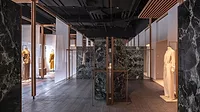
Neri&Hu Designs a South Korean Coffee Shop that Doubles as Social Infrastructure

Architects & Firms
The people of Busan, South Korea, are feeling the crunch of rising energy prices like the rest of the world. For the first time in 30 years, the country is imposing a fuel price cap, and in March launched an energy-savings campaign that encourages people to take shorter showers, use less electricity during the week, and ride bicycles, among other measures. While some daily routines are disrupted, others will likely remain sacrosanct—including a daily cup of coffee, or two.
.jpg "blue bottle coffee busan")
Photo courtesy Blue Bottle Coffee Busan
As a large port city, Busan has its own culture around coffee, according to Lyndon Neri and Rossana Hu, whose eponymous design firm recently created a new outpost there for the American coffee chain Blue Bottle. It is the fourth location that Shanghai-based Neri&Hu has designed for Blue Bottle, which has its roots in the San Francisco Bay Area.
“Busan's coffee culture is defined by its close relationship with the coastline and urban landscape,” elaborate the designers. “Unlike Seoul’s dense and fast-paced café scene, Busan places greater emphasis on ‘experience’—cafés are often treated as destinations where people slow down and engage with views of the ocean, river, and mountains.
.jpg "blue bottle coffee busan")
Photo © Pedro Pegenaute
.jpg "blue bottle coffee busan")
Photo © Pedro Pegenaute
The project included design of the café interior and its roof terrace, seeking to capitalize on an existing building’s position on Millak Subyeon Road along the Suyeong River, which offered a panoramic view of the water and natural environment as well as of city landmarks including Gwangan Bridge, I-Park, Busan Cinema Center, and Shinsegae Department Store.
The architects describe the café as a “social hub and a gateway” between the river and the backdrop of Baek Mountain, which overlooks the city. Neri&Hu’s research began with studying Korean architecture, particularly the hanok, or traditional Korean house. Rather than replicating formal elements, they focused on extracting underlying spatial logic and environmental responsiveness: “Among these, the concept of maru emerged as especially significant,” explain the architects. “It is an elevated wooden platform that exists between interior and exterior—neither fully enclosed nor completely open—but instead functions as a transitional space for gathering, resting, and observing.” They found the concept of this blurred boundary resonant with Blue Bottle’s wish to be a social destination for customers. But, balancing movement and lingering were a key challenge, due to the inherent split-level condition of the location.
.jpg "blue bottle coffee busan")
.jpg)
.jpg)
Photos © Pedro Pegenaute
The logic of the maru is also translated vertically: a stair connecting the fourth-floor café space to the rooftop was conceived as a glowing “lantern,” opening sightlines between floors and creating moments where visitors become aware of one another across space. The result is a layered interior where transparency and opacity, motion and pause, and individual and collective experiences are continuously balanced. Openness is maximized around the perimeter of the fourth floor and rooftop, ensuring a connection to views; the architects introduced more solid elements within interior spaces through timber columns and wooden eaves. Millwork and some furniture are constructed with Blue Bottle’s signature plywood finishes. The architects also introduced terra-cotta as a “grounding material,” both for its material warmth and potential for a circular lifespan.
.jpg "blue bottle coffee busan")
Photo courtesy Blue Bottle Coffee Busan
As the people of Busan, and the world as a whole, reconsider energy-use habits, their appreciation of spaces that offer something above and beyond consumption—a shared moment of pause and reflection—will likely continue to grow.
Looking for a reprint of this article?
From high-res PDFs to custom plaques, order your copy today!