From the RECORD Archives: ‘Restoring the Statue of Liberty’
A figure of many names and ideals, the Statue of Liberty has steadfastly weathered the tides of time in New York Harbor since autumn 1886. Designed by French sculptor Frédéric Auguste Bartholdi, in collaboration with engineer Gustave Eiffel, Lady Liberty was a gift to the United States from the people of France—a celebration of the two countries’ close relationship as well as a belated commemoration of the U.S.’s centennial 10 years prior. The ambitious restoration of the Mother of Exiles and her Richard Morris Hunt–designed pedestal was featured in RECORD’s July 1984 issue, including on its cover. In honor of America’s 250th anniversary, we look back at the renewal of one of this country’s most cherished—and aspirational—monuments.
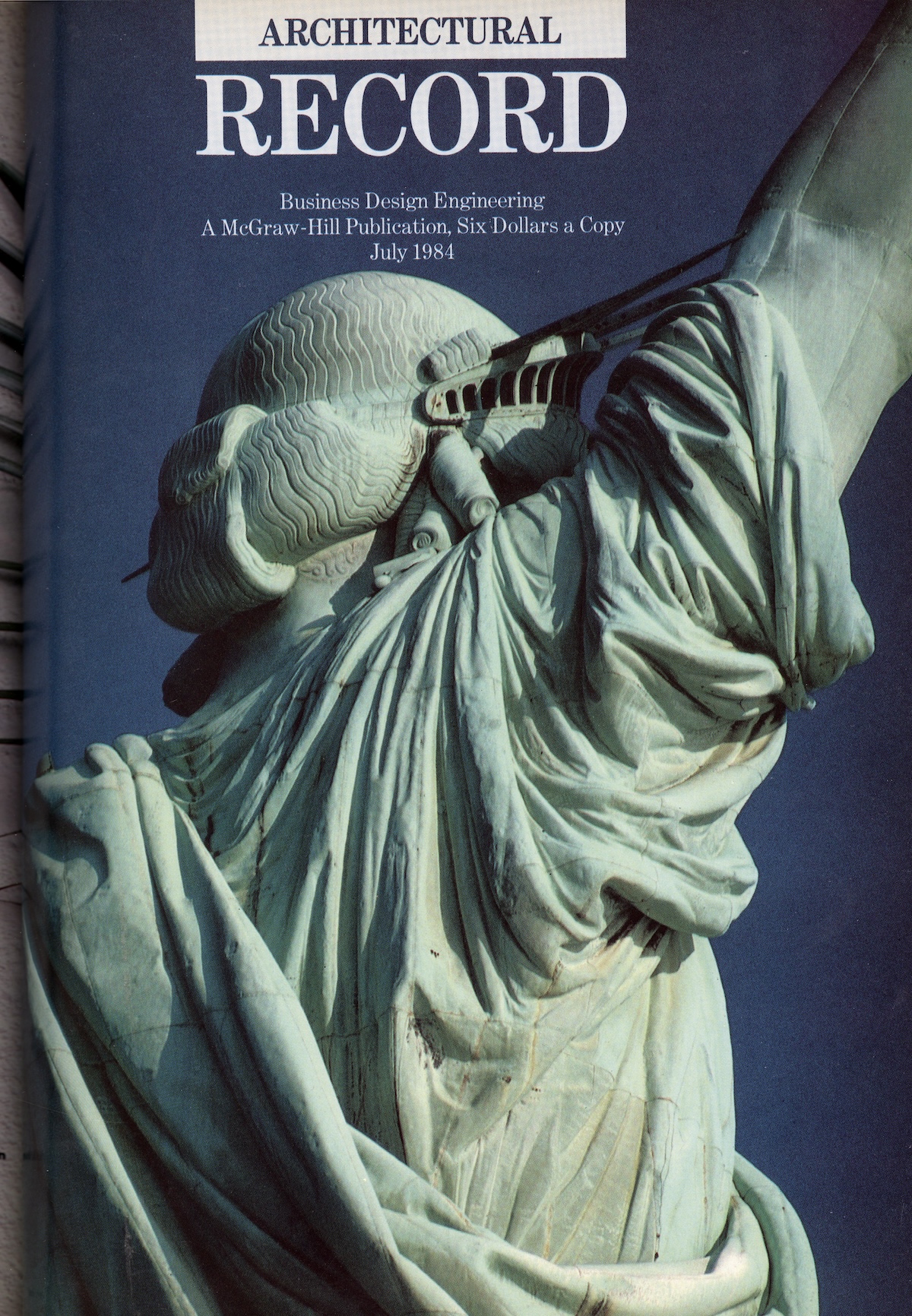
Image © Architectural Record, July 1984
By Grace Anderson
Architectural Record, July 1984
Most Americans have grown all too accustomed to her face, and her physical beauty has all too often been trivialized in cheap souvenir paperweights. But Frédéric Auguste Bartholdi clearly understood the aesthetic demands of monumental art when he sculptured the statue of Liberty Enlightening the World.
Bartholdi also understood the technical demands of monumental art very well. Starting with a small terra-cotta maquette, he increased the statue’s size through three meticulously scaled, successively larger versions, finally erecting the statue in Paris, where after suitable celebration it was disassembled and shipped to New York. The red-copper skin, which at 3/32 of an inch is proportionally as filmy as cloth drapery, consists of some 300 hand-hammered plates. The sculptured skin also has structural purpose: the hammering serves to rigidify the envelope, while the many folds in the drapery distribute stress and minimize sagging.
Moreover, the sculptor had the wit to commission a top-notch engineer, Alexandre-Gustave Eiffel, to design internal supports for the 151-foot statue. Eiffel devised an iron skeleton, the chief support a central pylon tied to the ground through the stone pedestal. The skin itself is supported by an armature of vertical and horizontal bars, the ribs a series of 1,350 rippling sections that follow the drapery’s folds. Loads are transferred from the ribs through flat bars to a secondary frame around the pylon.
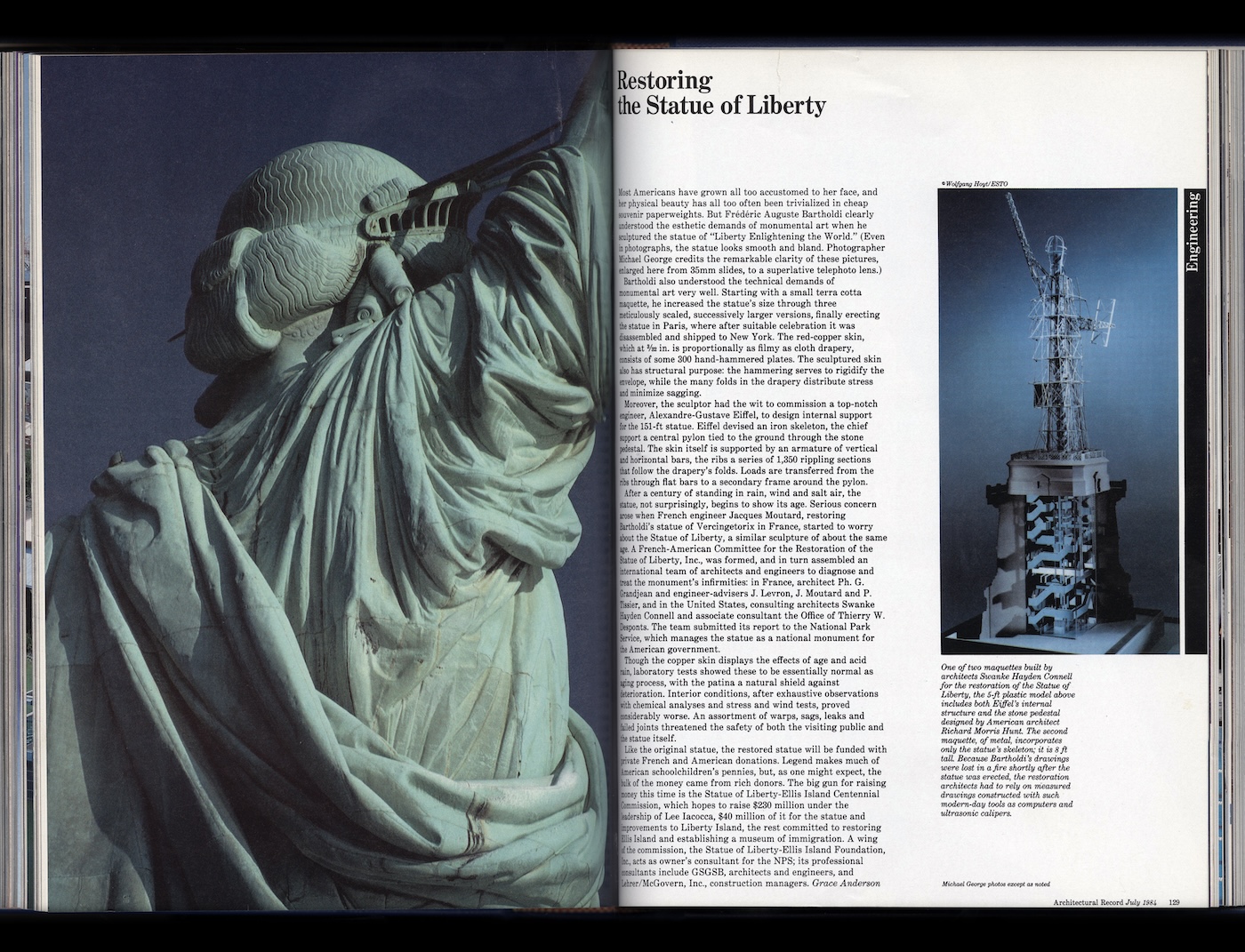
Image © Architectural Record, July 1984
After a century of standing in rain, wind, and salt air, the statue, not surprisingly, begins to show its age. Serious concern arose when French engineer Jacques Moutard, restoring Bartholdi’s statue of Vercingetorix in France, started to worry about the Statue of Liberty, a similar sculpture of about the same age. The French-American Committee for the Restoration of the Statue of Liberty, Inc., was formed, and in turn assembled an international team of architects and engineers to diagnose and treat the monument’s infirmities: in France, architect Ph. G. Grandjean and engineer-advisers J. Levron, J. Moutard, and P. Tissier; and in the United States, consulting architects Swanke Hayden Connell and associate consultant the Office of Thierry W. Despont. The team submitted its report to the National Park Service(NPS), which manages the statue as a national monument for the American government.
Though the copper skin displays the effects of age and acid rain, laboratory tests showed these to be essentially normal as aging process, with the patina a natural shield against deterioration. Interior conditions, after exhaustive observations with chemical analyses and stress and wind tests, proved considerably worse. An assortment of warps, sags, leaks and failed joints threatened the safety of both the visiting public and the statue itself.
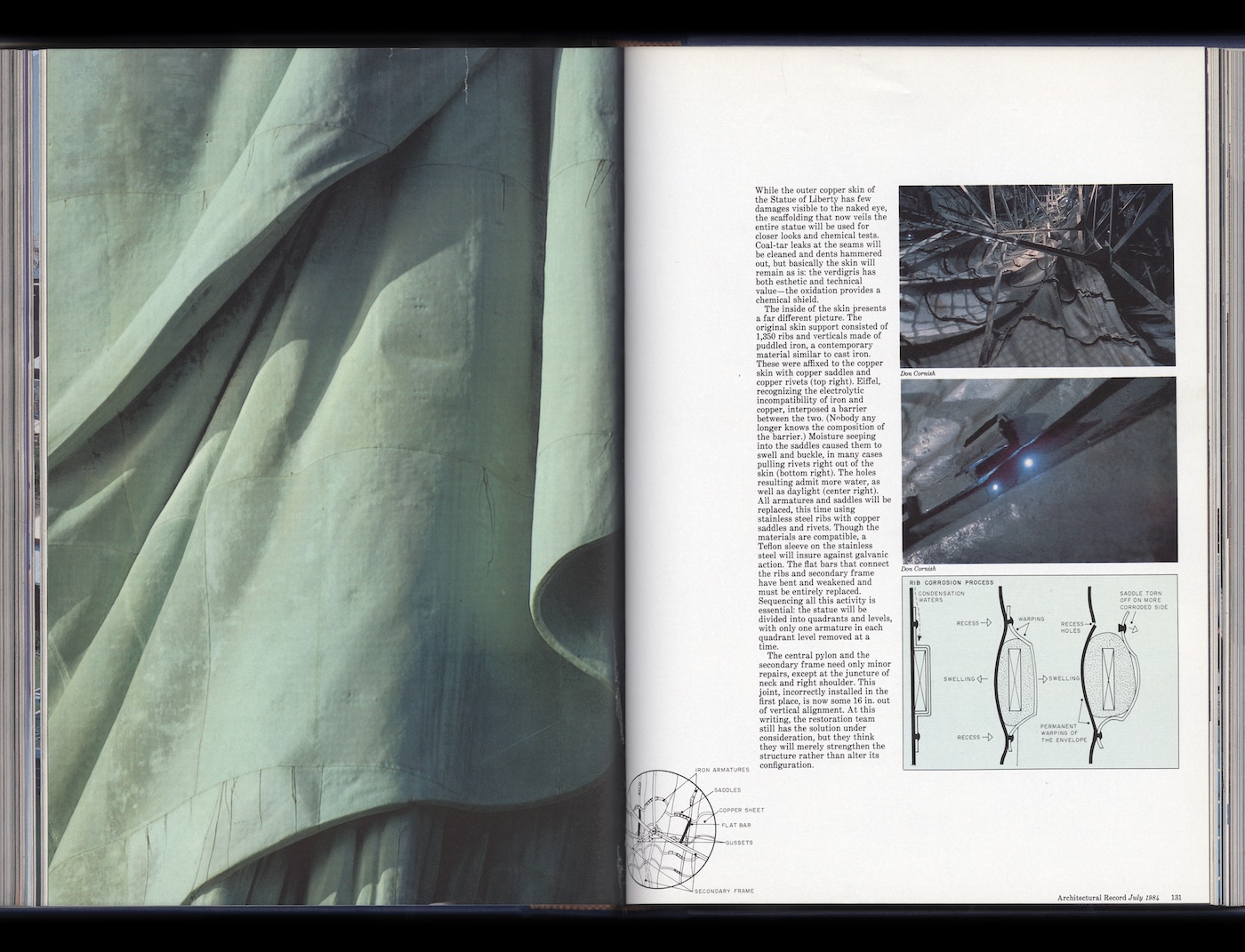
Image © Architectural Record, July 1984
Like the original statue, the restored statue will be funded with private French and American donations. Legend makes much of American schoolchildren’s pennies, but, as one might expect, the bulk of the money came from rich donors. The big gun for raising money this time is the Statue of Liberty-Ellis Island Centennial Commission, which hopes to raise $230 million under the leadership of Lee Iacocca, $40 million of it for the statue and improvements of Liberty Island, the rest committed to restoring Ellis Island and establishing a museum of immigration. A wing of the commission, the Statue of Liberty-Ellis Island Foundation, Inc., acts as owner’s consultant for the NPS; its professional consultants include Gilboy, Stauffer, Giombetti, Skibinski & Bellante (GSGSB) architects and engineers and Lehrer/McGovern, Inc., construction managers.
While the outer copper skin of the Statue of Liberty has little damage visible to the naked eye, the scaffolding that now veils the entire statue will be used for closer looks and chemical tests. Coal-tar leaks at the seams will be cleaned and dents hammered out, but basically the skin will remain as is: the verdigris has both aesthetic and technical value—the oxidation provides a chemical shield.
The inside of the skin presents a far different picture. The original skin support consisted of 1,350 ribs and verticals made of puddled iron, a contemporary material similar to cast iron. These were affixed to the copper skin with copper saddles and copper rivets. Eiffel, recognizing the electrolytic incompatibility of iron and copper, interposed a barrier between the two (nobody any longer knows the composition of the barrier). Moisture seeping into the saddles caused them to swell and buckle, in many cases pulling rivets right out of the skin. The holes resulting admit more water, as well as daylight. All armatures and saddles will be replaced, this time using stainless steel ribs with copper saddles and rivets. Though the materials are compatible, a Teflon sleeve on the stainless steel will ensure against galvanic action. The flat bars that connect the ribs and secondary frame have bent and weakened and must be entirely replaced. Sequencing all this activity is essential: the statue will be divided into quadrants and levels, with only one armature in each quadrant level removed at a time.
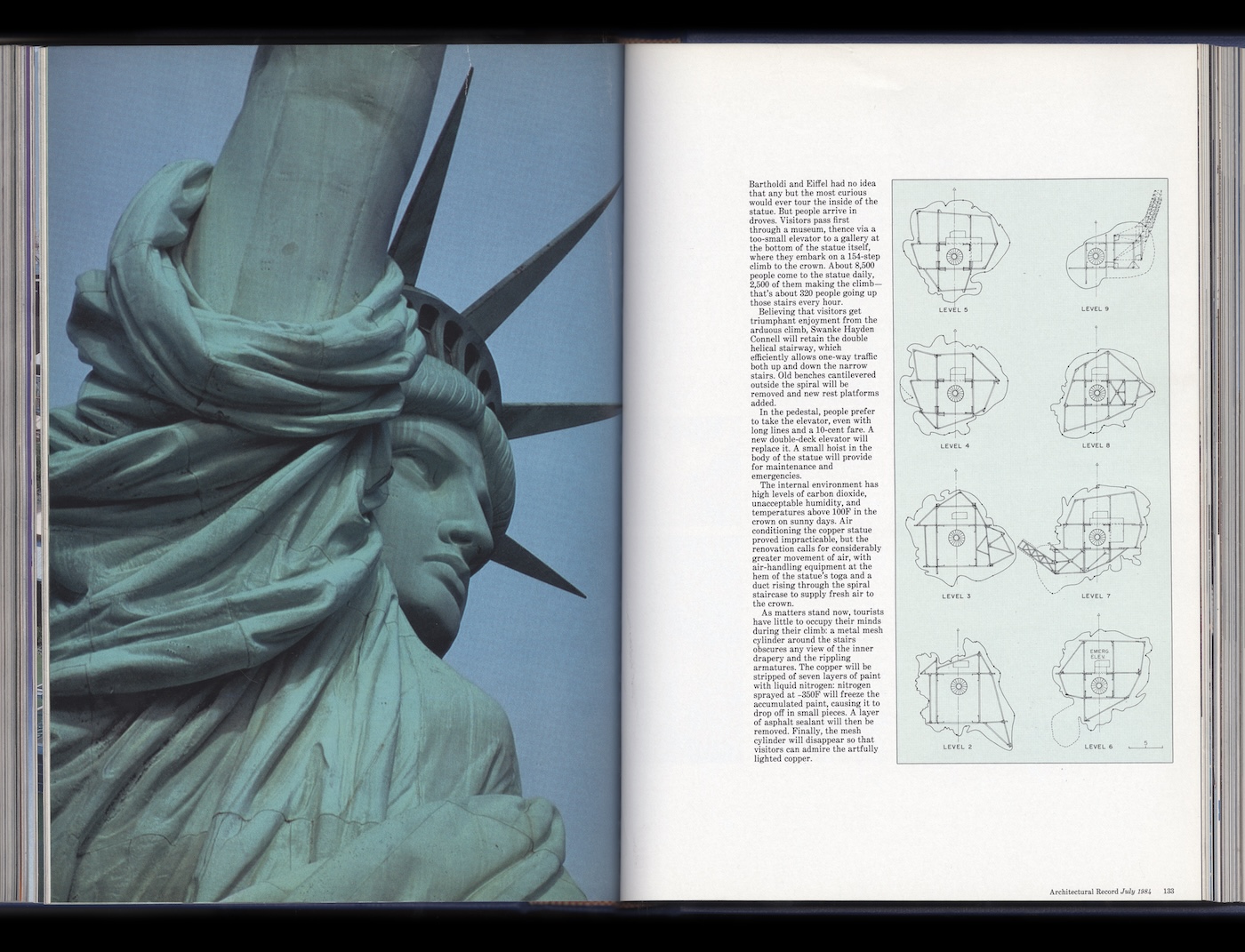
Image © Architectural Record, July 1984
The central pylon and the secondary frame need only minor repairs, except at the juncture of neck and right shoulder. This joint, incorrectly installed in the first place, is now some 16 inches out of vertical alignment. At this writing, the restoration team still has the solution under consideration, but they think they will merely strengthen the structure rather than alter its configuration.
Bartholdi and Eiffel had no idea that any but the most curious would ever tour the inside of the statue. But people arrive in droves. Visitors pass first through a museum, thence via too-small elevator to a gallery at the bottom of the statue itself, where they embark on a 154-step climb to the crown. About 8,500 people come to the statue daily, 2,500 of them making the climb—that’s about 320 people going up those stairs every hour.
Believing that visitors get triumphant enjoyment from the arduous climb, architects Swanke Hayden Connell will retain the double helical stairway, which efficiently allows one-way traffic both up and down the narrow stairs. Old benches cantilevered outside the spiral will be removed and new rest platforms added.
Looking for quick answers on architecture and design topics?
Try Ask RECORD, our new smart AI search tool.
Ask RECORD →
In the pedestal, people prefer to take the elevator, even with long lines and a 10-cent fare. A new double-deck elevator will replace it. A small hoist in the body of the statue will provide for maintenance and emergencies.
The internal environment has high levels of carbon dioxide, unacceptable humidity, and temperatures above 100 degrees Fahrenheit in the crown on sunny days. Air conditioning the copper statue proved impracticable, but the renovation calls for considerably greater movement of air, with air-handling equipment at the hem of the statue’s toga and a duct rising through the spiral staircase to supply fresh air to the crown.
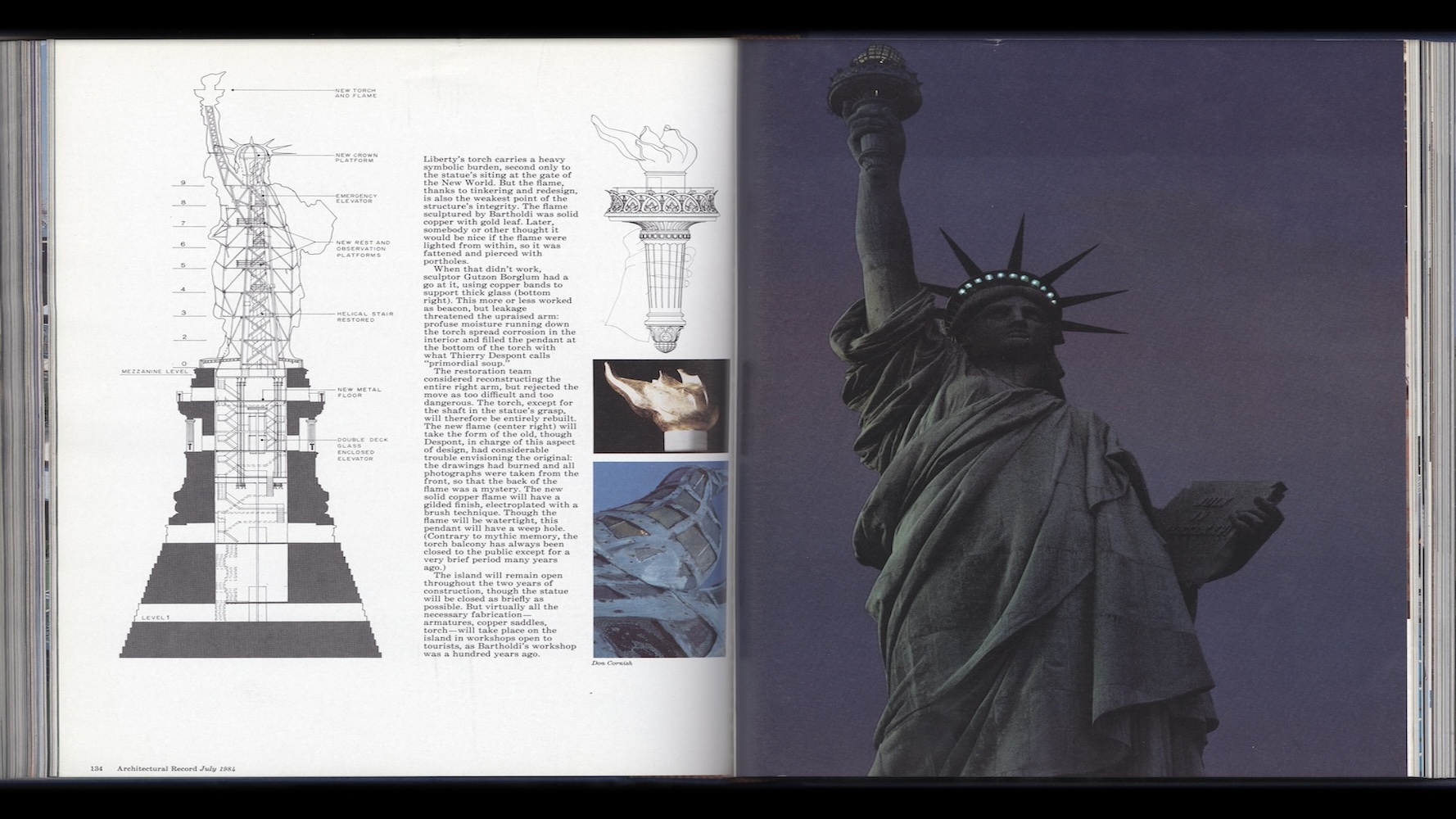
Image © Architectural Record, July 1984
As matters stand now, tourists have little to occupy their minds during their climb: a metal mesh cylinder around the stairs obscures any view of the inner drapery and rippling armatures. The copper will be stripped of seven layers of paint with liquid nitrogen: nitrogen sprayed at -350 degrees Fahrenheit will freeze the accumulated paint, causing it to drop off in small pieces. A layer of asphalt sealant will then be removed. Finally, the mesh cylinder will disappear so that visitors can admire the artfully lighted copper.
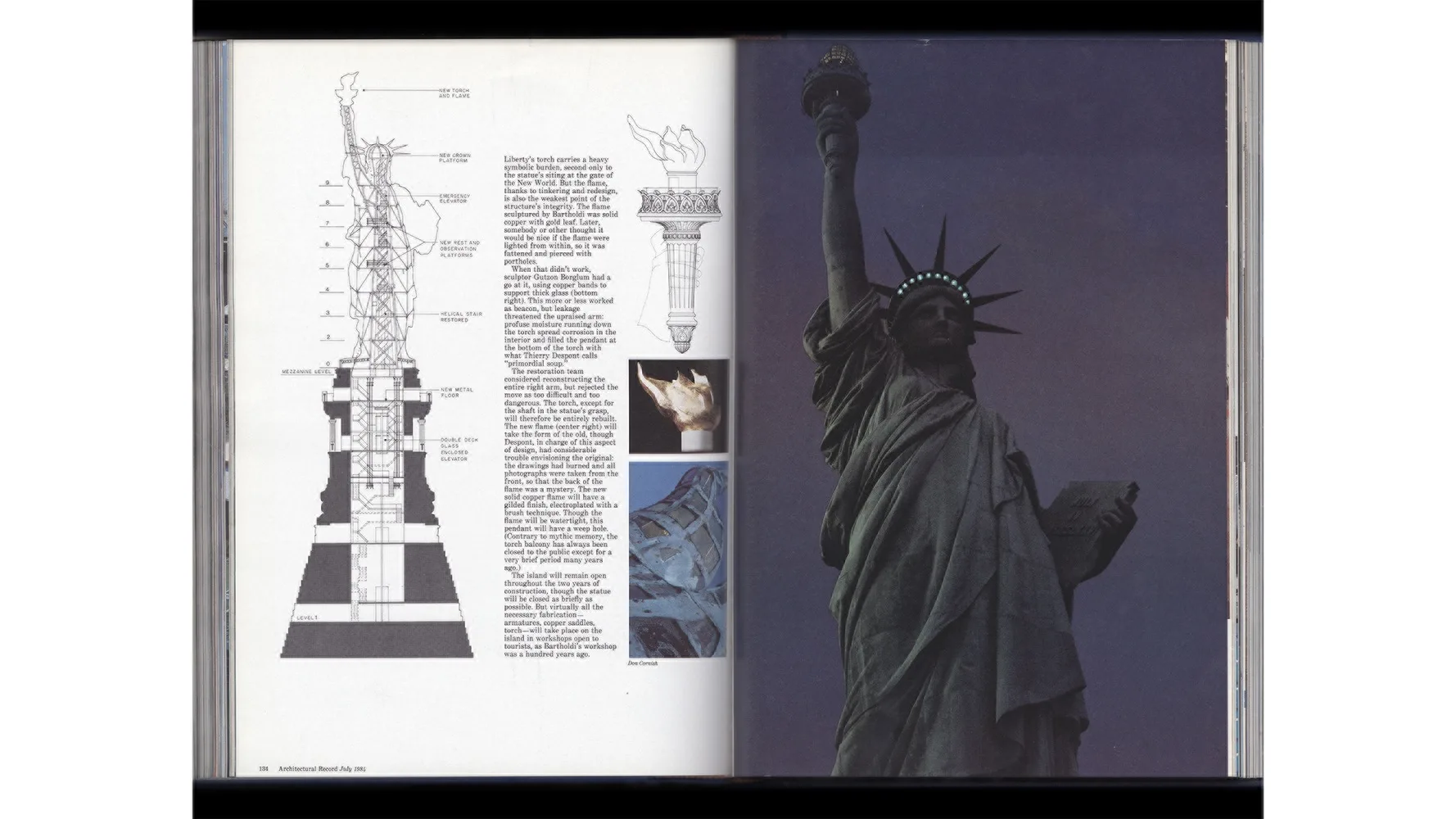
Lady Liberty’s torch carries a heavy symbolic burden, second only to the statue’s siting at the gate of the New World. But the flame, thanks to tinkering and redesign, is also the weakest point of the structure’s integrity. The flame sculpture by Bartholdi was solid copper with gold leaf. Later, somebody or other thought it would be nice if the flame were lighted from within, so it was fattened and pierced with portholes.
When that didn’t work, sculptor Gutzon Borglum had a go at it, using copper bands to support thick glass. This more or less worked as beacon, but leakage threatened the unraised arm: profuse moisture running down the torch spread corrosion in the interior and filled the pendant at the bottom of the torch with what Thierry Despont calls “primordial soup.”
The restoration team considered reconstructing the entire right arm, but rejected the move as too difficult and too dangerous. The torch, except for the shaft in the statue’s grasp, will therefore be entirely rebuilt. The new flame will take the form of the old, though Despont, in charge of this aspect of design, had considerable trouble envisioning the original: the drawings had burned and all photographs were taken from the front, so that the back of the flame was a mystery. The new solid copper flame will have a gilded finish, electroplated with a brush technique. Though the flame will be watertight, this pendant will have a weep hole. (Contrary to mythic memory, the torch balcony has always been closed to the public except for a very brief period many years ago.)
The island will remain open throughout the two years of construction, though the statue will be closed as briefly as possible. But virtually all the necessary fabrication—armatures, copper saddles, torch—will take place on the island in workshops open to tourists, as Bartholdi’s workshop was a hundred years ago.
Looking for a reprint of this article?
From high-res PDFs to custom plaques, order your copy today!