The Bullitt Center by Miller Hull Partnership
Seattle
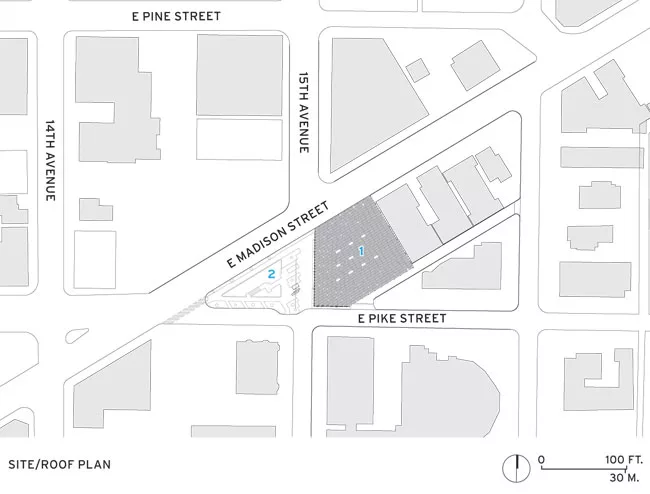
2 McGilvra Place
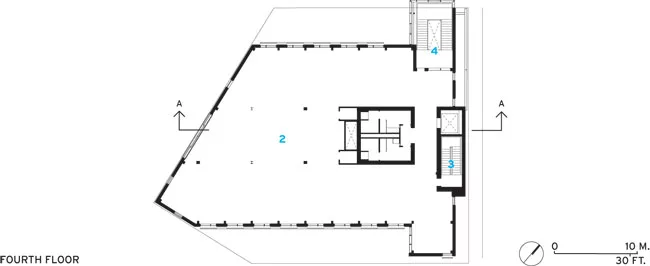
2 Office
3 Egress Stair
4 “Irresistible Stair”
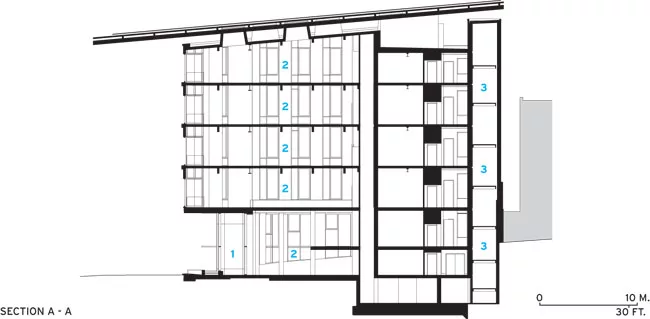
2 Office
3 Egress Stair
Architects & Firms
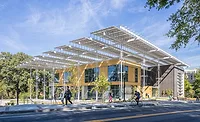
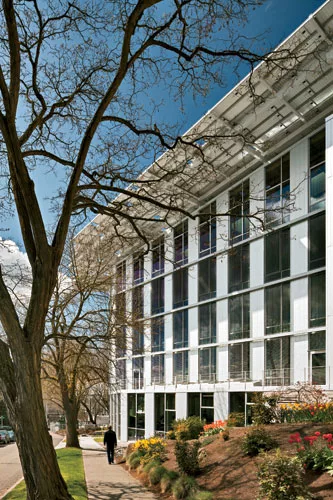
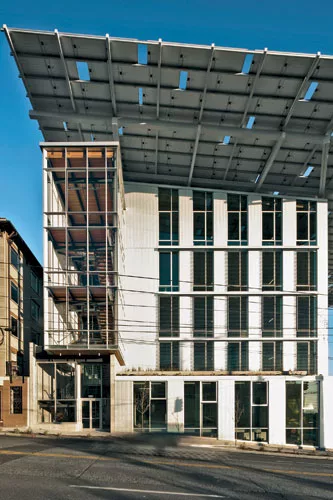
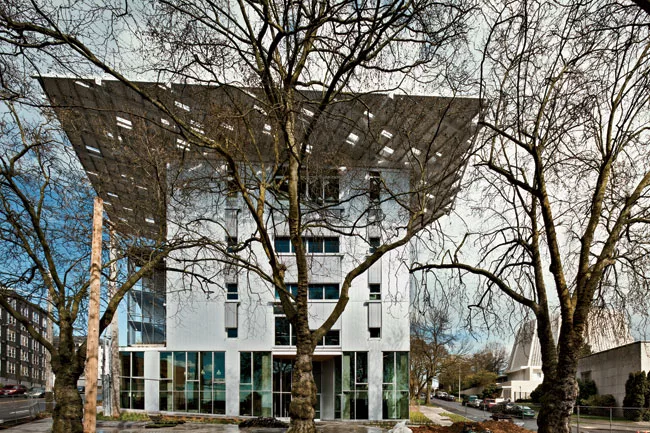
With its silvery metal panels and glass cladding, and a canted photovoltaic (PV) array that projects beyond the edges of the roof like the brim of a hat, the recently completed six-story Bullitt Center doesn't at all resemble a Douglas-fir forest, admits Denis Hayes. Nevertheless, Hayes, who is president and CEO of the Bullitt Foundation, is fond of describing the 52,000-square-foot office building in Seattle's Capitol Hill neighborhood as just such a forest. “It functions like one,” he says.
The structure, which serves as the headquarters for the environmentally focused foundation and as office space for like-minded tenants, is being billed as the earth's greenest commercial building. Its goals include Living Building Challenge (LBC) certification—a process that entails satisfying 20 mandatory “imperatives” organized into seven “petals,” or performance areas: site, water, energy, health, materials, equity, and beauty. The New Age terminology belies the system's rigor: the LBC is widely regarded as the world's most stringent green-building certification program. It has many tough-to-achieve requirements, including submission of a year's worth of post-occupancy data to demonstrate net-zero operations for energy and water. Certification is so arduous that since the LBC's launch in 2006, only four projects have achieved living-building status. Approximately 150 others, located all over the world, are registered with the LBC program, administered by the International Living Future Institute (ILFI). Of the 15 completed projects seeking certification, the Bullitt is the largest commercial building, and one of the few located in a dense urban environment.
Tenants began moving into the building earlier this year. Many, such as ILFI; the property's developer, Point32; and the Bullitt's m/e/p engineer, PAE, have some connection to the project. These organizations have sustainability in their DNA and might be willing to put up with some inconvenience for the sake of the environment. However, Hayes was determined to create a comfortable workplace. “Denis was clear that it couldn't be too much of a hippie experience,” says Craig Curtis, a Miller Hull partner. It had to be a place, says Curtis, where people would want to be and where they would enjoy working.
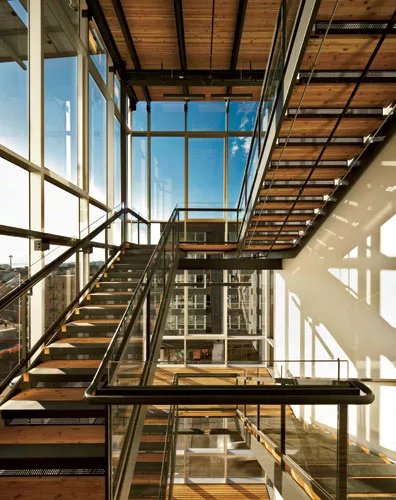
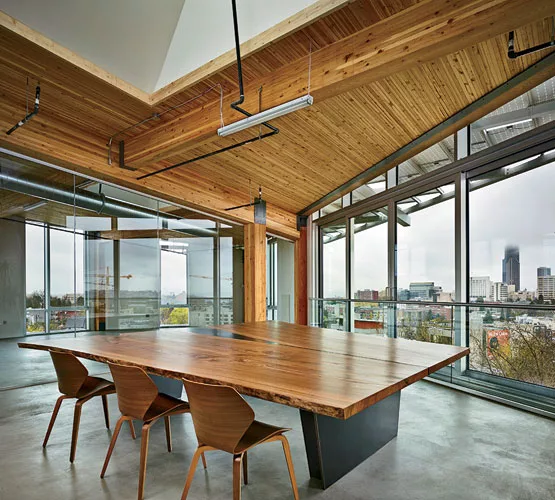
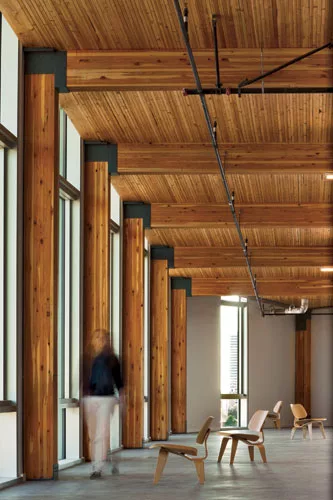
Toward that end, the project team devised a building with four floors framed in heavy timber above a two-story poured-in-place-concrete podium. Designers left the handsome wood structural components exposed, including laminated beams supporting decking of 2-by-6 dimensional lumber set on edge. They gave the Bullitt 14-foot floor-to-floor heights and correspondingly tall but thermally efficient glazing—a configuration that allows daylight to penetrate deep into the interior. And with the aim of making walking up the stairs more appealing than riding the elevator, they created what Hayes has dubbed the “irresistible stair,” with wood treads and glass balustrades. It is a prominent feature of the facade and provides views of the city's skyline.
The choice of heavy timber—which is durable and modifiable—was motivated in part by the decision to target a 250-year life span for the building. But the structure also provides a regional character and visual warmth. And if the carbon-sequestration capacity of the wood is taken into account, it offers a carbon-positive structural system, explains Brian Court, Miller Hull project designer.
Despite all these benefits, other materials were also considered. Reinforced concrete for the entire building was an early favorite, according to Court, because the project team wanted a material that would provide thermal mass—one that would dissipate heating or cooling energy slowly and remain at a constant temperature over a long period. In order to achieve this inertia against temperature fluctuations while maintaining the advantages of wood, the designers opted to keep the heavy-timber structure and to add a 3-inch topping slab to each floor. The decision slightly complicated the design of the structure, since engineers needed to ensure that the timber components could carry the extra load. “We had to make sure that the decking, columns, and beams could go along for the ride,” says Phil Johnson, an associate at DCI Engineers, the project's structural consultant.
In addition to the wood and concrete elements, the building has a steel lateral system to help resist seismic forces. “It's a hybrid,” says Court. “We used each material where it made the most sense.”
Looking for quick answers on architecture and design topics?
Try Ask RECORD, our new smart AI search tool.
Ask RECORD →
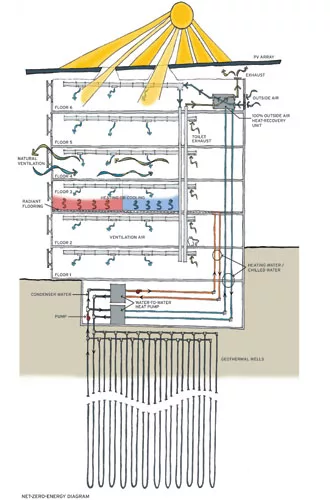
Climate control at Bullitt depends in large part on passive means: the thermal mass provided by the topping slabs and the podium structure, a high-performance building envelope, and natural ventilation through automated, operable windows. But when it is too hot or too cold to open the windows, a heat-recovery mechanical ventilator kicks in.
The building also has a radiant floor system that taps the consistent temperature of the earth via 26 geothermal wells, each 400 feet deep. Although this system provides both heating and cooling, its capacity was determined by the estimated loads for heating, says Paul Schwer, PAE's president. The approach helped keep initial costs in check by eliminating the need for additional geothermal wells and other equipment. However, as a result, there will likely be some parts of the building that occasionally creep above 78 degrees—the upper limit of what is generally considered comfortable in a conventional office building. But the radiant slab, along with ceiling fans, should make the rooms feel cooler than the actual air temperature, says Schwer.
In order to create what they felt was the most effective configuration of the building systems, the project team developed a thermal-comfort model. The simulation took into account outdoor and indoor conditions such as air temperature, humidity, building orientation, and wind direction. And it included the particulars of building elements, such as the depth of the topping slab and the height of partitions that might obstruct the path of the breezes traveling across the floor plates. Engineers say that such an analysis is critical for designing successful deep-green buildings, though it is far from routine.
The process for creating the building's energy model was also somewhat atypical. Although the engineers relied on the same energy-modeling software used by most of the industry, their projections contain an unusual amount of detail. The estimates even account for the electricity consumed by the sensors, thermostats, and other energy-sipping devices that make up the building-controls system. This granularity was crucial, since the Bullitt's dense surroundings and its vertical configuration meant the amount of space that could be devoted to PVs was limited.
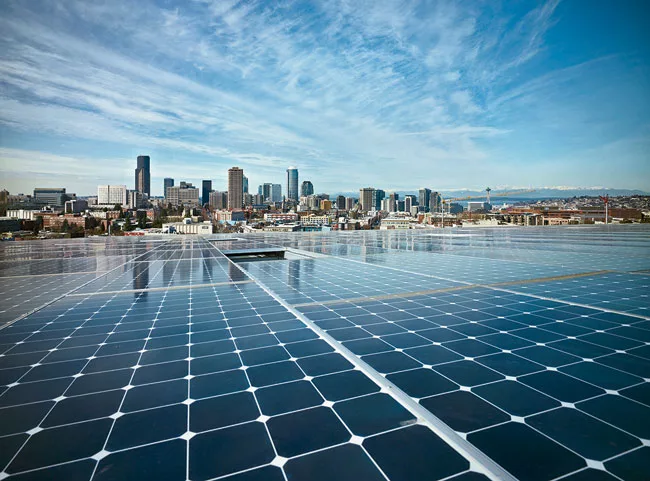
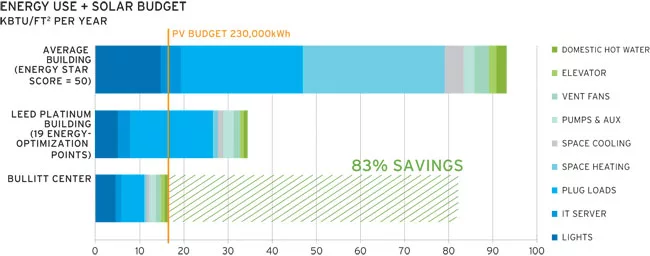
Through an iterative process that involved balancing the solar-energy potential of the site with the building's power needs, the project team arrived at an extremely aggressive energy-use intensity (EUI) target of 16kBtu per square foot. (EUI is a metric that describes a building's energy use relative to its size.) This number is more than 80 percent below the EUI of an average office building, and it leaves a razor-thin margin of only 2 to 3 percent between the power expected from the 242-kilowatt rooftop PV array and the building's estimated demand, say the designers. They predict that almost half the electricity used in the building will be consumed by so-called plug loads—devices such as printers, computers, and other appliances powered by an AC receptacle. Owners and property managers typically have little ability to control these unregulated loads, as they do for major building systems, like HVAC or water heating. However, at Bullitt, in order to keep plug loads in check, each tenant has agreed to an energy allowance as part of its lease.
The limits have prompted tenants to closely monitor their operations. In preparation for its move there, PAE analyzed its own electricity use and subsequently revamped its IT infrastructure and replaced equipment.
Getting the project built required clearing many regulatory hurdles. For example, providing enough PV panels to bring the net-zero energy goal within reach in cloudy Seattle meant an array covering 14,000 square feet, projecting as much as 20 feet beyond the building's perimeter. This extension over the public right-of-way involved a special “design-review departure” from Seattle's Department of Planning and Development. Bullitt's generous floor-to-floor dimension, an essential element of the daylighting scheme, was the product of a similar allowance—one that granted the developer an extra 10 feet of building height. The project obtained both allowances as part of a city pilot program intended to encourage the development of ultrahigh-performance buildings.
The developer and the foundation are still working on designating the building as its own water district. If granted this status by the local utility and the state Department of Health, the Bullitt will use rainwater collected from the roof and stored in a 56,000-gallon basement cistern to supply showers, sinks, and water fountains, after a multistep filtering and purification process. In the meantime, the project has an exemption from ILFI allowing it to rely on the municipal utility for potable uses but still satisfy the LBC net-zero water imperative. Other water-conserving strategies include irrigation that utilizes graywater and what the project team says is the world's only six-story composting toilet system.
One of the most labor-intensive aspects of the project has been the vetting of building products for compliance with the LBC's materials-selection criteria. These include limits on the distances that building components can be shipped—a restriction intended to reduce the energy embodied in materials and spur the development of a regional green economy. The standards also prohibit the use of 14 potentially toxic substances on the challenge's Red List—many of which, such as PVC, added formaldehyde, and halogenated flame retardants, are commonplace in building materials. These stipulations are designed to ensure a healthy environment for occupants, reduce pollution and resource depletion, and provide an incentive for market transformation; the hope is that the requirements will encourage manufacturers to examine their supply chains.
Joe David, a project associate with Point32, estimates that he devoted a year and a half to investigating about 1,200 products. He points to several materials specified at Bullitt as proof that the LBC requirements are serving as a catalyst for change. One example is the wall assembly's fluid-applied air-and-weather barrier. Although it was an essential part of the high-performance building envelope, David's research determined that the barrier contained phthalates, a Red Listed family of chemicals often added to plastics to increase their flexibility. In response to the project team's queries, the barrier's manufacturer, Prosoco, reformulated the product to eliminate the phthalates.
Another key element of the Bullitt's exterior curtain-wall assembly is the window system. The project team had identified an operable, triple-glazed unit that opens straight out as the best option, since the configuration maintains a tighter seal than casement or awning windows when closed. But the desired windows were manufactured well outside the allowed transportation radius, in Germany. In order to address the problem, the project team connected local glass-and-glazing contractor Goldfinch Brothers and the manufacturer, Sch'co. The two companies now have a licensing agreement that allows Goldfinch to fabricate and install Sch'co products.
It will be some time before the Bullitt has sufficient post-occupancy data to complete its LBC documentation. But the building is already making a mark on the design and construction industry. The response of the air-and-weather barrier's manufacturer and the window-licensing agreement are just two indications. And if the Bullitt's bid for living-building status proves successful, it could serve as a blueprint for an ecologically restorative office building almost anywhere in the world, says Jason McLennan, ILFI's CEO: “People won't be able to say that living buildings aren't practical anymore.”
PeopleFormal name of building Location Location, geophysical (minor watershed, major watershed, other descriptor) Gross area Total conditioned square footage Total construction cost Program of spaces Date completed Owner Developer Architect Personnel in architect's firm who should receive special credit: Architect of record Commissioning agent Engineers Consultants Energy: PAE Consulting Engineers Lighting: Luma Lighting Design Acoustical: BRC Acoustics & Technology Consulting Other: University of Washington Integrative Design Lab General contractor Photographer Size: 52,000 square feet (gross) Cost: $18.5 million Completion date: April 2013 |
ProductsStructural system Exterior cladding Metal Panels: Northshore Sheet Metal/Metal Sales Glazing Skylights: Schuco Roofing Flashing, accessories: Metal flashings: Northshore Sheet Metal Green roof: Cetco StrataSeal HR Interior finishes Paints and stains: Miller Paint, Sherwin Williams Paneling: Columbia Forest Products - PureBond Veneer Core Floor and wall tile: Daltile: Bathroom Tile - Natural Hues Carpet: Shaw/Patcraft - Ecoworx Drywall: CertainTeed Furnishings Conveyance Lighting Interior ambient: Architectural Lighting Works ALight Commalite ' T5 Accolade ' T5 and LED Downlights: Amerlux Cree Evoke ' LED LR6 - LED Task lighting: To be determined by Tenants but the recommended light is: Luxo L1 with Phillips Hue LED Lamp Exterior: Amerlux MP Lighting Evoke ' LED L96C5 - LED Controls: Core and Shell and Exterior by Specialized Lighting Solutions Tenant Control Varies and Include Intelligent Lighting Control DALI Light LEEDer Photovoltaics Chillers Plumbing (fountains/ water saving fixtures) Building management system Additional building components or special equipment that made a significant contribution to this project Weather Resistive Barrier: Prosoco - R-Guard Fast Flash (26) 400' Deep Geo-exchange Bore:s PAE/Kulchin Constructed wetland for grey water treatment: 2020 Engineering DDC controlled operable windows for natural ventilation: Schucho/Northwest Automation Automated exterior blinds for sun control: Warema Rainwater to potable treatment system (not yet permitted): 2020 Engineering/PSF Mechanical Water to water heat pump for domestic water: Colmac Radiant floor heating/cooling: Nibco Comprehensive metering system |
Looking for a reprint of this article?
From high-res PDFs to custom plaques, order your copy today!