Architectural Record
search
cart
facebook twitter linkedin youtube
  • Sign In
  • Subscribe
  • Sign Out
  • My Account
Architectural Record
  • NEWS
    • Latest News
    • Awards
    • Interviews
    • Obituaries
    • Podcasts
      • Design:Ed Podcast
      • Sponsored Podcasts
  • OPINION
    • Book Reviews / Excerpts
    • Exhibition Reviews
    • Forum
  • EXCLUSIVES
    • Videos
    • Design Vanguard
    • Top 300 Firms
    • Sponsored Content
    • Sponsored eBooks
    • From the Archives
  • CONTINUING ED
    • Editorial Continuing Ed
    • CE Center
    • CE Academies
  • PROJECTS
    • Buildings By Type
    • Reuse & Renovation
    • Museums & Arts Centers
    • Colleges & Universities
    • Multifamily Housing
    • Interiors
    • Lighting
    • Kitchen & Bath
  • HOUSES
    • Record Houses
    • House of the Month
    • Featured Houses
  • PRODUCTS
    • Products by Category
    • Record Products of the Year
    • Latest Products
  • EVENTS
    • Dates & Events
    • Record on the Road
    • Innovation Conference
    • Sustainability in Practice
    • Women In Architecture
    • Webinars
    • Ad Excellence Awards
    • Submit an Event
  • CONNECT
    • Ask RECORD AI
    • Newsletters
    • Contact
    • Advertise
    • Editorial Calendar
    • Store
    • Customer Service
  • SUBMIT
    • Submission Guidelines
    • RECORD Competitions
  • MAGAZINE
    • Subscribe
    • My Account
    • Digital Edition
    • Current Issue
    • Firm Pass
    • Historic Archive
ProjectsLighting Design

Marc Jacobs Flagship Building by Jaklitsch/Gardner Architects

Tokyo, Japan
By Naomi Pollock, FAIA
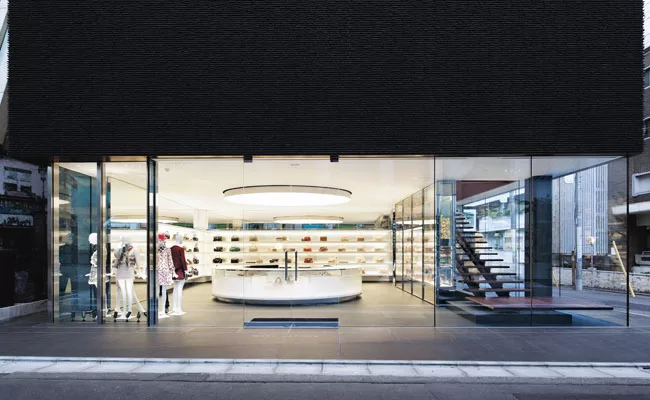
Made of a translucent formable material supported by a polished stainless steel frame, the shop’s oversize elliptical luminaire hovers above a glowing cash/wrap station and illuminates the acces
Marc Jacobs Flagship Building, Tokyo
Jaklitsch/Gardner Architects
Tokyo, Japan
Made of a translucent formable material supported by a polished stainless steel frame, the shop’s oversize elliptical luminaire hovers above a glowing cash/wrap station and illuminates the accessories boutique and street at grade.
Photo: © Nacasa & Partners
Illuminated panels of punched anodized aluminum transform the shop’s hollow third layer into a lantern by night.
Marc Jacobs Flagship Building, Tokyo
Jaklitsch/Gardner Architects
Tokyo, Japan
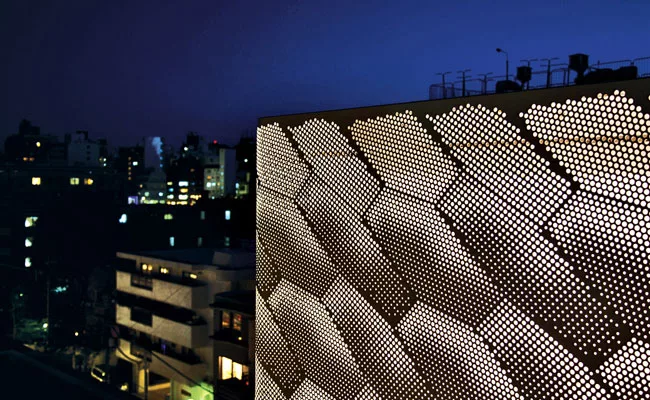
Illuminated panels of punched anodized aluminum transform the shop’s hollow third layer into a lantern by night.
Photo: © Liao Yusheng
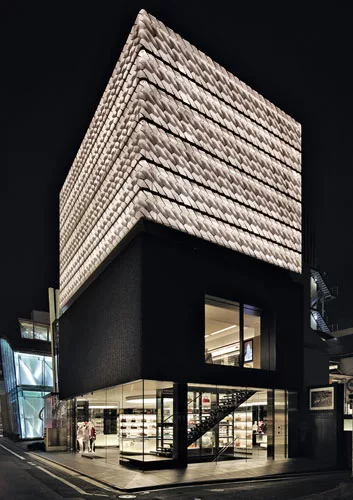
Stacked horizontally, three levels of different materials — glass, terra-cotta, and punched anodized aluminum panels — define the exterior of the 2,800-square-foot boutique.
Marc Jacobs Flagship Building, Tokyo
Jaklitsch/Gardner Architects
Tokyo, Japan
Stacked horizontally, three levels of different materials — glass, terra-cotta, and punched anodized aluminum panels — define the exterior of the 2,800-square-foot boutique.
Photo: © Nacasa & Partners
Made of a translucent formable material supported by a polished stainless steel frame, the shop’s oversize elliptical luminaire hovers above a glowing cash/wrap station and illuminates the acces
Illuminated panels of punched anodized aluminum transform the shop’s hollow third layer into a lantern by night.
Stacked horizontally, three levels of different materials — glass, terra-cotta, and punched anodized aluminum panels — define the exterior of the 2,800-square-foot boutique.
May 16, 2011

Architects & Firms

Jaklitsch / Gardner Architects

In Omotesando, Tokyo’s fashion epicenter, only the most flamboyant of buildings stand out. Concentrated around the area’s famous tree-lined boulevard, they aggressively vie for attention. But instead of competing head-on with its eye-catching neighbors, Jaklitsch/Gardner Architects’ Marc Jacobs boutique wows shoppers with understated elegance and bold lighting effects. While the building’s brightly lit, transparent base lures passersby, its translucent top beckons to the city.

Located on a side street between designer shops, including Prada and Cartier, and low-rise apartments, the site straddles commercial and residential zones. This condition legally limited the building to two above-ground stories, which inspired the boutique’s layered look. Stacked horizontally, three wide swaths of different materials — glass, terra-cotta tile, and punched anodized aluminum panels — define the exterior of the 2,800-square-foot boutique.

Inside, the architects tucked menswear below grade, enclosed street-level accessories behind a glass skin, and used terra-cotta tile to mask women’s wear upstairs. Crowning the occupied space is an uninhabitable aluminum box that nearly doubles the building’s stature. Open to the sky, the enclosure reads like a third floor but has the legal status of the roof-mounted signs that abound in Japan. “I always wanted to design a billboard,” jokes design principal Stephan Jaklitsch.

In lieu of logos, a continuous pattern of lozenge-shaped perforations adorns the box’s silvery surface, made of six rows of rectangular panels. Evocative of richly woven fabric, the intricate motif carries from panel to panel, wrapping the rounded corners. When the sun begins to set, each small dot emits a point of light from within, turning the metal box into a lantern. As darkness falls, the light intensity gradually decreases until the system shuts off after midnight.

The light source is a computer-controlled system of linear LED fixtures that line the top and bottom of each panel’s back side. Instead of shining directly outward, the LEDs face away from the street and reflect off strips of plastic fabric mounted behind the panels. An additional color filter adds warmth to the 2,700-Kelvin color temperature of the lamps.

A shadowy 20-inch slot, deftly integrated with the stratified exterior, melds the metal with the tile below. Supported by metal clips and concrete panels, the rough-hewn terra-cotta plates stack vertically — an installation that adds texture and depth by day but goes mute at night.

In contrast, the interior lighting on the ground floor radiates a warm glow onto the street via an elliptical ceiling fixture, drawing attention to the entire room. Comprising fluorescent tubes contained within a translucent nonflammable stretch material supported by a polished stainless steel frame, it also echoes the oval cash/wrap, a counter with glazed and internally lit display cases below.

Looking for quick answers on architecture and design topics?
Try Ask RECORD, our new smart AI search tool.
Ask RECORD →

Throughout, built-in shelves — in white solid surfacing or sycamore — line walls and illuminate merchandise with LED strips embedded above frosted-glass diffusers on their undersides. “Like in a theater,” says lighting designer Herv' Descottes. “Lighting the back wall gives the store depth.”

Fortunately, the lighting was unscathed by the earthquake that struck Japan in March, and the building sustained only cosmetic damage. Because of the acute electricity shortage, however, the rooftop lantern will remain dark for a while. Yet even unlit, this clever adaptation of the vernacular sets this Marc Jacobs flagship apart from the pack.

People

Architect:
Jaklitsch/Gardner Architects
115 West 27th Street, 9th floor
New York, NY 10001-6217
(212) 620-9166 p
(212) 620-9982 f

Registered Architects:
Stephan Jaklitsch, AIA, Principal
Mark Gardner, AIA, Principal

Project Architect:
Jonathan Kirk, Associate AIA

Designers:
Bronson Fung
Toshi Hirai
Palmer Thompson-Moss

Architect of Record:
Core and Shell
Creative Designers International

Interiors
D.Brain Co.

Interior designer:
Jaklitsch Gardner Architects with seating designed by Christian Liaigre

Consultant(s):
Landscape:
n/a

Lighting:
L’Observatoire International (interior and exterior)

General contractor:
Shell:
Kitano Construction Corp.

Interiors:
D.Brain Co., Ltd.

Photographer(s):
Liao Yusheng
liao@yusheng.ca

Nacasa & Partners
Tokyo, Japan
+81-3-5722-7757 p

Renderer(s):
Image courtesy of Jaklitsch / Gardner Architects PC

CAD system, project management, or other software used:
Autocad, 3D Studio Max


Products

Contact for additional questions on specifications:
Elizabeth H. Kubany
973-761-4117 p

Structural system
Concrete foundation and steel frame

Exterior cladding
Metal Panels:
Custom punched anodized aluminum panels w/ clear coat self cleaning.

Rainscreen:
INAX custom terra cotta blade tile over EXP panel and custom aluminum clip system

Windows
Metal frame:
Brushed Stainless Steel

Glazing
Glass:
Optical Clear Tempered Glass, Partially Wired Clear Glass

Doors
Wood doors:
Mirror

Hardware
Locksets:
Cylinder Lock / Electric Lock “Miwa”

Closers:
Floor Hinge / Door Closer “New Star”

Pulls:
Fitting Room Hook ' “Nikaya”

Security devices:
“SECOM”

Interior finishes
Cabinetwork and custom woodwork:
1st level: Custom Corian shelving; Basement and 2nd level: Custom sycamore shelving

Paints and stains:
Benjamin Moore

Paneling:
Custom brass water-jet screen

Floor and wall tile:
1st level-Zimbabwe Black Granite slabs

Carpet:
Van Dijk Carpet

Special interior finishes:
Fitting room curtains, Creation Baumann; Light feature diffusing glass, Schott Opalika

Furnishings
Chairs:
1st and 2nd level seating, Christian Liaigre

Tables:
2nd level coffee table, Christian Liaigre

Other furniture:
1st level: Custom fish tanks

Lighting
Interior ambient lighting:
2nd Level-custom pendant light fixtures by Axon Lighting; Basement level: custom wall sconce by Axon lighting; 1st level light feature, polished stainless steel frame and Barrisol; Fluorescents: “NIPPO”; LED: “Moriyama Sangyo”

Downlights:
Lucifer Lighting Company, “FLOS”

Exterior:
Winona LED

Dimming System or other lighting controls:
Lutron

Plumbing
Gray water cisterns

 
KEYWORDS: Tokyo

Share This Story

Looking for a reprint of this article?
From high-res PDFs to custom plaques, order your copy today!

Contributing Editor Naomi Pollock, FAIA, is the author of Japanese Design Since 1945: A Complete Sourcebook and the forthcoming Vanishing Japan: Modern Architecture Gone But Not Forgotten,

Post a comment to this article

Report Abusive Comment

Subscription Center
  • Create an Account
  • Start a Subscription
  • Manage My Account
  • Sign Up for Newsletters
  • Visit Customer Service
  • Update Preferences

More Videos

Sponsored Content

Sponsored Content is a special paid section where industry companies provide high quality, objective, non-commercial content around topics of interest to the Architectural Record audience. All Sponsored Content is supplied by the advertising company and any opinions expressed in this article are those of the author and not necessarily reflect the views of Architectural Record or its parent company, BNP Media. Interested in participating in our Sponsored Content section? Contact your local rep!

close
  • cold storage facility
    Sponsored byCarlisle SynTec Systems

    How Architects Can Design More Continuous Cold Storage Envelopes

  • TAMLYN XtremeTrim Exterior Trim
    Sponsored byTamlyn

    Designing Cleaner Panel Facades: Why Exterior Trim Details Matter

  • Building with Vapor Barriers
    Sponsored byReef Industries, Inc.

    Vapor Barriers Help Control Moisture in Tighter Building Designs

DESIGN:ED Podcast
Listen to Architectural Record’s DESIGN:ED Podcast

Events

June 23, 2026

Enhancing Fire Resistance with Advanced PVC Solutions

Credits: 1 AIA LU/HSW; 1 AIBD P-CE; 0.1 ICC CEU; 1 IIBEC CEH

Evaluate advanced PVC solutions that improve fire resistance, support WUI compliance, and enhance resilience in residential and commercial building design.

June 25, 2026

Designing Glass Railing Systems that Enhance Aesthetics and Meet Code

Credits: 1 AIA LU/HSW; 1 AIBD P-CE; 0.1 ICC CEU

Upon course completion, participants will possess a deeper understanding of glass railings to help ensure that safety, aesthetic, and performance objectives are achieved.

View All Submit An Event

Products

2026 Architect's Square Foot Costbook

2026 Architect's Square Foot Costbook

See More Products

Popular Stories

SanDiegoAirport

Top 300 Architecture Firms of 2026

Lorcan O' Herilhy

California Architect Lorcan O’Herlihy Has Died, Age 66

Coronado Bridge

The Architect’s Guide to San Diego

CCA, Studio Gang

The Winners of the AIA’s 2026 Architecture Award Range from Collegiate Rowing Hubs to Housing for the Homeless

Dusk House

Design Vanguard 2026: ONO

Enhancing Fire Resistance with Advanced PVC Solutions - Free Webinar - June 23, 2026

Related Articles

  • Marc Jacobs Showroom and Offices

    See More
  • Marc Jacobs International

    See More
  • Saint Louis Art Museum

    Saint Louis Art Museum, East Building by David Chipperfield Architects and Arup

    See More

Related Products

See More Products
  • facade.jpg

    Sustainable Facades: Design Methods for High-Performance Building Envelopes

See More Products

Events

View AllSubmit An Event
  • December 16, 2025

    Sustainable by Design: Transforming Building Envelopes with GFRC

    NOW ON DEMANDCredits: 1 AIA LU/HSW; 1 AIBD P-CE; 0.1 ICC CEU; 0.1 IACET CEU; 1 IDCEC CEU/HSW; 1 GBCI CE HourThis course will provide insights into the performance, versatility and environmental benefits of GFRC facades.
View AllSubmit An Event
×

The latest news and information

#1 Source for Architectural Design, News and Products

SUBSCRIBE
  • RESOURCES
    • Advertise
    • Contact Us
    • Submit
    • Store
  • ACCOUNT CENTER
    • Create an Account
    • Start a Subscription
    • Manage My Account
    • Sign Up for Newsletters
    • Visit Customer Service
    • Update Preferences
  • PRIVACY
    • PRIVACY POLICY
    • TERMS & CONDITIONS
    • DO NOT SELL MY PERSONAL INFORMATION
    • PRIVACY REQUEST
    • ACCESSIBILITY
  • SERVICES
    • Marketing Services
    • Reprints
    • Market Research
    • List Rental
    • Survey/Respondent Access
  • STAY CONNECTED
    • Linkedin
    • Facebook
    • Instagram
    • YouTube
    • X (Twitter)

Copyright ©2026. All Rights Reserved BNP Media, Inc. and BNP Media II, LLC.

Design, CMS, Hosting & Web Development :: ePublishing