Architectural Record
search
cart
facebook twitter linkedin youtube
  • Sign In
  • Subscribe
  • Sign Out
  • My Account
Architectural Record
  • NEWS
    • Latest News
    • Awards
    • Interviews
    • Obituaries
    • Podcasts
      • Design:Ed Podcast
      • Sponsored Podcasts
  • OPINION
    • Book Reviews / Excerpts
    • Exhibition Reviews
    • Forum
  • EXCLUSIVES
    • Videos
    • Design Vanguard
    • Top 300 Firms
    • Sponsored Content
    • Sponsored eBooks
    • From the Archives
  • CONTINUING ED
    • Editorial Continuing Ed
    • CE Center
    • CE Academies
  • PROJECTS
    • Buildings By Type
    • Reuse & Renovation
    • Museums & Arts Centers
    • Colleges & Universities
    • Multifamily Housing
    • Interiors
    • Lighting
    • Kitchen & Bath
  • HOUSES
    • Record Houses
    • House of the Month
    • Featured Houses
  • PRODUCTS
    • Products by Category
    • Record Products of the Year
    • Latest Products
  • EVENTS
    • Dates & Events
    • Record on the Road
    • Innovation Conference
    • Sustainability in Practice
    • Women In Architecture
    • Webinars
    • Ad Excellence Awards
    • Submit an Event
  • CONNECT
    • Ask RECORD AI
    • Newsletters
    • Contact
    • Advertise
    • Editorial Calendar
    • Store
    • Customer Service
  • SUBMIT
    • Submission Guidelines
    • RECORD Competitions
  • MAGAZINE
    • Subscribe
    • My Account
    • Digital Edition
    • Current Issue
    • Firm Pass
    • Historic Archive
ProjectsTransportation Architecture

Taxi Rank No. 2 by 26'10 South Architects

Diepsloot, South Africa
By Hannah le Roux
Taxi Rank No. 2
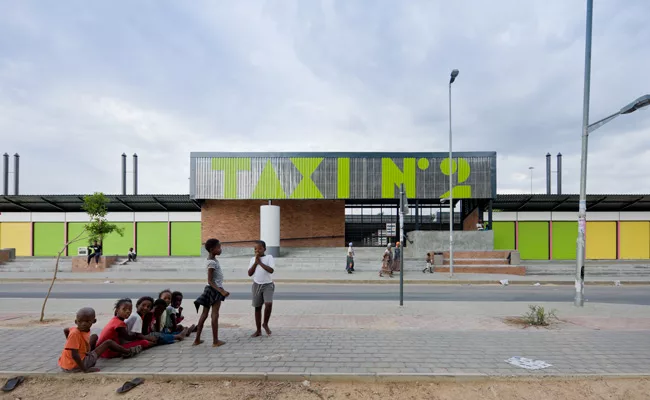
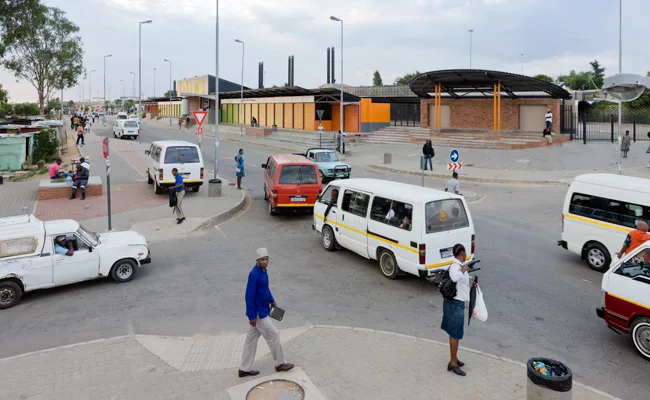
The architects designed a new building with colorful metal doors that roll up to reveal market stalls. A brick structure with a half-disc canopy provides a public porch on the street and restrooms inside.
 
Photo © Iwan Baan
Taxi Rank No. 2
The new retail building engages the local community with places to sit and shop.
 
Photo © Iwan Baan
Taxi Rank No. 2
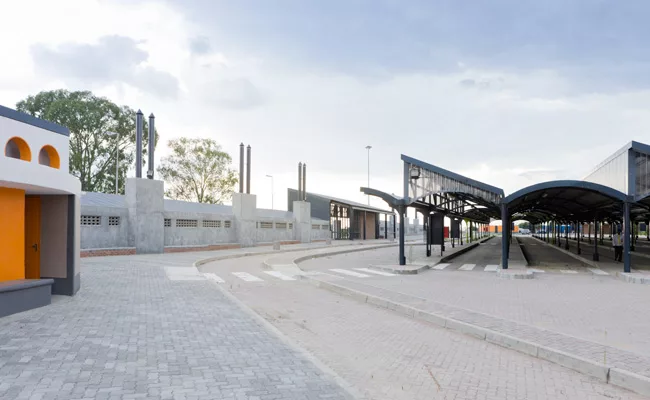
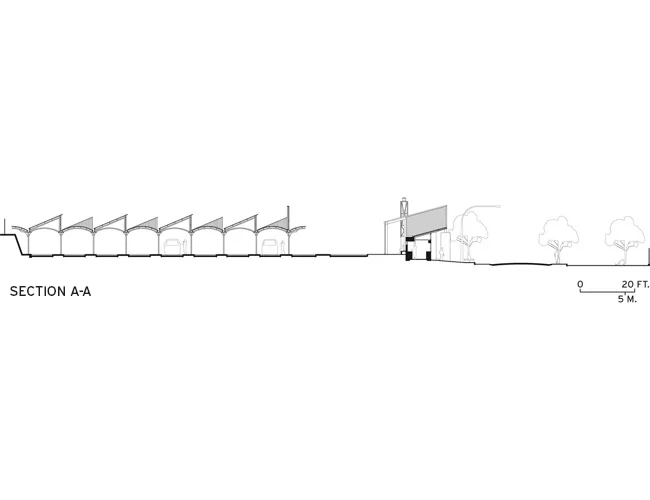
The architects added pitched roofs and clerestory glazing above some of the shed's original barrel vaults to bring more daylight to the taxi aisles.
 
Photo © Iwan Baan
Taxi Rank No. 2
Photo © Iwan Baan
Taxi Rank No. 2
Photo © Iwan Baan
Taxi Rank No. 2
Taxi Rank No. 2
Taxi Rank No. 2
Taxi Rank No. 2
Taxi Rank No. 2
August 16, 2012

Architects & Firms

26'10 South Architects

From the center of Johannesburg, it takes a minibus taxi about an hour to get to Diepsloot, a poor, densely populated settlement beyond the fringes of the city's wealthy suburbs. Trips in the privately managed minibuses—often the only affordable transportation—usually begin and end inauspiciously on a dusty field or at a dark shed surrounded by hundreds of other vehicles. But now travelers to Diepsloot arrive at a very different kind of place: a refurbished taxi station (or rank) that combines bold graphics and an engagement with the small-scale entrepreneurs who bring vitality to South Africa's urban streets.

In the less than 20 years since its establishment, first as an informal settlement and then as a dumping site for evicted squatters, Diepsloot has grown in an ad hoc way with camplike construction and self-built housing. It now has a population of roughly 200,000 people, including immigrants from other African countries, rural job seekers, and low-paid employees who work in Johannesburg's rich northern suburbs, says Anton Harber in his 2011 book Diepsloot: A Place at the Side of the Road. Despite its newness and its distance from the city center, the settlement has developed an intricate urban fabric, largely through residents' often-ingenious appropriation of the spaces between its simple buildings.

Thorsten Deckler and Anne Graupner of the Johannesburg firm 26'10 South Architects have been preoccupied with these interstitial spaces since the Johannesburg Development Agency (JDA) appointed them in 2008 to survey one of Diepsloot's main roads, ahead of an upgrade that would relocate the numerous small enterprises encroaching on the street. But as the architects documented the fabric of these shops and social spaces, they realized the effectiveness of self-built, microscaled places in humanizing Diepsloot's urban environment. So they developed an alternative plan to improve the housing stock through small catalytic projects—an effort that unfortunately did not move forward.

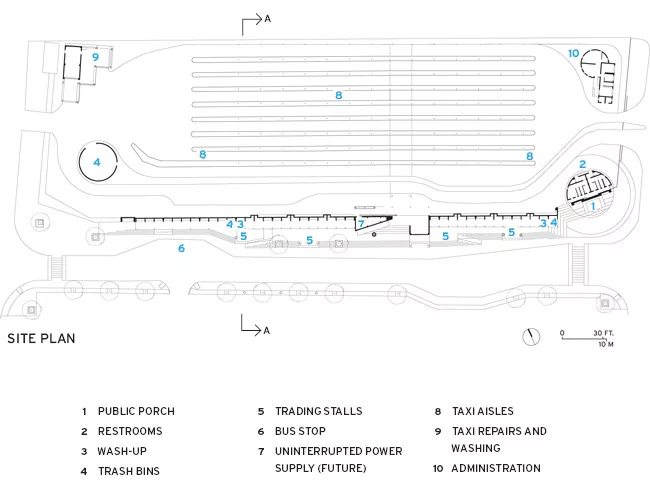
Deckler and Graupner have since applied their insights to another JDA project, the renovation and expansion of Taxi Rank No. 2, Diepsloot's main minibus station, asserting the role of microenterprises in the organization of the urban realm. Their design makes significant changes to the existing rank, a utilitarian shed that was set back from the street. The architects lengthened the structure and brought more daylight inside by adding pitched roofs with clerestory glazing above some of the original barrel vaults. They also enlarged a small block of offices and encircled it with a curving brick wall that softens its profile. Other improvements include an expanded toilet block, a service bay for the vehicles, and a new area for garbage bins.

From the street, the most visible portion of the project is a new 400-foot-long structure that functions as a colorful gateway to the taxi queues and flexible space for small shops and services. Constructed on a tight budget with prefabricated steelwork and local labor, this long, narrow building mediates between the taxi area and the street several steps below. Stalls set behind steel roller doors are allocated to traders who sell food, household items, cellular airtime, and clothing, and whose activities create a safer environment for people arriving at the rank in the early morning and at night. An overhanging roof lets shops spill out onto the pavement during the day, while cross-ventilation keeps the covered spaces cool and chimneys remove smoke from stalls where food is cooked. The architects envisage using the stoa-like building's roof for harvesting rainwater and its chimneys as supports for billboards that might provide an extra source of revenue.

Rodgers Makhubele, the local councillor, watched the project throughout its three-year gestation (from December 2008 to December 2011) and is excited about its potential as a model for local development. He understands that the new stalls facing the street will bring immediate value and vitality to the precinct, while other opportunities for the project as a whole develop over time. Makhubele would like to negotiate with the taxi companies and the rank's management to establish a community radio station there and add public art, banking facilities, and temporary stalls and eateries on the north side of the retail building. What he pictures is urbanity itself, happening through an architecture that has secured a space within which it can take place.


People

Client:

Johannesburg Devlopment Agency


Architect and Site Design:

26’10 South Architects & Urban Designers
30 Wimbledon Road
Brixton, Johannesburge
South Africa 2914
(T) +27 11 830 0220
(F) +27 11 830 0268

Personnel in architect's firm who should receive special credit:

Thorsten Deckler (principal, registered architect)
Anne Graupner (principal, registered architect)
Nkululeko Bhengu (candidate architectural technologist)
Stephen Reid (registered architect)
Carl Jacobsz (registered architect)
Guy Trangoš (registered architect)
Lara Wilson (registered architect)
Nzinga Biegueng Mboup (architectural assistant)
Alexandra Howell (architectural assistant)
Thulani Rachia (architectural assistant)
Mtembekhi Ngema


Engineer(s):

Civil & Structural: Hlanganani Consulting Engineers & Project Manageers

Electrical: Selanya Consulting Engineers


Consultant(s):

Other:      
Project management: Triviron Project Managment
Environmental & community liaison consultant: Envirolution Consultating
Quantity Surveyor: PCQS Paresh Chiba Quantity Surveyor


General contractor:

Dryden Construction
Moseme Construction (Admin & Ablution Buildings only)


Photographer(s):

+31 (0)6 5463 0468
Iwan Baan www.iwan.com


Products

Structural system

Concrete, bricks, steel frame– Drydon Construction
Manufacturer of any structural components unique to this project:


Exterior cladding

Masonry: Corobrik – Mahonie Satin

Precast concrete: (Interlocking conc. Pavers) Infraset

Moisture barrier: (waterproofing)  Derbigum


Roofing

Metal: (Roof sheeting) Chromadek

Other: (IBR Polycarbonate sheeting)  Modek


Windows

Metal frame: Durowin


Glazing

Other: Metal grating: Andrew Mentis


Interior finishes

Paints and stains: Prominent paints

Ceilings: Rhino board

 
KEYWORDS: Africa South Africa

Share This Story

Looking for a reprint of this article?
From high-res PDFs to custom plaques, order your copy today!


Post a comment to this article

Report Abusive Comment

Subscription Center
  • Create an Account
  • Start a Subscription
  • Manage My Account
  • Sign Up for Newsletters
  • Visit Customer Service
  • Update Preferences

More Videos

Sponsored Content

Sponsored Content is a special paid section where industry companies provide high quality, objective, non-commercial content around topics of interest to the Architectural Record audience. All Sponsored Content is supplied by the advertising company and any opinions expressed in this article are those of the author and not necessarily reflect the views of Architectural Record or its parent company, BNP Media. Interested in participating in our Sponsored Content section? Contact your local rep!

close
  • TAMLYN XtremeTrim Exterior Trim
    Sponsored byTamlyn

    Designing Cleaner Panel Facades: Why Exterior Trim Details Matter

  • Building with Vapor Barriers
    Sponsored byReef Industries, Inc.

    Vapor Barriers Help Control Moisture in Tighter Building Designs

  • Duct Interior with Prodeq System
    Sponsored byHenry, a Carlisle Company

    Designing Resilient Water Containment Systems

DESIGN:ED Podcast
Listen to Architectural Record’s DESIGN:ED Podcast

Events

June 10, 2026

Rethinking Stormwater – The Power of Porous Paving

Credits: 1 AIA LU/HSW; 1 AIBD P-CE; 0.1 ICC CEU

Learn how porous paving systems support stormwater management, reduce heat island effects, and enhance sustainable site design performance.

June 11, 2026

Very Early Warning Fire Detection for Mission-Critical Facilities

Credits: 1 AIA LU/HSW; 1 AIBD P-CE; 0.1 ICC CEU

Examine advanced fire detection strategies that support uptime and enhance safety in data centers and other mission-critical facilities.

View All Submit An Event

Products

2026 Architect's Square Foot Costbook

2026 Architect's Square Foot Costbook

See More Products

Popular Stories

Practice Matters illustration

What’s in a (Firm’s) Name? Thinking About Succession and Legacy

Coronado Bridge

The Architect’s Guide to San Diego

Practice Matters illustration

By the Numbers: Counting America's Architects

House on a Hill

Design Vanguard 2026: Forma

Crane Cove, ONO

Design Vanguard 2026 Winners

Broader Sustainability of CMU - Free Webinar - May 21, 2026

Related Articles

  • Pier 17

    Pier 17 at South Street Seaport by SHoP Architects

    See More
  • South Bronx Housing

    South Bronx Housing by Alexander Gorlin Architects

    See More
  • Baha’i Temple of South America

    Baha'i Temple of South America by Hariri Pontarini Architects

    See More
×

The latest news and information

#1 Source for Architectural Design, News and Products

SUBSCRIBE
  • RESOURCES
    • Advertise
    • Contact Us
    • Submit
    • Store
  • ACCOUNT CENTER
    • Create an Account
    • Start a Subscription
    • Manage My Account
    • Sign Up for Newsletters
    • Visit Customer Service
    • Update Preferences
  • PRIVACY
    • PRIVACY POLICY
    • TERMS & CONDITIONS
    • DO NOT SELL MY PERSONAL INFORMATION
    • PRIVACY REQUEST
    • ACCESSIBILITY
  • SERVICES
    • Marketing Services
    • Reprints
    • Market Research
    • List Rental
    • Survey/Respondent Access
  • STAY CONNECTED
    • Linkedin
    • Facebook
    • Instagram
    • YouTube
    • X (Twitter)

Copyright ©2026. All Rights Reserved BNP Media, Inc. and BNP Media II, LLC.

Design, CMS, Hosting & Web Development :: ePublishing