Architectural Record
search
cart
facebook twitter linkedin youtube
  • Sign In
  • Subscribe
  • Sign Out
  • My Account
Architectural Record
  • NEWS
    • Latest News
    • Awards
    • Interviews
    • Obituaries
    • Podcasts
      • Design:Ed Podcast
      • Sponsored Podcasts
  • OPINION
    • Book Reviews / Excerpts
    • Exhibition Reviews
    • Forum
  • EXCLUSIVES
    • Videos
    • Design Vanguard
    • Top 300 Firms
    • Sponsored Content
    • Sponsored eBooks
    • From the Archives
  • CONTINUING ED
    • Editorial Continuing Ed
    • CE Center
    • CE Academies
  • PROJECTS
    • Buildings By Type
    • Reuse & Renovation
    • Museums & Arts Centers
    • Colleges & Universities
    • Multifamily Housing
    • Interiors
    • Lighting
    • Kitchen & Bath
  • HOUSES
    • Record Houses
    • House of the Month
    • Featured Houses
  • PRODUCTS
    • Products by Category
    • Record Products of the Year
    • Latest Products
  • EVENTS
    • Dates & Events
    • Record on the Road
    • Innovation Conference
    • Sustainability in Practice
    • Women In Architecture
    • Webinars
    • Ad Excellence Awards
    • Submit an Event
  • CONNECT
    • Ask RECORD AI
    • Newsletters
    • Contact
    • Advertise
    • Editorial Calendar
    • Store
    • Customer Service
  • SUBMIT
    • Submission Guidelines
    • RECORD Competitions
  • MAGAZINE
    • Subscribe
    • My Account
    • Digital Edition
    • Current Issue
    • Firm Pass
    • Historic Archive
Projects

Cantina Antinori by Archea Associati

Bargino, Italy

By Hugh Pearman
Cantina Antinori
Using rustic and local materials such as concrete and terra-cotta, the architects created a landform building that is at once bold, with undulating Cor-Ten steel structural elements and corkscrew terrace stairs, and discreet.
 
Photo © Leonardo Finotti
Cantina Antinori
Using rustic and local materials such as concrete and terra-cotta, the architects created a landform building that is at once bold, with undulating Cor-Ten steel structural elements and corkscrew terrace stairs, and discreet.
 
Photo © Leonardo Finotti
Cantina Antinori
Built into the hillside, enveloped and surrounded by a working vineyard and olive trees, the three-level structure is barely visible from the road below.
 
Photo © Leonardo Finotti
Cantina Antinori
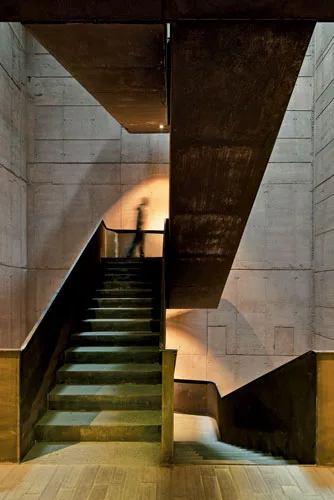
Three earth-tone materials dominate, continuing throughout the back of house, where a Cor-Ten steel stair connects all three levels, the walls are fabricated with reddish concrete (an iron-oxide mix), and the floors are paved with long terra-cotta bricks.
 
Photo © Leonardo Finotti
Cantina Antinori
A wine shop has panoramic views of the surrounding countryside.
 
Photo © Leonardo Finotti
Cantina Antinori
Spanning over 527,000 square feet, Cantina Antinori houses all aspects of the 600-year-old vintner's business and history, including a museum with a Renaissance-era wine press designed by Leonardo da Vinci.
 
Photo © Leonardo Finotti
Cantina Antinori
Terra-cotta-wrapped cellars contain stainless steel fermentation tanks.
 
Photo © Leonardo Finotti
Cantina Antinori
The dramatic vaulted cellars form a sinusoidal sequence on a steel frame, built within a much larger concrete rectilinear space. This is where the best wines are held in oak barriques, or small barrels'the ideal backdrop for guests and customers sipping wine in the glazed tasting rooms that project from the adjacent wall (shown).
 
Photo © Leonardo Finotti
Cantina Antinori
Image courtesy Archea Associati
Cantina Antinori
Image courtesy Archea Associati
Cantina Antinori
Image courtesy Archea Associati
Cantina Antinori
Image courtesy Archea Associati
Cantina Antinori
Cantina Antinori
Cantina Antinori
Cantina Antinori
Cantina Antinori
Cantina Antinori
Cantina Antinori
Cantina Antinori
Cantina Antinori
Cantina Antinori
Cantina Antinori
Cantina Antinori
July 16, 2013

Architects & Firms

Archea Associati

In Tuscany, they tell you, wine is close to being a religion. If so, the 600-year-old winemaking dynasty of Antinori is an oenological priesthood, the current high priest being the Marchese Piero Antinori, widely regarded as a hero of the post'World War II Italian wine industry. His company developed the luscious, long-lived wines called Super Tuscans, which challenged both archaic Italian winemaking laws and the finest wines of Bordeaux. Now the Antinori descendants have gone right back to their roots, building a new winery and headquarters among the hilly vineyards of the Chianti Classico region outside their ancestral home of Florence. For all the family history, there is nothing remotely traditional about this earth-sheltered building.

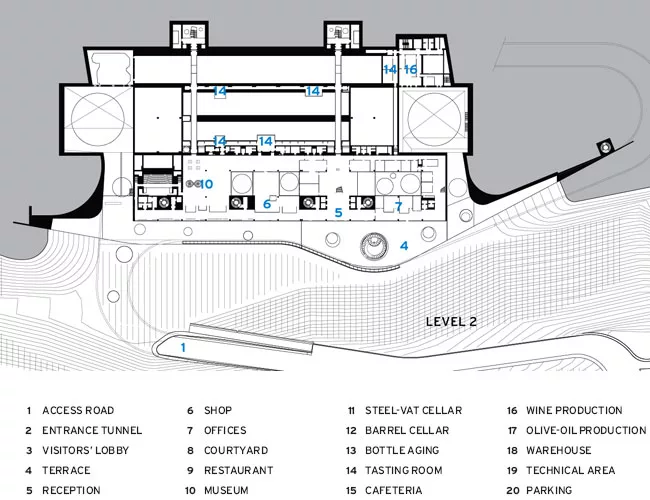
Designed by Archea Associati, a Florence-based firm with offices around the world, the new Antinori HQ is just outside the village of Bargino. It is a building that is simultaneously industrial (a winery is, after all, a factory with warehousing), a visitor destination complete with museum and restaurant, and an office housing 120 people, including senior Antinori family members. The public face and administration area are at the front, factory functions are set higher at the back, and a sequence of wine vaults dug into the slope links the two.

The complex is large by European standards. Excluding landscape, it is some 550 feet long by nearly 500 feet deep on a staggered section, and 60 feet tall in total, arranged over four interlocking levels. Despite this, there is no visible bulk and little by way of elevations. Using a selective palette of materials in harmony with the color of the soil, the architects worked with the idea that it should appear from a distance as no more than a couple of horizontal slashes in the terrain. Some costly engineering was needed to achieve this. When excavation began in 2005 the land turned out to be unstable, requiring extensive piling and horizontal ground anchors. Made mainly of poured-in-place concrete, the building boasts a curvilinear steel canopy along the main terrace with a very deep cantilever, an especially formidable feat considering the weight of soil on top.

Now complete after a slow and difficult build, this 'earth ship' is successfully merging with its surroundings, though it will take another season before the hillside, still raw in places, fully greens up. The profile of the excavated ground'a roughly rectangular, steeply sloping 35-acre site that resembled a quarry during construction'has been restored. Vines are planted over the building, olive trees above and behind it. From the road below, you are aware only of a retaining wall in reddish concrete with the company's name and crest emblazoned on it. At this point a driveway'quite large, to take trucks'snakes up the hillside, disappears beneath the building, and deposits you either at a drop-off point beneath the main terrace or in a sunken parking lot.

The design is all about gradual disclosure: you catch a glimpse of the Cor-Ten steel cornice of the main terrace as you drive up the approach, only for it to disappear as you move beneath the building. The visitor entrance is the visual fulcrum of the structure, expressed by a virtuoso asymmetric spiral staircase (also Cor-Ten)'sculptural as much as practical, since elevators and more conventional stairs inside provide the main vertical movement. Nearly all finishes throughout are left rough and industrial, whether more of the oxidized steel used for handrails or sawn-oak interior wall surfaces.

Three earth-tone materials dominate: Cor-Ten steel; that reddish concrete (achieved through an iron oxide in the mix); and long terra-cotta bricks, similar in tone to the concrete, used variously for paving, soffit cladding, and walls. In the wine-storage vaults they wrap right around the interiors.

Although principally a single-aspect building, facing west across a valley, the structure was designed to bring in daylight both from above'through numerous circular apertures in the covering landscape'and more unexpectedly from the rear, where a service road for trucks and employee parking is terraced high into the slope. This part of the facility is wholly for the winemaking process, from the arrival of grapes for crushing through fermentation, barrel aging, bottling, bottle aging, and eventual packaging and dispatch. Visitor tours include the Antinori museum, complete with a Renaissance-era geared double wine press designed by Leonardo da Vinci; tasting rooms, some of which project into the barrel vaults in the form of glazed boxes: a promenade along a high-level walkway traversing the vaults; a small restaurant perched on the main terrace looking out across the valley; and, of course, the shop, where the company's products are displayed in terra-cotta shelving units designed by the architects.

Since the cellars are a key part of the tour, they were conceived in dramatic fashion to be cavelike. Rather than being regularly arched, they form a sinusoidal sequence on a steel frame, built within a much larger concrete rectilinear space. The frame was then lined with the terra-cotta bricks, slid onto concealed metal rail fittings. In these vaults the oak barriques, or small barrels, associated with the best wines are stacked in rows. Less exalted wines are matured in larger barrels, some very large indeed. Perhaps most impressive of all are the tall stainless steel fermentation tanks, but few members of the public are allowed to see those overtly industrial objects. Seen or unseen, however, all enjoy the constant cool temperature that wine needs to mature, as a natural consequence of being sunk into the hillside.

Archea's cofounder, architect Marco Casamonti, talks of 'a contemplative relationship with, rather than an emulation of, the natural landscape.' The project implies a kind of equilibrium with nature, and takes a manifesto position: yes, a large manufacturing complex such as this can harmonize with a rural area.

The time and effort that have gone into this building are palpable. But as one of the key movers in the ancestral business, Piero's elder daughter, Albiera, pointed out as we talked in their Renaissance palazzo in Florence: 'Obviously the new building is very innovative. But this house has been the center of activity for us since 1506. It too was designed in a way that was modern for its time. It still works exactly as it did 500 years ago. It was looking forward, not back.' Plainly, the 26th generation of the Antinori family has lost none of its perfectionist zeal.

Hugh Pearman is architecture critic of the Sunday Times of London and editor of the Journal of the Royal Institute of British Architects.

Size: 527,400 square feet

Cost: $111.2 million

Completion date: October 2012

People

Owner:

Marchesi Antinori S.r.l.


Location:

San Casciano Val di Pesa, Italy


Architect:

Archea Associati
Lungarno B. Cellini, 13
50125 Firenze – Italia
www.archea.it

Personnel in architect's firm who should receive special credit:
Marco Casamonti, Francesco Giordani, Laura Andreini, Silvia Fabi, Giovanni Polazzi


Engineer(s):

HYDEA


Consultant(s):

Structural: AEI Progetti

Landscape:  M&E Management & Engineering (design); Emex Engineering (oenological)


General contractor:

Inso


Products

Structural system

Steel: Secco Sistemi (Corten)

Concrete: CSP (prefabricated)

Formwork: ALPI

Glazing

Pilkington, Sunglass (curved)
 
Doors

MPA (glass)

Interior finishes

Acoustical surfaces and plasterboard: Knauf

Paints and stains: Novocolor

Terra cotta: Sannini Impruneta, Ceipo Ceramiche (furniture elements)

Adhesivies: MAPEI

Carpet: Besana

Raised floor: Teknofloor

Furnishings

Office furniture: Estel

Furniture: Moroso (furniture, chairs, sofas), Castelli (chairs)

Lighting

Zumtobel, Martini Illuminazione

Conveyance

Elevators/Escalators: Kone

 
KEYWORDS: Italy

Share This Story

Looking for a reprint of this article?
From high-res PDFs to custom plaques, order your copy today!

London-based Hugh Pearman is the editor of the RIBA Journal.

Post a comment to this article

Report Abusive Comment

Subscription Center
  • Create an Account
  • Start a Subscription
  • Manage My Account
  • Sign Up for Newsletters
  • Visit Customer Service
  • Update Preferences

More Videos

Sponsored Content

Sponsored Content is a special paid section where industry companies provide high quality, objective, non-commercial content around topics of interest to the Architectural Record audience. All Sponsored Content is supplied by the advertising company and any opinions expressed in this article are those of the author and not necessarily reflect the views of Architectural Record or its parent company, BNP Media. Interested in participating in our Sponsored Content section? Contact your local rep!

close
  • TAMLYN XtremeTrim Exterior Trim
    Sponsored byTamlyn

    Designing Cleaner Panel Facades: Why Exterior Trim Details Matter

  • Building with Vapor Barriers
    Sponsored byReef Industries, Inc.

    Vapor Barriers Help Control Moisture in Tighter Building Designs

  • Duct Interior with Prodeq System
    Sponsored byHenry, a Carlisle Company

    Designing Resilient Water Containment Systems

DESIGN:ED Podcast
Listen to Architectural Record’s DESIGN:ED Podcast

Events

June 10, 2026

Rethinking Stormwater – The Power of Porous Paving

Credits: 1 AIA LU/HSW; 1 AIBD P-CE; 0.1 ICC CEU

Learn how porous paving systems support stormwater management, reduce heat island effects, and enhance sustainable site design performance.

June 11, 2026

Very Early Warning Fire Detection for Mission-Critical Facilities

Credits: 1 AIA LU/HSW; 1 AIBD P-CE; 0.1 ICC CEU

Examine advanced fire detection strategies that support uptime and enhance safety in data centers and other mission-critical facilities.

View All Submit An Event

Products

2026 Architect's Square Foot Costbook

2026 Architect's Square Foot Costbook

See More Products

Popular Stories

Practice Matters illustration

What’s in a (Firm’s) Name? Thinking About Succession and Legacy

Practice Matters illustration

By the Numbers: Counting America's Architects

House on a Hill

Design Vanguard 2026: Forma

Crane Cove, ONO

Design Vanguard 2026 Winners

KRESA by DLR

In Kalamazoo, DLR Group Completes a Mass-Timber Hub for Career and Technical Education Programs

Broader Sustainability of CMU - Free Webinar - May 21, 2026

Related Articles

  • Featured Image Snapshot

    Plaxil 8 by Studio Valle Architetti Associati

    See More
  • NOI Techpark

    NOI Techpark by Claudio Lucchin & Architetti Associati and Chapman Taylor

    See More
  • Scuola Colognola

    Scuola Colognola Ai Colli by Claudio Lucchin & Architetti Associati

    See More

Related Products

See More Products
  • 3dthinking.jpg

    3D Thinking in Design and Architecture: From Antiquity to the Future

  • american arch.jpg

    American Architecture: An Illustrated Encyclopedia

See More Products
×

The latest news and information

#1 Source for Architectural Design, News and Products

SUBSCRIBE
  • RESOURCES
    • Advertise
    • Contact Us
    • Submit
    • Store
  • ACCOUNT CENTER
    • Create an Account
    • Start a Subscription
    • Manage My Account
    • Sign Up for Newsletters
    • Visit Customer Service
    • Update Preferences
  • PRIVACY
    • PRIVACY POLICY
    • TERMS & CONDITIONS
    • DO NOT SELL MY PERSONAL INFORMATION
    • PRIVACY REQUEST
    • ACCESSIBILITY
  • SERVICES
    • Marketing Services
    • Reprints
    • Market Research
    • List Rental
    • Survey/Respondent Access
  • STAY CONNECTED
    • Linkedin
    • Facebook
    • Instagram
    • YouTube
    • X (Twitter)

Copyright ©2026. All Rights Reserved BNP Media, Inc. and BNP Media II, LLC.

Design, CMS, Hosting & Web Development :: ePublishing