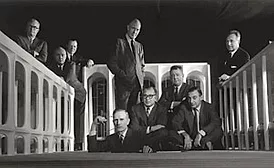
I know people will be reading this in crisp October, but as I write I’m hanging on to summer in the week before Labor Day. Summer is a time for many things. One of them, for the right-minded architect, is golf. I realize that I’ll alienate some readers here, but golf and architecture are, I believe, related activities. Golf is said to be an old person’s sport — witness Tom Watson, who almost won the British Open this summer at age 59 — and as we all know, architects, like symphony conductors, tend to flourish in their later years. I.M.
Never the same shot Golf is also like architecture in that there are no cookie-cutter plans, or at least no good ones. Unlike bowling or tennis, golf is played on a surface in which every course, every fairway, every green is different. In a lifetime, you never play exactly the same shot twice. Isn’t that part of what makes the practice of architecture, too, so fascinating? Mark Twain should have tried golf. He might have come up with something to rival John Updike’s marvelous short story “Farrell’s Caddie,” in which a wizened caddie steers a callow American golfer around a
I know people will be reading this in crisp October, but as I write I’m hanging on to summer in the week before Labor Day. Summer is a time for many things. One of them, for the right-minded architect, is golf. I realize that I’ll alienate some readers here, but golf and architecture are, I believe, related activities. Golf is said to be an old person’s sport — witness Tom Watson, who almost won the British Open this summer at age 59 — and as we all know, architects, like symphony conductors, tend to flourish in their later years. I.M.
Earlier this year, I was in the Emirates to give a lecture and was invited to visit the school of architecture where one of my hosts taught. Segregated by gender, the place was a Foucault fantasy made concrete. On one side of the building lay the studios and classrooms for women students and on the other — in mirror image — the rooms for the men. Between them were faculty offices, all of which had two doors, one to each side. The dean — natty in Armani — explained to me (as if the whole thing made sense) that the
There are some small signs of movement, especially in the stirrings of fungibility on the part of planning and landscape. Although I run a program in urban design, I have a fundamental disbelief in any unitary discourse of the city and try to offer access to many. Originally conceived as a way of recuperating physical design from a planning profession that had fallen in thrall to the social sciences, urban design is often taught simply as big building and fixates excessively on historic patterns. But urbanism’s most desperate needs devolve on the new morphologies of sustainability and equity that an
In New York City, where restaurants last an average of two years and seldom more than seven, a dining establishment that survives for half a century might seem a culinary Methuselah.
Curating Wright The Wright show disappoints in other ways, too. There’s no sense of a governing critical intelligence. The exhibition is simply a haphazard attic of Wrightiana, certainly fascinating for Wright buffs, but lacking a clear point of view. The title is the giveaway: Frank Lloyd Wright: From Within Outward. The idea is that Wright designed his buildings by first planning the interior spaces, and only then shaping the exterior appearance around them. Well, sure he did, but so what? This is a tired cliché, not a stirring theme for a new exhibition. It’s an idea for an old-fashioned show
The idea that inspired Lincoln Center began during the Roaring 20s, when John D. Rockefeller, Jr. — pious and penitent son of the rascally robber baron — hoovered up blocks of Midtown Manhattan for a state-of-the-art Metropolitan Opera House.
Not long ago, a small midblock building was demolished not far from my office in SoHo. The excision was a revelation. Because of a sequence of low buildings in succeeding blocks, it was suddenly possible to look through a remarkable cut in the city that reconfigured the backs of buildings with their principal facades on the avenues into a long series of fronts. The space is like none other in New York in its proportions and architectonic character, the elegant austerity of the backs of buildings with ornamented facades making a place both lyrical and tough. Looking at it, it’s
 RSS
RSS