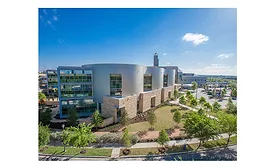
Legacy ER, a freestanding emergency room and urgent-care facility, stops traffic in Allen, Texas, with an angular folded roof of zinc panels and perforated screens.
Salvaged materials, sensory gardens, and non-toxic medical equipment have all helped the recent expansion of Dell Children’s Medical Center earn the first-ever LEED for Healthcare (LEED-HC) Platinum designation.
Behind the eye-catching design of the 969,000-square-foot Rey Juan Carlos Hospital in the Madrid suburb of M'stoles, Spanish architect Rafael de La-Hoz has created a therapeutic atmosphere, organizing the building around accessible atria that help orient patients and immerse them in a protective, inward-looking environment.
A Prescription for Campus Care: Lake|Flato renovates and expands an outdated health-services facility at Arizona State University, Tempe. Built as two structures in 1953 and 1968, the Health Services'Tempe Building (HSTB) at Arizona State University (ASU) had become inefficient and out of rhythm with the vibrant, growing campus around it. Designed by San Antonio'based Lake | Flato in collaboration with architect of record Orcutt | Winslow of Phoenix, the overhauled, 36,900-square-foot HSTB is light-filled, inviting, and designed for LEED Platinum certification. Its gardenlike environment is a refuge for the campus's 60,000 students when they need medical treatment and guidance. Located
Light Touch: The Corbusian pavilions of the UCLA Outpatient Surgery and Medical Building, by Michael W. Folonis Architects, bring daylight to the patient experience.
Michael Folonis reacted with baffled delight when he was chosen to design the 50,000-square-foot, three-story UCLA Outpatient Surgery and Medical Building in Santa Monica.
In recent years the design of hospitals that emulate hotels has generated a warming trend in this often forbiddingly cold, institutional building type.
 RSS
RSS