This website requires certain cookies to work and uses other cookies to help you have the best experience. By visiting this website, certain cookies have already been set, which you may delete and block. By closing this message or continuing to use our site, you agree to the use of cookies. Visit our updated privacy and cookie policy to learn more.
This Website Uses Cookies By closing this message or continuing to use our site, you agree to our cookie policy. Learn MoreThis website requires certain cookies to work and uses other cookies to help you have the best experience. By visiting this website, certain cookies have already been set, which you may delete and block. By closing this message or continuing to use our site, you agree to the use of cookies. Visit our updated privacy and cookie policy to learn more.
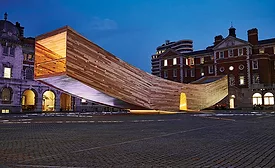
Held this year from September 13 to September 21, the festival has grown to become one of the city’s calendar events, visited by an estimated 350,000 people. In over 12 years the London Design Festival, held this year from September 13 to September 21, has grown to become one of the city’s calendar events, visited by an estimated 350,000 people and acting as an umbrella for projects by over 250 collaborators, from retailers and manufacturers to galleries and colleges. Its hub was the Victoria & Albert Museum (V&A), where many of the Festival’s commissioned pieces are temporarily installed. Here, explains
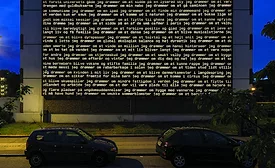
BruumRuum! is a dynamic installation by David Torrents with artec3 Studio and LEDsControl that transforms the sounds of Barcelona into patterns of light.
In five years’ time, when Barcelona’s largest urban regeneration project is complete, the Plaça de les Glòries Catalanes will be a leafy oasis in the middle of a new business and leisure district.
Odile Decq draws from Lyon’s industrial context to project the waterfront’s new identity. From Oslo and Lisbon to Hamburg and Amsterdam, the last 20 years have seen many of Europe’s redundant urban dockyards transformed into architectural zoos, peppered with signature structures by top-tier architects, often with greater regard for novelty than for the particularities of history or place.
Portal to the Past: Denton Corker Marshall created a forest of columns for the Stonehenge Exhibition and Visitor Centre that respects the ancient monument it serves.
Laboratory buildings are often the graveyard of architects' good intentions, as stringent technical requirements leave little room for environmental and aesthetic concerns.
The Sky's The Limit: The expansion of a vast trade-fair complex satisfies demanding exhibition-hall requirements and figures into a city's plans for urban renewal.
Two teams of architects employ very different strategies to reinvigorate a pair of ambitious 1960s apartment projects, one in the north of England and the other in Paris. Bois-le-Pêtre, Paris The $15.4 million overhaul of Bois-le-Pêtre, completed in 2011, is a more explicit manifesto for renovation. Its roots are in a combined response by Lacaton & Vassal and Frédéric Druot to the French government's 2003 demolition plan: 'We were shocked by the idea that nothing could be done except tabula rasa redevelopment,' recalls Anne Lacaton. The two architecture firms embarked on a published research project which concluded that such buildings