Architectural Record
search
cart
facebook twitter linkedin youtube
  • Sign In
  • Subscribe
  • Sign Out
  • My Account
Architectural Record
  • NEWS
    • Latest News
    • Awards
    • Interviews
    • Obituaries
    • Podcasts
      • Design:Ed Podcast
      • Sponsored Podcasts
  • OPINION
    • Book Reviews / Excerpts
    • Exhibition Reviews
    • Forum
  • EXCLUSIVES
    • Videos
    • Design Vanguard
    • Top 300 Firms
    • Sponsored Content
    • Sponsored eBooks
    • From the Archives
  • CONTINUING ED
    • Editorial Continuing Ed
    • CE Center
    • CE Academies
  • PROJECTS
    • Buildings By Type
    • Reuse & Renovation
    • Museums & Arts Centers
    • Colleges & Universities
    • Multifamily Housing
    • Interiors
    • Lighting
    • Kitchen & Bath
  • HOUSES
    • Record Houses
    • House of the Month
    • Featured Houses
  • PRODUCTS
    • Products by Category
    • Record Products of the Year
    • Latest Products
  • EVENTS
    • Dates & Events
    • Record on the Road
    • Innovation Conference
    • Sustainability in Practice
    • Women In Architecture
    • Webinars
    • Ad Excellence Awards
    • Submit an Event
  • CONNECT
    • Ask RECORD AI
    • Newsletters
    • Contact
    • Advertise
    • Editorial Calendar
    • Store
    • Customer Service
  • SUBMIT
    • Submission Guidelines
    • RECORD Competitions
  • MAGAZINE
    • Subscribe
    • My Account
    • Digital Edition
    • Current Issue
    • Firm Pass
    • Historic Archive

Social Housing U.S.A.
By Ben Adler
Michael Pyatok of Pyatok Architects designed Fox Courts affordable housing in Oakland to provide 80 dwellings for families and single people. The four-story, stucco-on-wood-frame struc
Fox Courts
Pyatok Architects
Oakland, California
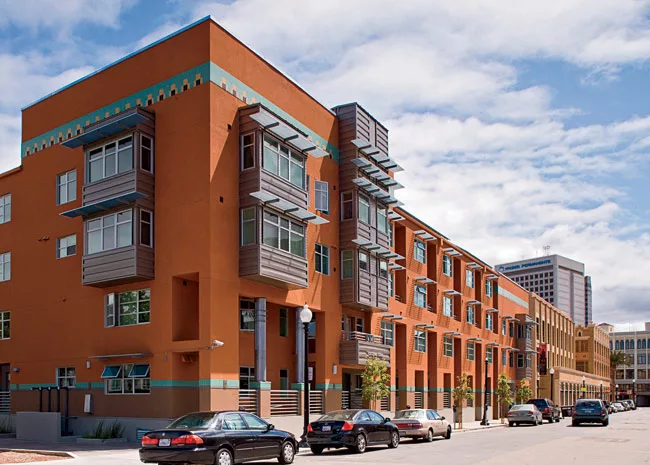
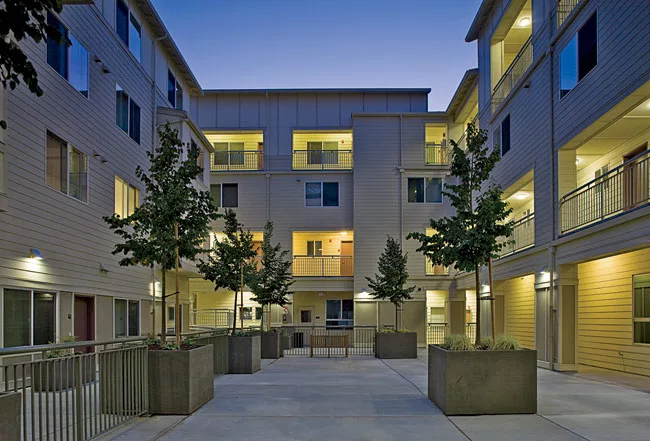
Michael Pyatok of Pyatok Architects designed Fox Courts affordable housing in Oakland to provide 80 dwellings for families and single people. The four-story, stucco-on-wood-frame structure is distinguished on the exterior by projecting aluminum-sided bay windows that alternate with double-height, carved-out spaces.
Photo © Frank Domin
The sustainable complex, completed in 2009 for Resources for Community Development, includes two courtyards and a day-care center.
Fox Courts
Pyatok Architects
Oakland, California
The sustainable complex, completed in 2009 for Resources for Community Development, includes two courtyards and a day-care center.
Photo © Frank Domin
Jonathan Kirschenfeld Architect designed Teller Avenue, a five-story loadbearing-masonry and precast-concrete-plank structure with 43 singleroom units in the Bronx. The building, compl
Teller Avenue
Jonathan Kirschenfeld Architect
Bronx, NY
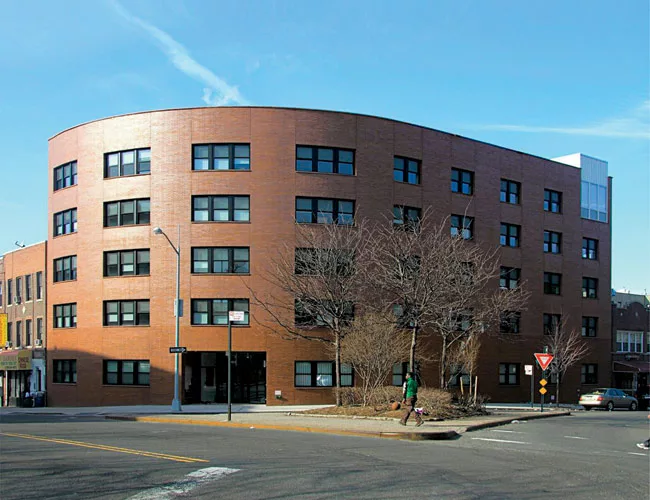
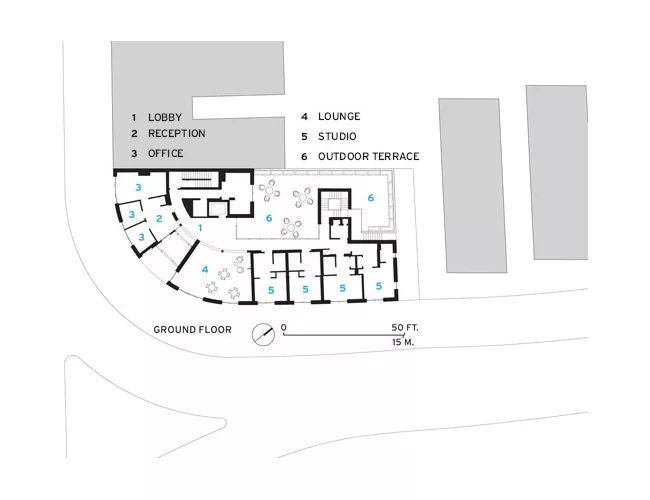
Jonathan Kirschenfeld Architect designed Teller Avenue, a five-story loadbearing-masonry and precast-concrete-plank structure with 43 singleroom units in the Bronx. The building, completed in 2011 for the Postgraduate Center for Mental Health, offers tenants common spaces at the ground level and on the top floor. The building's curve follows the site's contour.
Photo © Pedro Pulido/JKA
Inside, translucent sandwich panels admit daylight to the halls.
Teller Avenue
Jonathan Kirschenfeld Architect
Bronx, NY
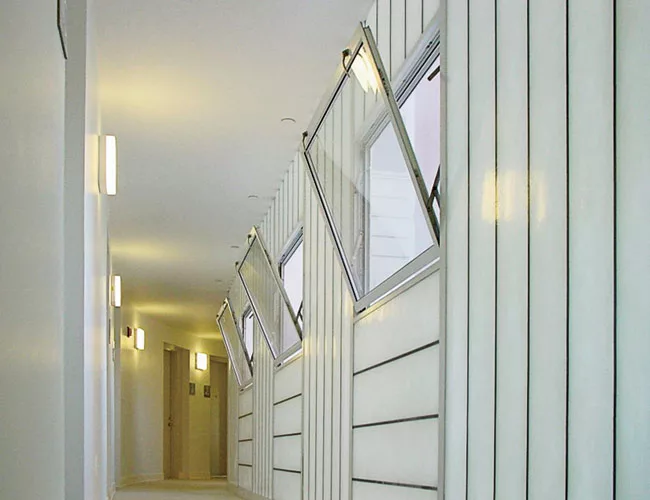
Inside, translucent sandwich panels admit daylight to the halls.
Photo © Adrian Vasile/JKA
Ground Floorplan
Teller Avenue
Jonathan Kirschenfeld Architect
Bronx, NY
Ground Floorplan
Photo © Michael Moran
While Le Corbusier's towers-in-the-park idea didn't fare well in the U.S., Alexander Gorlin Architects returned to the master's low-rise housing schemes for the Brook, a si
The Brook
Alexander Gorlin Architects
Bronx, NY
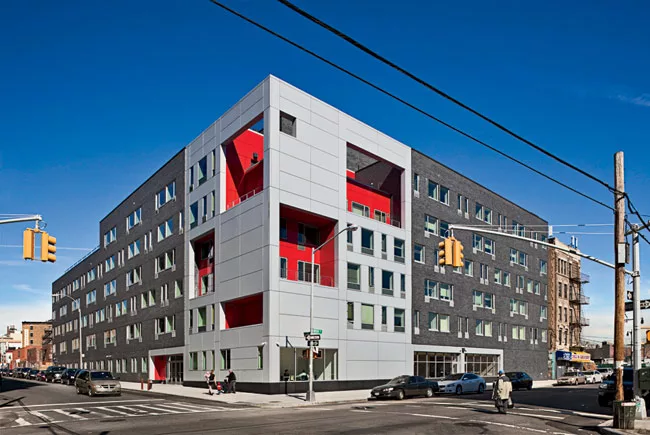
While Le Corbusier's towers-in-the-park idea didn't fare well in the U.S., Alexander Gorlin Architects returned to the master's low-rise housing schemes for the Brook, a six-story, 190-unit residence in the Bronx (2010). Designed for Common Ground, the building features double-height common porches in the brick-and-aluminum-clad structure.
Photo © Michael Moran
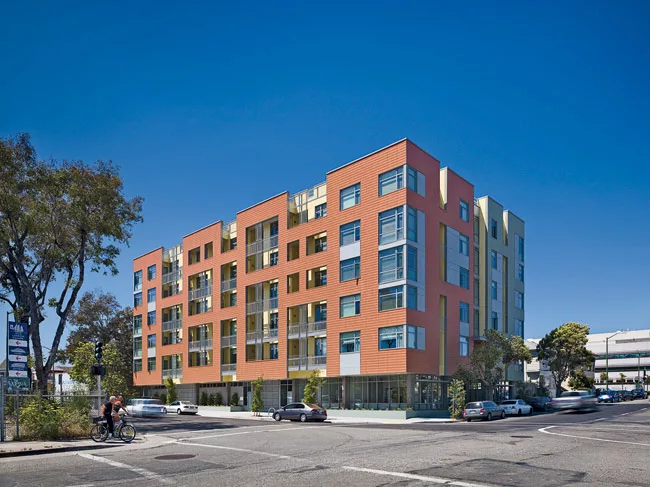
In 2012 Leddy Maytum Stacy Architects completed the 70-unit Merritt Crossing Senior Apartments for Affordable Housing Associates in Oakland.
Merritt Crossing Senior Apartments
Leddy Maytum Stacy Architects
Oakland, California
In 2012 Leddy Maytum Stacy Architects completed the 70-unit Merritt Crossing Senior Apartments for Affordable Housing Associates in Oakland.
Photo © Tim Griffith
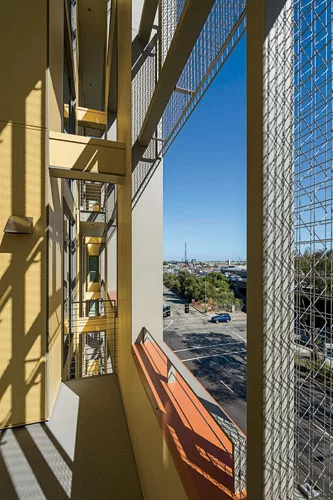
The design, with cement-board panels and brick cladding, includes open outdoor spaces that puncture the exterior wall plane.
Merritt Crossing Senior Apartments
Leddy Maytum Stacy Architects
Oakland, California
The design, with cement-board panels and brick cladding, includes open outdoor spaces that puncture the exterior wall plane.
Photo © Tim Griffith
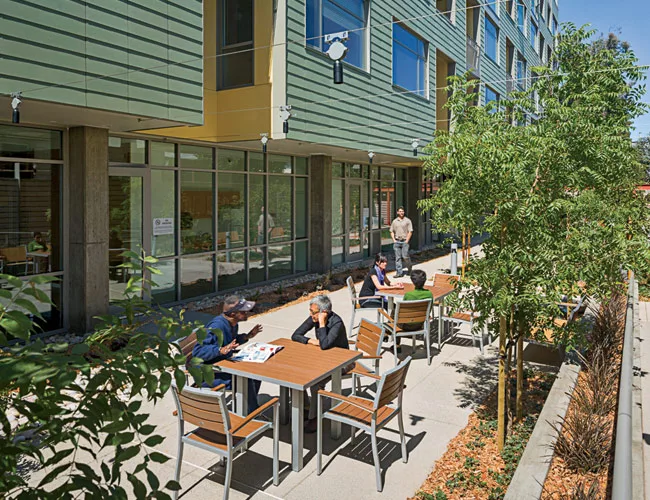
A variety of community multipurpose spaces on the ground floor connect to outdoor landscaped areas for the residents.
Merritt Crossing Senior Apartments
Leddy Maytum Stacy Architects
Oakland, California
A variety of community multipurpose spaces on the ground floor connect to outdoor landscaped areas for the residents.
Photo © Tim Griffith
Michael Pyatok of Pyatok Architects designed Fox Courts affordable housing in Oakland to provide 80 dwellings for families and single people. The four-story, stucco-on-wood-frame struc
The sustainable complex, completed in 2009 for Resources for Community Development, includes two courtyards and a day-care center.
Jonathan Kirschenfeld Architect designed Teller Avenue, a five-story loadbearing-masonry and precast-concrete-plank structure with 43 singleroom units in the Bronx. The building, compl
Inside, translucent sandwich panels admit daylight to the halls.
Ground Floorplan
While Le Corbusier's towers-in-the-park idea didn't fare well in the U.S., Alexander Gorlin Architects returned to the master's low-rise housing schemes for the Brook, a si
In 2012 Leddy Maytum Stacy Architects completed the 70-unit Merritt Crossing Senior Apartments for Affordable Housing Associates in Oakland.
The design, with cement-board panels and brick cladding, includes open outdoor spaces that puncture the exterior wall plane.
A variety of community multipurpose spaces on the ground floor connect to outdoor landscaped areas for the residents.
March 16, 2013

The architecture has evolved, joining design with support services.

Over the last five decades, models for social housing in U.S. cities have continually evolved. First, the postwar subsidized brick high-rises—based on Le Corbusier's towers-in-the-park of the 1920s—were largely abandoned. Then, starting in the 1970s, smaller infill developments, often mimicking a neighborhood's rowhouses, were increasingly adopted. But low-rises with separate entries and limited communal space have not been able to serve all the needs of some populations, such as the elderly, disabled, or formerly homeless.

Michael Pyatok of Pyatok Architects designed Fox Courts affordable housing in Oakland to provide 80 dwellings for families and single people. The four-story, stucco-on-wood-frame structure is distinguished on the exterior by projecting aluminum-sided bay windows that alternate with double-height,carved-out spaces. The sustainable complex, completed in 2009 for Resources for Community Development, includes two courtyards and a day-care center.

More and more, architects, planners, and community activists are recognizing that housing for growing low-income and special-needs urban populations should be flexible. It has to accommodate single adults (young and old), single-parent families, and multigenerational clans bunking together. Furthermore, housing experts maintain that social and community services are as essential to the success of public housing as building design.

And so a new prototype is emerging: mid-rise apartment buildings that maintain the street wall, achieve a desirable density, and better meet the needs of the communities they serve. Actually, this type of housing has been part of middle-class city neighborhoods since before World War II—but it was aimed at the private market. The important shift today is recognizing that it should go hand in hand with a strong social agenda.

In talking to advocates and architects, it becomes clear that low-income housing must be integrated into a healthy neighborhood; that it must accommodate a variety of household configurations; and that it should project the dignity and interior warmth of market-rate architecture. And it needs to feel safe. “Defined, observable open space with a clear definition of entries to a building leads to a sense of security,” says Theodore Liebman, a principal at Perkins Eastman who was chief of architecture for the New York State Urban Development Corporation from 1971 to 1975. “But crime reduction in public housing is as much about active street life as the design of buildings.”

Hallways inside the buildings can be dangerous as well, points out Deborah Gans, principal of Gans Studio in New York City and a professor of architecture at Pratt Institute in Brooklyn. Gans advocates an “eyes on the hallway” design approach as the interior equivalent of Jane Jacobs's famous “eyes on the street” formulation. If a window looks onto the hallway from an apartment's kitchen, parents can cook and still see kids playing in those corridors. Liebman notes that buildings should locate laundry rooms next to children's playrooms, with a window from one to the other, so parents can keep an eye on their kids while doing the wash.

Twenty-first-century social networks differ from the norm that guided designers in the urban-renewal building boom of the 1950s and '60s. During those years architects conceived of public housing as shelter for two-parent nuclear families. But today's low-income households are frequently headed by a single mother who needs child-care support. “You have to do a careful analysis of how people live,” says Gans. “If the single parent works in three jobs, who's going to take care of the kids?” Many families rely upon grandparents for child care, or, sometimes, a steady flow of relatives arriving from a home country. In many cases, these communities have three generations under one roof where extended-family members come and go. “Maybe it's good to have a grandma unit on one floor and yours on another,” suggests Gans.

Unlike wealthier families, people in public housing usually depend on the community for such amenities as gyms and after-school and summer activities for children. Architects are increasingly concerned about whether there is a well-designed public park in close proximity to the housing complex, or at least an attractive interior courtyard or community garden within its confines.

In addition, multigenerational family living requires more than simply making apartments bigger. Michael Pyatok, principal of Pyatok Architects in Oakland, who has been specializing in affordable housing for several decades, points out that including space for grandparents or adult children is different from building an apartment with the same number of rooms for a family with kids. “The best way to accomplish this cohabitation by different generations is to separate the bedrooms at opposite ends of an apartment or put them on separate floors of a townhouse,” says the architect, who is a winner of the American Institute of Architects' 2013 Thomas Jefferson Award for Public Architecture.

Architects today seek to destigmatize public housing with designs that fit into the surrounding urban realm, both in scale and in interaction with the street. They can also employ subtler elements—such as materials and detailing—not typically associated with low-income housing.

“My goal is to make the new structure look like housing, period,” says New York architect Jonathan Kirschenfeld, who often designs single-room-occupancy supportive housing for recently homeless or mentally ill residents. “We use iron-spot brick for every exterior, which is traditionally identified with solid 1930s and 1940s good urban fabric. We spend a lot of time finessing the facade: windows are punched, compositions carefully calibrated.”

Historically, housing projects have been known for uninviting double-loaded corridors lit with harsh or flickering fluorescent fixtures. Kirschenfeld and other architects include lot-line windows at the end of each corridor to bring daylight into the hallways. At the Hegeman (page 102), a mix of supportive and low-income housing in Brownsville, Brooklyn, the architect, CookFox, introduced daylight into the lobby by placing glazed entrance walls across from the elevator in the middle of an L-shaped building.

The designs of a number of recent projects reflect current thinking about the importance of offering social and community services to residents—so placing those amenities with care is a priority. And while ground-floor shops in apartment blocks might seem ideal for generating activity in the neighborhood, rooms providing social services or amenities also help create engagement with the street. “Often, affordable housing is in an economically challenged neighborhood where the location may not be great for retail,” says Richard Stacy, a partner at the San Francisco firm Leddy Maytum Stacy Architects, which has designed many affordable-housing projects in the Bay Area. “So what we do instead is place community spaces—the common room, computer room, and gym—along the street, where they offer built-in casual surveillance,” as demonstrated by his firm's Merritt Crossing Senior Apartments in Oakland.

Common Ground, a nonprofit organization that built and manages the Hegeman in Brooklyn and the Brook in the Bronx (designed by Alexander Gorlin), reinforces community engagement by providing classes in everything from résumé writing to knitting for residents, and sometimes for anyone from the neighborhood. While public housing originally addressed a perceived housing shortage, advocates and architects now understand that problems such as homelessness are social issues, requiring social solutions. Common Ground's supportive housing includes on-site case management, with staffers, including medical personnel, who are available to meet with residents having problems. “We have big buildings because we set the bar high on programming and staff, and in order to do that you need economies of scale,” explains Brenda Rosen, executive director of Common Ground.

Incorporating various activities into a housing complex to help generate economic opportunities is advocated by Rosanne Haggerty, who founded Common Ground and, in 2011, began Community Solutions, also a New York nonprofit focused on affordable housing. Inspired by The Stop, a community food center in Toronto, Community Solutions is developing a 2.5-acre site in Hartford, Connecticut, that contains an abandoned 65,000-square-foot 19th-century factory. The organization plans to build housing and a library, plus a community food center with classes in cooking and nutrition as well as a commercial kitchen that residents can rent for their food-related businesses. Nearby will be a community garden. “You need to create optimism and hope for people who are living from crisis to crisis,” says Haggerty. “Design once contributed to the problem, but it can now contribute to the solution.”

Ben Adler is a Brooklyn-based journalist covering politics, architecture, and urban design.

Share This Story

Looking for a reprint of this article?
From high-res PDFs to custom plaques, order your copy today!
Post a comment to this article

Report Abusive Comment

Subscription Center
  • Create an Account
  • Start a Subscription
  • Manage My Account
  • Sign Up for Newsletters
  • Visit Customer Service
  • Update Preferences

More Videos

Sponsored Content

Sponsored Content is a special paid section where industry companies provide high quality, objective, non-commercial content around topics of interest to the Architectural Record audience. All Sponsored Content is supplied by the advertising company and any opinions expressed in this article are those of the author and not necessarily reflect the views of Architectural Record or its parent company, BNP Media. Interested in participating in our Sponsored Content section? Contact your local rep!

close
  • TAMLYN XtremeTrim Exterior Trim
    Sponsored byTamlyn

    Designing Cleaner Panel Facades: Why Exterior Trim Details Matter

  • Building with Vapor Barriers
    Sponsored byReef Industries, Inc.

    Vapor Barriers Help Control Moisture in Tighter Building Designs

  • Duct Interior with Prodeq System
    Sponsored byHenry, a Carlisle Company

    Designing Resilient Water Containment Systems

DESIGN:ED Podcast
Listen to Architectural Record’s DESIGN:ED Podcast

Events

June 10, 2026

Rethinking Stormwater – The Power of Porous Paving

Credits: 1 AIA LU/HSW; 1 AIBD P-CE; 0.1 ICC CEU

Learn how porous paving systems support stormwater management, reduce heat island effects, and enhance sustainable site design performance.

June 11, 2026

Very Early Warning Fire Detection for Mission-Critical Facilities

Credits: 1 AIA LU/HSW; 1 AIBD P-CE; 0.1 ICC CEU

Examine advanced fire detection strategies that support uptime and enhance safety in data centers and other mission-critical facilities.

View All Submit An Event

Products

2026 Architect's Square Foot Costbook

2026 Architect's Square Foot Costbook

See More Products

Popular Stories

Practice Matters illustration

What’s in a (Firm’s) Name? Thinking About Succession and Legacy

Coronado Bridge

The Architect’s Guide to San Diego

Practice Matters illustration

By the Numbers: Counting America's Architects

House on a Hill

Design Vanguard 2026: Forma

Crane Cove, ONO

Design Vanguard 2026 Winners

Broader Sustainability of CMU - Free Webinar - May 21, 2026

Related Articles

  • Catelonia Social Housing.

    Social Housing by Peris+Toral

    See More
  • Borrassa

    Peris+Toral Brings Dignified Design to Social Housing in Barcelona

    See More
  • Glory of Spangen Social Housing Complex Restored

    See More

Related Products

See More Products
  • 9 ways.jpg

    9 Ways To Make Housing for People

See More Products
×

The latest news and information

#1 Source for Architectural Design, News and Products

SUBSCRIBE
  • RESOURCES
    • Advertise
    • Contact Us
    • Submit
    • Store
  • ACCOUNT CENTER
    • Create an Account
    • Start a Subscription
    • Manage My Account
    • Sign Up for Newsletters
    • Visit Customer Service
    • Update Preferences
  • PRIVACY
    • PRIVACY POLICY
    • TERMS & CONDITIONS
    • DO NOT SELL MY PERSONAL INFORMATION
    • PRIVACY REQUEST
    • ACCESSIBILITY
  • SERVICES
    • Marketing Services
    • Reprints
    • Market Research
    • List Rental
    • Survey/Respondent Access
  • STAY CONNECTED
    • Linkedin
    • Facebook
    • Instagram
    • YouTube
    • X (Twitter)

Copyright ©2026. All Rights Reserved BNP Media, Inc. and BNP Media II, LLC.

Design, CMS, Hosting & Web Development :: ePublishing