Architectural Record
search
cart
facebook twitter linkedin youtube
  • Sign In
  • Subscribe
  • Sign Out
  • My Account
Architectural Record
  • NEWS
    • Latest News
    • Awards
    • Interviews
    • Obituaries
    • Podcasts
      • Design:Ed Podcast
      • Sponsored Podcasts
  • OPINION
    • Book Reviews / Excerpts
    • Exhibition Reviews
    • Forum
  • EXCLUSIVES
    • Videos
    • Design Vanguard
    • Top 300 Firms
    • Sponsored Content
    • Sponsored eBooks
    • From the Archives
  • CONTINUING ED
    • Editorial Continuing Ed
    • CE Center
    • CE Academies
  • PROJECTS
    • Buildings By Type
    • Reuse & Renovation
    • Museums & Arts Centers
    • Colleges & Universities
    • Multifamily Housing
    • Interiors
    • Lighting
    • Kitchen & Bath
  • HOUSES
    • Record Houses
    • House of the Month
    • Featured Houses
  • PRODUCTS
    • Products by Category
    • Record Products of the Year
    • Latest Products
  • EVENTS
    • Dates & Events
    • Record on the Road
    • Innovation Conference
    • Sustainability in Practice
    • Women In Architecture
    • Webinars
    • Ad Excellence Awards
    • Submit an Event
  • CONNECT
    • Ask RECORD AI
    • Newsletters
    • Contact
    • Advertise
    • Editorial Calendar
    • Store
    • Customer Service
  • SUBMIT
    • Submission Guidelines
    • RECORD Competitions
  • MAGAZINE
    • Subscribe
    • My Account
    • Digital Edition
    • Current Issue
    • Firm Pass
    • Historic Archive

Bringing Good Design to Affordable Housing

Bay Area architects see their affordable housing work as part of a long tradition of progressive culture and urbanism.
By John King
Bringing Good Design to Affordable Housing

Bringing Good Design to Affordable Housing

Photo © Brian Rose
Bringing Good Design to Affordable Housing

Bringing Good Design to Affordable Housing

Photo © Brian Rose
Bringing Good Design to Affordable Housing

Bringing Good Design to Affordable Housing

Photo © Brian Rose
Bringing Good Design to Affordable Housing

Bringing Good Design to Affordable Housing

Photo © Brian Rose
Bringing Good Design to Affordable Housing

Bringing Good Design to Affordable Housing

Photo © Brian Rose
Bringing Good Design to Affordable Housing

Bringing Good Design to Affordable Housing

Photo © Tim Griffith
Bringing Good Design to Affordable Housing

Bringing Good Design to Affordable Housing

Photo © Tim Griffith
Bringing Good Design to Affordable Housing
Bringing Good Design to Affordable Housing
Bringing Good Design to Affordable Housing

Bringing Good Design to Affordable Housing

Bringing Good Design to Affordable Housing

Bringing Good Design to Affordable Housing

Image courtesy WRT/Solomon E.T.C.
Bringing Good Design to Affordable Housing

Bringing Good Design to Affordable Housing

Photo © Tim Griffith

Bringing Good Design to Affordable Housing
January 19, 2009
High-profile buildings by big names aside, new buildings in San Francisco and the Bay Area tend to be nondescript—especially the infill housing projects that often look like nothing so much as interchangeable product wrapped in unimaginative garb.
 
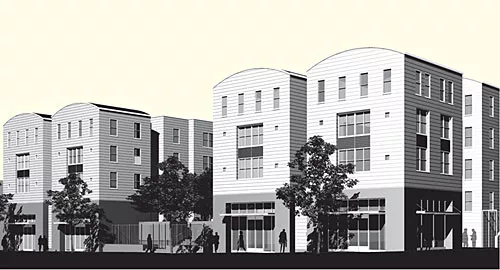
In one field of design, though, the region shows real innovation: affordable housing. The architecture is more likely to be adventurous, the layouts more imaginative. There’s a sense of public engagement as buildings provide not just shelter for residents, but engaging spaces for neighborhood shops or community services.
 
The factors at work include government planners who emphasize the role of such projects as potential catalysts, and nonprofit developers with the track records and confidence to take a chance on less conventional designs. With median home prices in San Francisco still near $700,000 despite the recent housing slump, there’s a political imperative to deliver as many affordable projects as possible.
 
But a key reason that quantity translates to quality stems from the region’s progressive cultural tradition. For many Bay Area architects, the design of such housing is an integral part of their craft.
 
“We’re an affordable-housing architect first,” says David Baker, founder of David Baker + Partners (DB+P). “Being a business-owning socialist, I enjoy the mission. It’s much more satisfying—people need you. They’re the world’s best clients.”
 
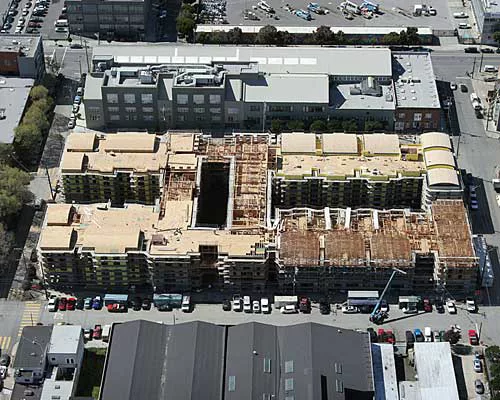
The San Francisco firm has made a mark with projects ranging from the subdued refinement of Hotel Healdsburg in Sonoma County’s wine country to the conversion of a printing factory into now-desirable lofts in San Francisco’s South of Market district. That same neighborhood contains two recent DB+P projects that are exclusively for low-income residents—each complex a bright accent amid a landscape that elsewhere is a drab procession of low-rise service buildings and crudely detailed “contemporary” lofts that meet the sidewalk with bare walls and iron-barred windows.
 
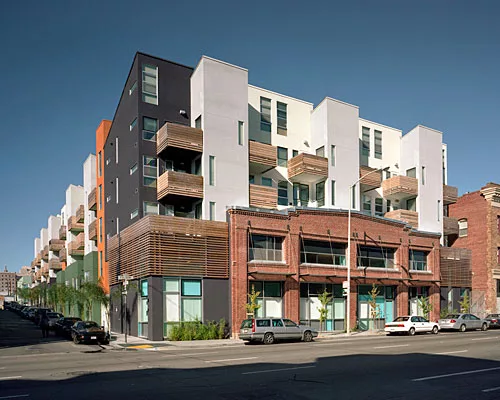
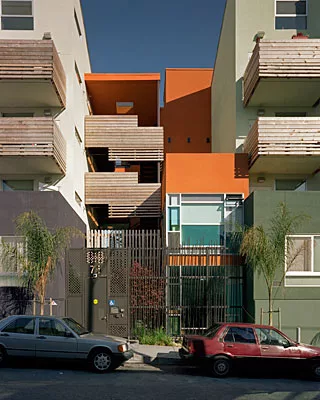
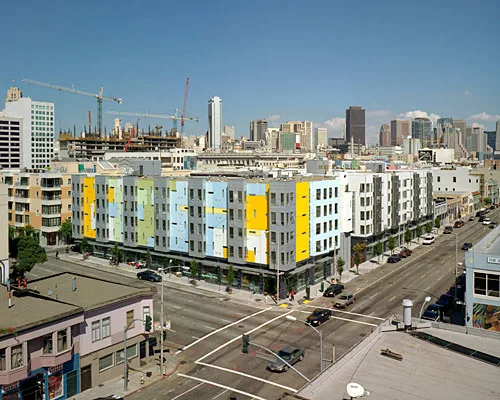
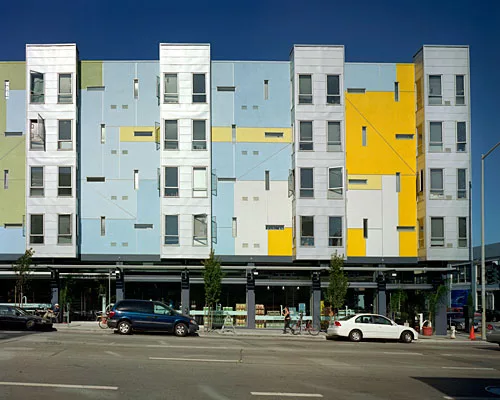
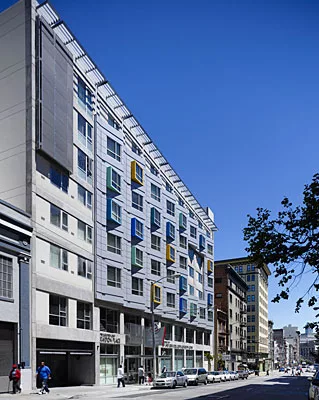
At Folsom and Dore Streets, Baker kept the brick facade of a former garage as an artifact and then inserted an emphatic procession of stacked stucco volumes behind it, warmed by balconies clad in horizontal slats of ipé wood and containing 98 apartments for tenants with disabilities or transitioning from homelessness. Nearby, at 8th and Howard Streets, the six-story complex known as SOMA Studios and Family Apartments has a color scheme that’s a pastel circuit board of lime green and yellow, orange, and sky blue; on an alley, there’s a wavy black stucco wall. And while the upper floors contain 166 housing units, the neighborhood at large benefits from the high-ceilinged corner storefront devoted to a locally owned grocery.
 
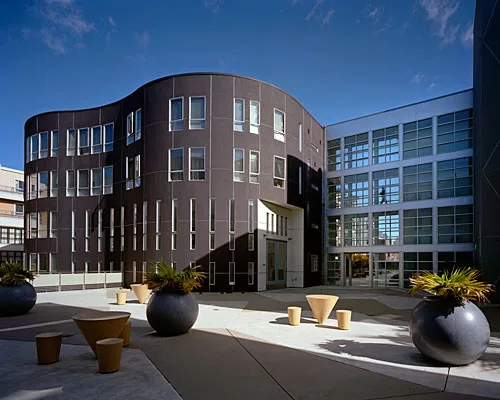
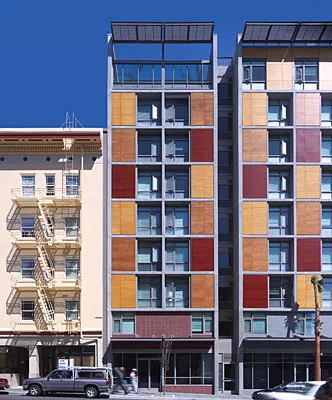
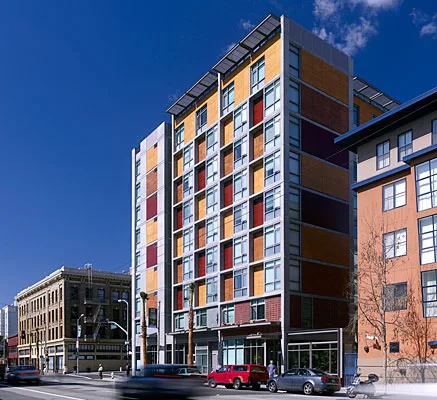
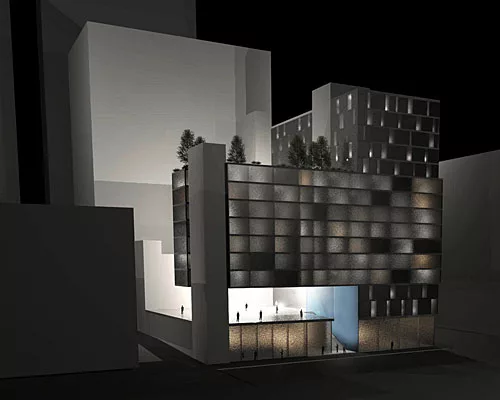
That same formula of strong design and street-level presence is on display two blocks down Howard at Sixth Street, where the San Francisco Redevelopment Agency hired Leddy Maytum Stacy Architects and Paulett Taggart Architects to design Plaza Apartments with 106 single-room occupancy units and in-house social services. A simple cube in shape—80 feet wide and 85 feet high—the Plaza makes a visual mark through the contrast of the gridlike concrete frame with resin-impregnated panels that enclose the units and suggest weathered wood. At sidewalk level, there’s an entrance to basement space for a community theater and two storefronts, one for a credit union that will offer the only access to legitimate banking on San Francisco’s version of Skid Row.
 
For nearly a decade, the redevelopment agency has emphasized affordable housing as its core goal, rather than economic renewal. It sees such housing as a means to a more rounded community.
 
“We try to create neighborhood infrastructure through our affordable housing,” says Olson Lee, a deputy executive director at the agency. This translates to the credit union on Sixth Street and the branch library that occupies the ground floor of a senior housing complex in the Mission Bay redevelopment district.
 
But infrastructure can also be buildings that use distinctive design to establish a sense of place. During the competition procession for a senior complex at the corner of Turk and Gough Streets in fashionable Hayes Valley, the agency stressed its desire for a landmark building. The winning team—developers A.F. Evans and Chinatown Community Development Center—included as its consulting architect Anne Fougeron, whose work has received local and national AIA awards. The result, Parkview Terraces [record, October 2008, page 200], designed with Kwan Henmi, opened last year with rippling bays and a glassy Modern look.
 
“The public subsidies involved give us a great say,” Lee says. “It’s a partnership with the developer, so we can push them further. All it takes is one ugly subsidized building and people point at it for the next 50 years.”


Share This Story

Looking for a reprint of this article?
From high-res PDFs to custom plaques, order your copy today!

John King is a contributing editor to RECORD and former urban-design critic at the San Francisco Chronicle. He is the author of Portal: San Francisco’s Ferry Building and the Reinvention of American Cities.

Post a comment to this article

Report Abusive Comment

Subscription Center
  • Create an Account
  • Start a Subscription
  • Manage My Account
  • Sign Up for Newsletters
  • Visit Customer Service
  • Update Preferences

More Videos

Sponsored Content

Sponsored Content is a special paid section where industry companies provide high quality, objective, non-commercial content around topics of interest to the Architectural Record audience. All Sponsored Content is supplied by the advertising company and any opinions expressed in this article are those of the author and not necessarily reflect the views of Architectural Record or its parent company, BNP Media. Interested in participating in our Sponsored Content section? Contact your local rep!

close
  • TAMLYN XtremeTrim Exterior Trim
    Sponsored byTamlyn

    Designing Cleaner Panel Facades: Why Exterior Trim Details Matter

  • Building with Vapor Barriers
    Sponsored byReef Industries, Inc.

    Vapor Barriers Help Control Moisture in Tighter Building Designs

  • Duct Interior with Prodeq System
    Sponsored byHenry, a Carlisle Company

    Designing Resilient Water Containment Systems

DESIGN:ED Podcast
Listen to Architectural Record’s DESIGN:ED Podcast

Events

June 10, 2026

Rethinking Stormwater – The Power of Porous Paving

Credits: 1 AIA LU/HSW; 1 AIBD P-CE; 0.1 ICC CEU

Learn how porous paving systems support stormwater management, reduce heat island effects, and enhance sustainable site design performance.

June 11, 2026

Very Early Warning Fire Detection for Mission-Critical Facilities

Credits: 1 AIA LU/HSW; 1 AIBD P-CE; 0.1 ICC CEU

Examine advanced fire detection strategies that support uptime and enhance safety in data centers and other mission-critical facilities.

View All Submit An Event

Products

2026 Architect's Square Foot Costbook

2026 Architect's Square Foot Costbook

See More Products

Popular Stories

Practice Matters illustration

What’s in a (Firm’s) Name? Thinking About Succession and Legacy

Coronado Bridge

The Architect’s Guide to San Diego

Practice Matters illustration

By the Numbers: Counting America's Architects

Riverdale House by Studio Lau

Riverdale House by Studio Lau

KRESA by DLR

In Kalamazoo, DLR Group Completes a Mass-Timber Hub for Career and Technical Education Programs

Broader Sustainability of CMU - Free Webinar - May 21, 2026

Related Articles

  • Bringing Good Design to Affordable Housing

    See More
  • Nbar-BIG-1.jpg

    DESIGN:ED Podcast: Bjarke Ingels On How His New Company Is Building Pathways to Affordable Housing

    See More
  • Microsoft

    Microsoft Commits $500 Million to Affordable Housing in Seattle Area

    See More

Related Products

See More Products
  • movable arch.jpg

    Movable Architecture: A Design Guide to Container Reuse

  • 9 ways.jpg

    9 Ways To Make Housing for People

See More Products
×

The latest news and information

#1 Source for Architectural Design, News and Products

SUBSCRIBE
  • RESOURCES
    • Advertise
    • Contact Us
    • Submit
    • Store
  • ACCOUNT CENTER
    • Create an Account
    • Start a Subscription
    • Manage My Account
    • Sign Up for Newsletters
    • Visit Customer Service
    • Update Preferences
  • PRIVACY
    • PRIVACY POLICY
    • TERMS & CONDITIONS
    • DO NOT SELL MY PERSONAL INFORMATION
    • PRIVACY REQUEST
    • ACCESSIBILITY
  • SERVICES
    • Marketing Services
    • Reprints
    • Market Research
    • List Rental
    • Survey/Respondent Access
  • STAY CONNECTED
    • Linkedin
    • Facebook
    • Instagram
    • YouTube
    • X (Twitter)

Copyright ©2026. All Rights Reserved BNP Media, Inc. and BNP Media II, LLC.

Design, CMS, Hosting & Web Development :: ePublishing