Architectural Record
search
cart
facebook twitter linkedin youtube
  • Sign In
  • Subscribe
  • Sign Out
  • My Account
Architectural Record
  • NEWS
    • Latest News
    • Awards
    • Interviews
    • Obituaries
    • Podcasts
      • Design:Ed Podcast
      • Sponsored Podcasts
  • OPINION
    • Book Reviews / Excerpts
    • Exhibition Reviews
    • Forum
  • EXCLUSIVES
    • Videos
    • Design Vanguard
    • Top 300 Firms
    • Sponsored Content
    • Sponsored eBooks
    • From the Archives
  • CONTINUING ED
    • Editorial Continuing Ed
    • CE Center
    • CE Academies
  • PROJECTS
    • Buildings By Type
    • Reuse & Renovation
    • Museums & Arts Centers
    • Colleges & Universities
    • Multifamily Housing
    • Interiors
    • Lighting
    • Kitchen & Bath
  • HOUSES
    • Record Houses
    • House of the Month
    • Featured Houses
  • PRODUCTS
    • Products by Category
    • Record Products of the Year
    • Latest Products
  • EVENTS
    • Dates & Events
    • Record on the Road
    • Innovation Conference
    • Sustainability in Practice
    • Women In Architecture
    • Webinars
    • Ad Excellence Awards
    • Submit an Event
  • CONNECT
    • Ask RECORD AI
    • Newsletters
    • Contact
    • Advertise
    • Editorial Calendar
    • Store
    • Customer Service
  • SUBMIT
    • Submission Guidelines
    • RECORD Competitions
  • MAGAZINE
    • Subscribe
    • My Account
    • Digital Edition
    • Current Issue
    • Firm Pass
    • Historic Archive
Projects

SHED

The Modern Grange: A San Francisco firm turns a workaday agricultural building into a gleaming display case for locavore living.
By William Hanley
SHED
SHED
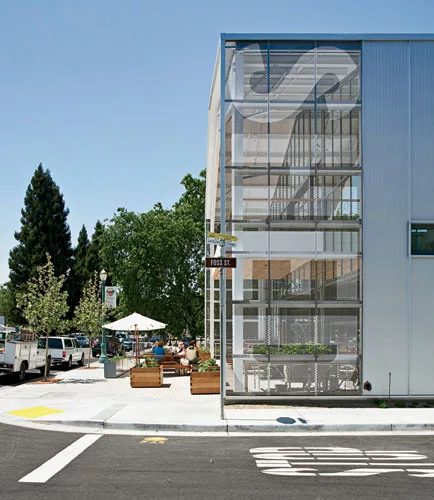
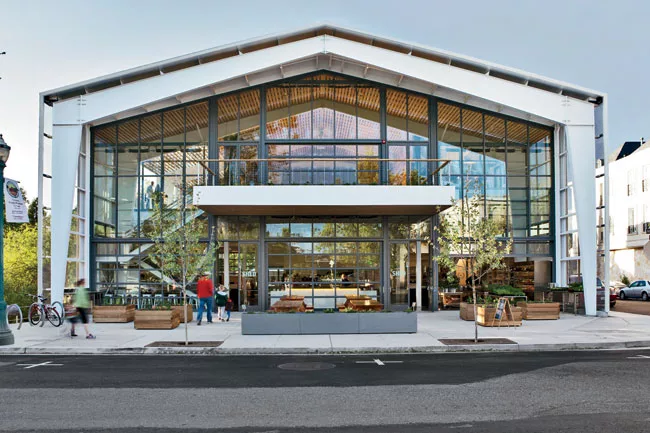
Under the clean geometry of SHED's gabled form, an outdoor seating area and clusters of planter boxes are shaded by a cantilevered deck.
 
Photo © Mariko Reed
SHED
SHED
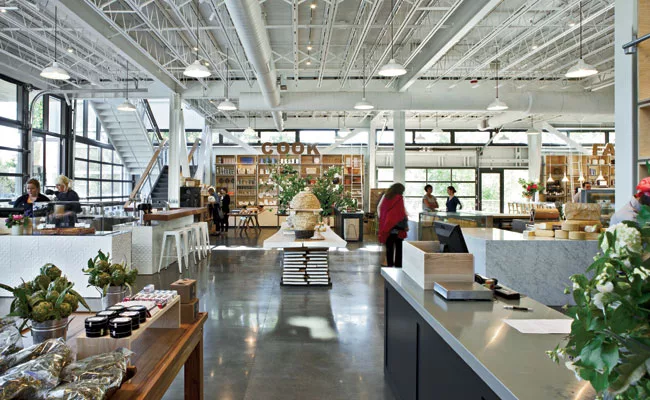
An open plan, white walls, and polished-concrete floors give SHED an art-gallery feel. The effect carries through to Jensen Architects' custom refrigerator cases'designed as orthogonal vitrines'integrated into the caf' counter.
 
Photo © Mariko Reed
SHED
SHED
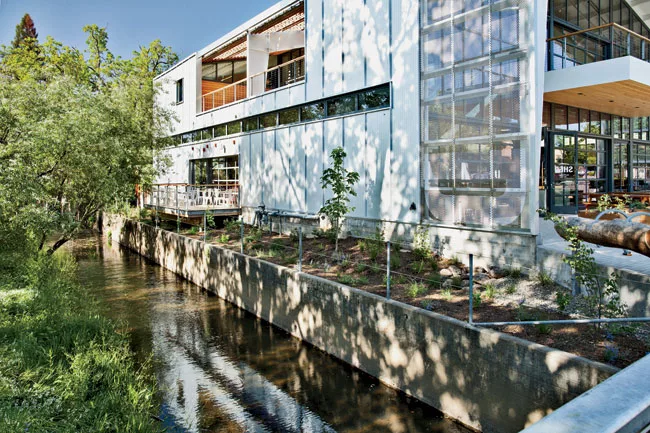
Jensen Architects planted a rain garden along the adjacent creek to manage runoff and added two terraces that overlook the water and vegetation.
 
Photo © Mariko Reed
SHED
SHED
Signage printed on perforated metal screens that extend the project's long sides past its front facade.
 
Photo © Mariko Reed
SHED
SHED
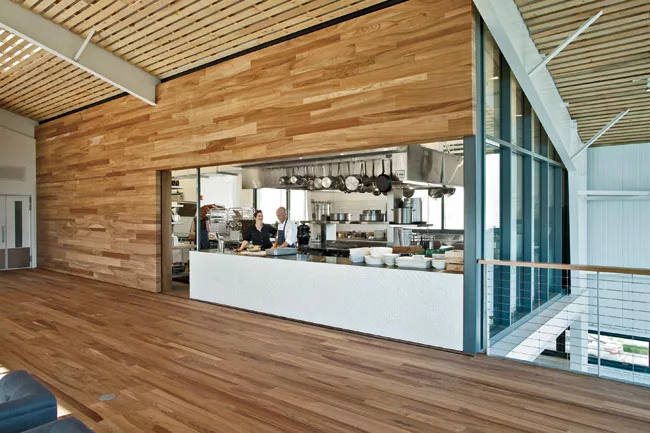
A sliding wall reveals and conceals a kitchen to meet the needs of different events and performances.
 
Photo © Mariko Reed
SHED
SHED
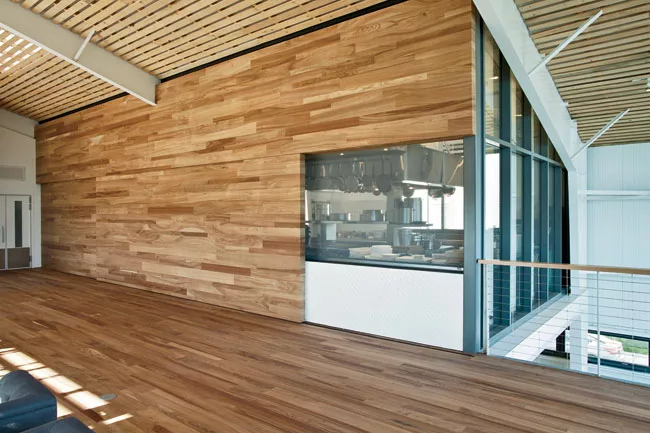
A sliding wall reveals and conceals a kitchen to meet the needs of different events and performances.
 
Photo © Mariko Reed
SHED
SHED
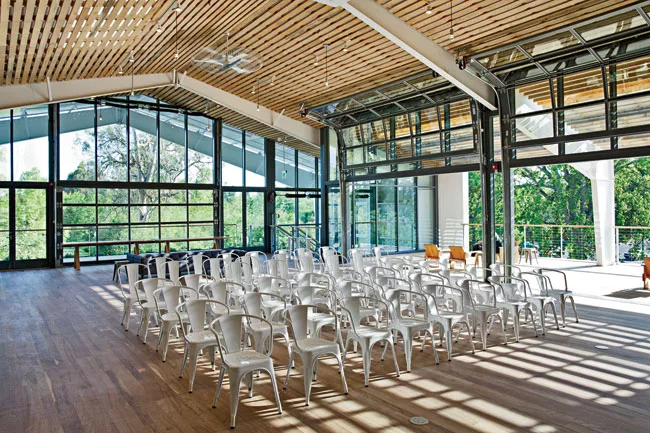
Jensen Architects gave SHED's upstairs space a countrified but refined finish with a wooden ceiling lattice made to resemble loading pallets.
 
Photo © Mariko Reed
SHED
SHED
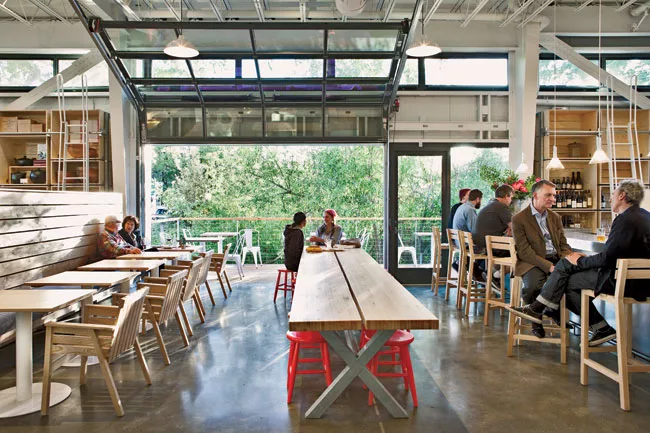
Downstairs, caf' seating and the 'fermentation bar' open to a terrace overlooking the creek and separate the housewares section of the store from farm and gardening tools.
 
Photo © Mariko Reed
SHED
SHED
 
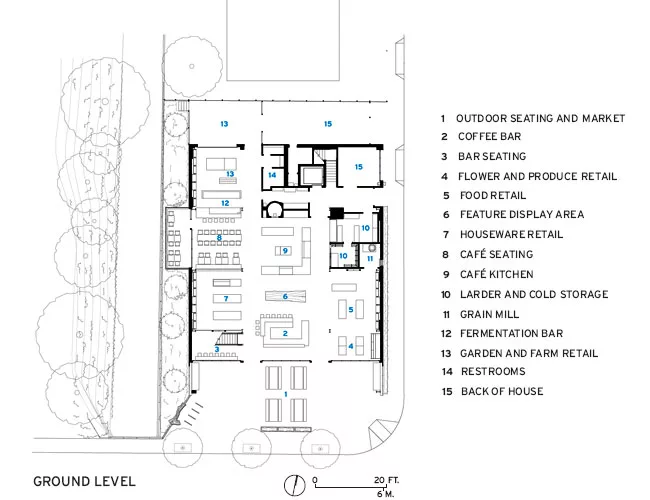
Image courtesy Jensen Architects
SHED
SHED
SHED
SHED
SHED
SHED
SHED
SHED
SHED
July 16, 2013

Architects & Firms

Jensen Architects

Healdsburg, California

People/Products

Northern California &mash; the region that gave birth to Chez Panisse and the French Laundry — is ground zero for the local-food movement, and SHED, an haute general store in the heart of wine country, lets you know it even before you walk through the door. Located in Healdsburg, a tiny city at the convergence of three vineyard-striped valleys in Sonoma County, SHED stands just a few blocks from the wine destination's immoderately quaint town square. Its neighbors include preppy boutiques catering to affluent oenophiles and structures styled as faux chateaus. But SHED is literally a shed'an agricultural building made from pre-engineered components'with a classic, gable-sided form that signals the market's roots on the farm.

San Francisco architect Mark Jensen and his firm turned the standardized building system into a barn-size display case that venerates food preparation from seed to serving dish. 'People don't want to see just the shrink-wrapped finished product,' said Jensen over a lunch at SHED that featured local lettuces, pizza made with grain milled on-site, and a mildly fruity ros'. 'They want to see how things get done.'

Behind its glass facade, the 10,000-square foot, two-story retail space offers a tightly curated selection of sustainably sourced goods and locavore lifestyle accoutrements. You can shop for fresh produce, artisanal dry goods, well-crafted cookware, and heritage-brand garden tools. You can also have a meal prepared with many of the same utensils and ingredients, sip a latte poured with a perfect leaf pattern, or drink a beer or a kombucha at the 'fermentation bar.' An upstairs space operates like a modern country grange, hosting everything from beekeeping workshops to jazz concerts. 'It's not just a food place, but more of a hub,' says SHED co-owner Cindy Daniel. 'As much as possible, we want to show the hand, the people, the process behind the food.'

Daniel and her partner, Doug Lipton, own a small farm a few miles outside of Healdsburg in the Dry Creek Valley. For years they had considered opening a store in town; they eventually found a site across from a parking lot that hosts a twice-weekly farmers' market. They met Jensen through a mutual friend, and after playing with the idea of reusing an existing appliance store on the site, the architect persuaded them to replace it with the agricultural shed. Not only did the pre-engineered building'commonly known as a Butler building, though the project uses a different brand'save on construction costs and waste, it also saved time. A creek runs along one side of the lot, and the project required drilling 40-foot helical piles into the soft soil before the building's concrete slab was poured. Once that was in place, the structure went up in a matter of weeks.

To turn the barn into a showcase, the firm used glazing for its entire front elevation, with transparent garage doors opening to the sidewalk and to a pair of terraces facing the recently restored creek. The building is otherwise clad in off-the-shelf insulated metal panels. Transom windows'which operate automatically to flush out hot air from the interior at night'run the length of the building, accentuating the ceiling height and bringing in a huge amount of daylight. Jensen's team kept the building's perfect, Monopoly-piece profile by tucking rain gutters into the roof and hiding HVAC equipment in a well toward the rear of the building. They punctuated the street-side facade with a second-floor deck that cantilevers 10 feet over an outdoor seating area. 'This is technically vernacular in terms of what agricultural buildings look like today,' says Jensen. 'We wanted to avoid a nostalgic wood-sided barn, the Disneyland approach.'

Inside, a coffee bar brings a social space to the entry, while different areas of the program pivot around a central kitchen and caf' counter anchored by a wood-fired oven. The structure's large spans and the well-scaled partitions allow the components to flow into one another with an openness that mimics the owners' approach to food. Items on the shelves end up on the menu at the caf', cross-pollinating according to seasonal themes. 'If we have cazuela bowls in the housewares section, we're also using them in the kitchen,' says Daniel. 'We want to really arouse people's curiosity'to encourage them to taste an ingredient or even learn how to grow it.'

On the loftlike second floor, the project's main kitchen is separated from the event space by a sliding, wood-covered wall. It can open to display the cooking process; a screen rolls down to protect food preparation when the doors leading to two terraces are open. Or it can close completely to insulate performances from kitchen noise. Even without an event taking place, the project is a social space for Healdsburg's culinary-minded locals as well as weekenders and wine tourists. 'It's kind of like the new post office,' says Jensen. 'It's the place where people come to meet and greet and hang out.'

The design strikes a note between rustic and rarefied, but it rings more toward the latter. A palette of light wood and bright-white walls elevates the workaday building into a gallery that fetishizes the growing, making, and serving of food. And on Healdsburg's streetscape, it projects through its glass facade the ideas about culinary culture that made the region famous.


People

Owner: Cindy Daniel and Doug Lipton

Location: 25 North Street, Healdsburg, Ca. 95448

Architect:
Jensen Architects
833 Market St., 7th Floor
San Francisco, Ca. 94103
phone 415-348-9650
fax 415-348-9651

Personnel in architect's firm who should receive special credit:
Principal: Mark Jensen, AIA (licensed)
Project Lead: Lincoln Lighthill, LC, LEED AP (not licensed)
Project Team: Dean Orr, AIA, Associate (licensed)
Scott Davis (not licensed)

Engineer(s):
ZFA Structural Engineers (Slab, curtain wall)
Soule Building Systems/ CBC Steel Buildings (Pre-engineered metal building)
Guttman & Blaevoet Consulting Engineers (MEP)
PJC Associates (Geotechnical)
Atterbury & Associates (Civil)

Consultant(s):
Food Service Consultant: Muller Design Associates

Surveyor: Curtis & Associates

Landscape: Russian Riverkeeper (Rain garden)

A/V and Controls: Lavish Automation

Acoustical: Terry Hill

General contractor:
Oliver & Company

Photographer(s):
Mariko Reed Architectural Photography
808-226-7676

CAD system, project management, or other software used: Vectorworks, Sketch-up, V-Ray.

Size:

10,800 square feet

Cost:

withheld

Completion date:

April 2013


Products

Structural system
Pre-engineered metal building (PEMB)

Manufacturer of structural components unique to this project: Soule Building Systems/ CBC Steel Buildings

Exterior cladding
Metal Panels: Kingspan (insulated metal panels)

Metal/glass curtain wall: Arcadia (storefront doors, windows, curtain wall)

Wood: Evan Shively, Arborica, urban salvage reclaimed wood: Monterey Cypress decking, wall and eave cladding, trellis, guardrail caps.

Curtain wall: Arcadia

Roofing
Elastomeric: Grace (under exterior wood decks)

Metal: Kingspan (see ‘metal panels’ above)

Windows
Metal frame: Arcadia

Glazing
Glass: PPG, Solarban 60 coated

Skylights: Sunoptics

Doors
Entrances: Arcadia

Wood doors: Oregon Door (Agrifiber core interior doors)

Sliding doors: Custom, by G.C.

Fire-control doors, security grilles (roll-down insect screens): High Tech Screens and Shades

Upswinging doors, other: Clopay (overhead garage doors)

Hardware
Locksets: Schlage

Closers: LCN

Exit devices: Von Duprin (panic hardware)

Pulls: Rockwood

Other special hardware: Hafele (sliding wood wall in Event Space)

Interior finishes
Cabinetwork and custom woodwork: Fremont Millwork

Paints and stains: Benjamin Moore, Vermont Natural Coatings, Rubio Monocoat

Special surfacing: Retroplate concrete polishing system (exposed concrete floors)

Floor and wall tile: Sonoma Tilemakers (Coffee bar and Event Space bar faces, Larder and Fermentation Bar backsplashes, restroom and kitchen wall tile). Daltile (Kitchen floor)

Special interior finishes unique to this project: Evan Shively, Arborica, urban salvage reclaimed wood: Event space elm wood flooring, elm wall cladding, Monterey Pine slat wood ceiling, Farm area Monterey Cypress wall cladding, Coffee Bar elm wood tops and Larder Bay Laurel butcher block countertops

Furnishings
Chairs: Tolix, Scott Constable

Tables: Scott Constable, Foster Fine Woodworking

Lighting
Interior ambient lighting: Resolute, Metalux, Hi Lite Manufacturing

Downlights: Portfolio

Task lighting: Halo, Sylvania

Exterior: RSA, Hi Lite Manufacturing

Dimming System or other lighting controls: Crestron

Conveyance
Elevator: Kone Ecospace

Plumbing
Kohler, Toto, Zurn

Energy
Energy management or building automation system: Crestron

Photovoltaic system: Real Goods Solar

Other unique products that contribute to sustainability:
Permeable concrete paving system: Stepstone
Gravel ring system: Gravelpave

Acoustic insulation: Bonded Logic (Recycled denim batts in event space ceiling and interior wall cavities)

Add any additional building components or special equipment that made a significant contribution to this project:
Perforated aluminum panels: Diamond Perforated Metals

Hand painted signage: New Bohemia Signs
 
KEYWORDS: California

Share This Story

Looking for a reprint of this article?
From high-res PDFs to custom plaques, order your copy today!

Post a comment to this article

Report Abusive Comment

Subscription Center
  • Create an Account
  • Start a Subscription
  • Manage My Account
  • Sign Up for Newsletters
  • Visit Customer Service
  • Update Preferences

More Videos

Sponsored Content

Sponsored Content is a special paid section where industry companies provide high quality, objective, non-commercial content around topics of interest to the Architectural Record audience. All Sponsored Content is supplied by the advertising company and any opinions expressed in this article are those of the author and not necessarily reflect the views of Architectural Record or its parent company, BNP Media. Interested in participating in our Sponsored Content section? Contact your local rep!

close
  • TAMLYN XtremeTrim Exterior Trim
    Sponsored byTamlyn

    Designing Cleaner Panel Facades: Why Exterior Trim Details Matter

  • Building with Vapor Barriers
    Sponsored byReef Industries, Inc.

    Vapor Barriers Help Control Moisture in Tighter Building Designs

  • Duct Interior with Prodeq System
    Sponsored byHenry, a Carlisle Company

    Designing Resilient Water Containment Systems

DESIGN:ED Podcast
Listen to Architectural Record’s DESIGN:ED Podcast

Events

June 10, 2026

Rethinking Stormwater – The Power of Porous Paving

Credits: 1 AIA LU/HSW; 1 AIBD P-CE; 0.1 ICC CEU

Learn how porous paving systems support stormwater management, reduce heat island effects, and enhance sustainable site design performance.

June 11, 2026

Very Early Warning Fire Detection for Mission-Critical Facilities

Credits: 1 AIA LU/HSW; 1 AIBD P-CE; 0.1 ICC CEU

Examine advanced fire detection strategies that support uptime and enhance safety in data centers and other mission-critical facilities.

View All Submit An Event

Products

2026 Architect's Square Foot Costbook

2026 Architect's Square Foot Costbook

See More Products

Popular Stories

Practice Matters illustration

What’s in a (Firm’s) Name? Thinking About Succession and Legacy

Coronado Bridge

The Architect’s Guide to San Diego

Practice Matters illustration

By the Numbers: Counting America's Architects

Riverdale House by Studio Lau

Riverdale House by Studio Lau

House on a Hill

Design Vanguard 2026: Forma

Broader Sustainability of CMU - Free Webinar - May 21, 2026

Related Articles

  • Manhattan Districts 1/2/5 Garage

    Spring Street Salt Shed by Dattner Architects and WXY

    See More
  • Shed Preview

    Coming Soon: The Shed, New York's Newest Art and Performance Space

    See More
  • A Salt Shed for Spring Street

    See More

Related Products

See More Products
  • manual

    2026 National Building Cost Manual

  • bni book

    BNi Building News Remodeling Costbook 2026 (Print Edition)

  • screen_shot_.png

    Casting Architecture: Ventilation Blocks

See More Products
×

The latest news and information

#1 Source for Architectural Design, News and Products

SUBSCRIBE
  • RESOURCES
    • Advertise
    • Contact Us
    • Submit
    • Store
  • ACCOUNT CENTER
    • Create an Account
    • Start a Subscription
    • Manage My Account
    • Sign Up for Newsletters
    • Visit Customer Service
    • Update Preferences
  • PRIVACY
    • PRIVACY POLICY
    • TERMS & CONDITIONS
    • DO NOT SELL MY PERSONAL INFORMATION
    • PRIVACY REQUEST
    • ACCESSIBILITY
  • SERVICES
    • Marketing Services
    • Reprints
    • Market Research
    • List Rental
    • Survey/Respondent Access
  • STAY CONNECTED
    • Linkedin
    • Facebook
    • Instagram
    • YouTube
    • X (Twitter)

Copyright ©2026. All Rights Reserved BNP Media, Inc. and BNP Media II, LLC.

Design, CMS, Hosting & Web Development :: ePublishing