From Around the World, Help Arrives for Ukrainian Designers and Students
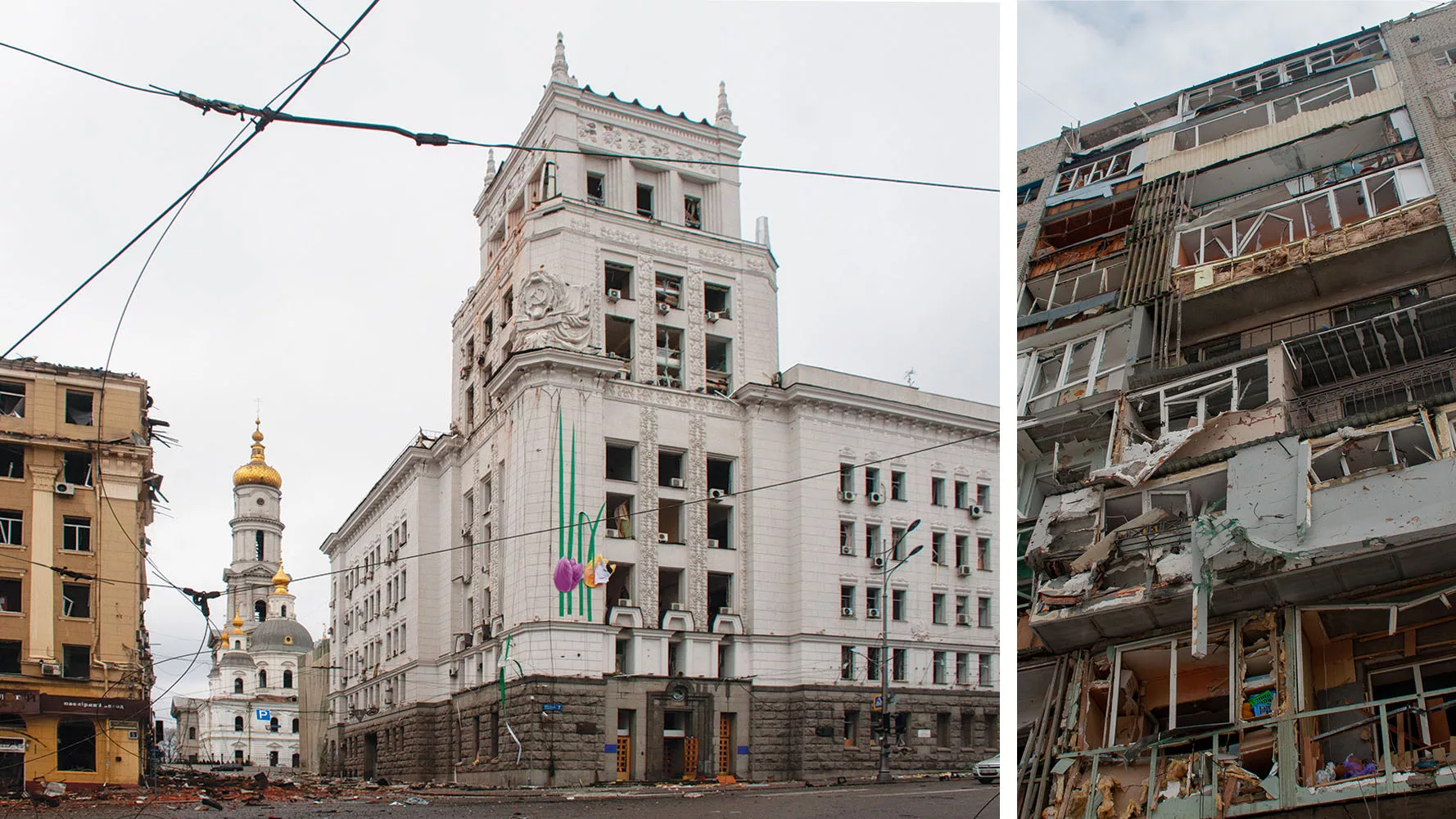
Russian attacks on Kharkiv, seen here in early March, have forced much of the population to flee. Photos © Fotoreserg
Until early March, Mariia Rusanova, an architect and Ph.D. student at Ukraine’s Kharkiv National University of Civil Engineering and Architecture, lived comfortably in a city just a few miles from Russia. The window in her apartment looked out toward the border, and, one morning after the Russian invasion began on February 24, she awoke to the sound of bombs exploding. For a week afterward, she practically lived in her basement, before finally realizing the war would not end soon and deciding to flee into Poland with her brother and his family.
Kharkiv has been under relentless attack since the beginning of the invasion, and, beyond the tragic loss of life, the city’s heritage and cultural sites have been devastated. Parts of Rusanova’s university have been bombed, as has the Kharkiv School of Architecture (KhSA), which has now temporarily relocated to Ukraine’s National Academy of Arts in Lviv, 540 miles west.
Both KhSA and Kharkiv National University are among the Ukrainian architecture schools calling for urgent support from their counterparts throughout Europe—from space for refugee students to the creation of workshops on urban reconstruction. In response, a constellation of aid efforts has emerged across the continent in an international show of solidarity with Ukraine.
Many of these efforts are impromptu, rapidly coordinated schemes by a variety of actors, including nonprofits, academic institutions, and grassroots groups. Online resources are among the lowest-hanging fruit; the European Association for Architectural Education has collated a list of initiatives, including the American site Hire Ukrainian Designers and a European equivalent. Larger institutions are offering similar support, including the Royal Institute of British Architects (RIBA), which is using its job page to match refugees with positions across the U.K.
A London friend recently told Rusanova about a job posted on the RIBA site. She was hired and will soon move to England, but not all Ukrainians are as fortunate. Speaking to record, Rusanova outlined the difficulties Ukrainians face in finding employment, including the disappearance of essential paperwork. “I needed to send some documents showing that I work at my university, but the university has been bombed,” she says.
Katja Ignatieva is a second-year student at Ukraine’s Odessa State Academy of Civil Engineering and Architecture, and, like Rusanova, she at first remained in her hometown after the invasion began, before leaving the country. Her journey through Moldova and subsequent resettlement in Germany were supported at every step by well-organized volunteer and government systems, she says, including free buses and twice-weekly food packages and financial support provided by the German government. She now takes remote classes, but studying online is difficult. “To find materials is expensive,” she says. “You don’t have a lot of money when you run from your country.”
Bob Sheil, the director of London’s Bartlett School of Architecture, is aware that not all countries are as proactive as Germany, and that national bureaucracy can slow institutional plans. “U.K. government strategies are inadequate, lacking breadth and failing to grasp the urgency,” he told record. The impact of the war, he adds, “will intensify for a considerable period ahead—thus long-term as well as short-term planning is essential.”
Looking for quick answers on architecture and design topics?
Try Ask RECORD, our new smart AI search tool.
Ask RECORD →
The Bartlett is involved in several initiatives, including projects organized by its parent institution, University College London (UCL). Ongoing fundraising efforts will support a new Academic Sanctuary Fellowship that will see UCL—home to the School of Slavonic and East European Studies—work with the Council for At-Risk Academics to support scholars facing threats as a result of the war.
UCL and Yale University are also partnering in support of an international conference organized by the Ukraine Reconstruction Network, a new consortium of Ukrainian academic, cultural, and architectural organizations. The conference, “The Reconstruction of Ukraine: Sovereignty, Heritage, Solidarity,” is planned for July and will seek ideas for a sustainable, Ukraine-led rebuilding process, with parallel events planned in Lviv, London, and New York.
In the Baltic, where anxieties around the war run high, additional efforts are under way. The Nordic Baltic Academy of Architecture (NBAA), a network of 19 institutions, is working to provide space for Ukrainian schools to temporarily relocate to the Baltic states. Vilnius Tech, a member of the network, is already hosting seven full-time Ukrainian students in its architecture school, each receiving a monthly stipend.
“Vilnius Tech teachers who worked on projects in Ukraine before the war are now working in contact with Ukrainians who fled the country,” says Eglė Bazaraitė, a lecturer at Vilnius Tech in architectural history and vice dean for international relations and infrastructure.
Back in Ukraine, the Kharkiv School of Architecture is fundraising to support teaching the generation of architects who will rebuild Ukraine. Architecture will be “one of the most relevant professions of the next decade,” founder Oleg Drozdov told record, and KhSA plans to grow its faculty and rebuild and improve facilities—both short-term in Lviv and eventually in Kharkiv. The war and economic crisis have crippled fundraising for now, however, and the school’s tuition fees will be reduced, due to families’ losing employment.
KhSA is also “negotiating some activities with MIT,” Drozdov says, and pursuing long-term international partnerships. American firms could support individual students through their education, he notes. And the school is working on plans to invest in large-scale 3D-printing technology to help fulfill Ukraine’s postwar housing needs.
In Kharkiv, postwar reconstruction plans are already under way—with the much publicized involvement of Norman Foster, with whom Kharkiv mayor Ihor Terekhov has been working on a plan for the city that could form the basis of similar efforts across Ukraine.
Rusanova is nervous about the rebuilding process. “From one side, we have Russian troops that have destroyed everything, and from the other side, we have a lot of good architects who haven’t worked with our heritage, who will build something new,” she says. In her view, the best approach is for non-Ukrainian academics and architectural historians to advise but not dominate.
Drozdov agrees. Citing the threat of what he calls “intellectual colonization,” he argues for the involvement of the city’s architectural schools in the process. The rebuilding, he says, is “a chance to rethink the city in terms of a new social formation.”
Looking for a reprint of this article?
From high-res PDFs to custom plaques, order your copy today!