From the RECORD Archives: ‘Some Reflections on the John Hancock Tower’

© Architectural Record, June 1977, photos by John Cserna
As Boston readies itself for the AIA Conference on Architecture and Design, revisit the John Hancock Tower, one of the city’s cutting-edge icons—ironically so, considering the many problems that arose mid-construction with its glazed curtain wall. Individual lites failed, some falling great heights and shattering. Designed by Henry Cobb of I.M. Pei & Partners (today Pei Cobb Freed & Partners), this 60-story steel-framed tower at Copley Square was plagued by zoning constraints, public backlash, and defects since its inception in 1967, but ultimately managed to rise above it all to become a poised presence on Beantown’s skyline. A meticulous reflection on the high-rise, written by Architectural Forum editor in chief William Marlin, was published in the June 1977 issue of RECORD, just three years after that magazine folded and one year after the tower’s completion. In the article, Marlin mulls over the deeper implications, clouded by the controversy, that lie beneath the making of this elegant edifice.
Editor’s note: This article has been condensed for ease of online reading but reflects the original text.

© Architectural Record, June 1977, photo by John Cserna. Click to enlarge
“Some reflections on the John Hancock Tower”
By William Marlin
Architectural Record, June 1977
It may turn out that what we know about this notoriously vulnerable Boston building is not half as important as what we do not know. But it is hard to figure out which is which. If a design, and a brilliant one at that, was ever bedeviled, this was it. What combative spirits possessed the John Hancock Tower? What was it like for a conscientious architectural team, headed by Harry N. Cobb of I. M. Pei & Partners, to be cast in the role of exorcist? And how is it that the tower can stand there now, cozying up to historic Copley Square, as if nothing had happened––one of the best-looking, best-behaved buildings ever to set foot in a city? A lot of life, fortune, and sacred honor is tied up in the truth, whatever that turns out to be.
The John Hancock Tower, on the southeastern edge of historic Copley Square, though maligned as an incursion, has turned out to be a strong, energetic, civil presence––giving the Square, if anything, more closure, definition, and even delight. Looking from the west, along Boylston Street, existing edges and elements have been enlivened, not enervated by the 60-story building’s adroit rhomboidal shape. From the eastern entrance plaza, beyond Copley Square on Clarendon Street, H.H. Richardson’s Trinity Church is seen in the round for the first time. The block-long three-story lobby is cadenced by stainless-steel-clad columns, creating a temple for a suspended replica of the Declaration of Independence.
The John Hancock Tower is plenty of building, probably the best of its breed, and maybe even the last.
More than that though, the Hancock is a tersely composed primer about predicaments that are unique to our time, and the resolution of these has given the building an almost mythic presence in the annals of architecture, gradually making it, too, an important case, and perhaps even a cardinal precedent, in the annals of law.
Looking for quick answers on architecture and design topics?
Try Ask RECORD, our new smart AI search tool.
Ask RECORD →
Just how important remains to be seen. Because the John Hancock Mutual Life Insurance Company, in September 1975, sued everybody concerned with the design and construction of its 60-story glass-sheathed $158-million headquarters tower. And no one concerned, for understandable reasons, will talk about the facts behind the myth except to say––as the building client has publicly, even pridefully––that more is known about this building than anyone has ever known about any building.
This is, of course, the building––brought to completion in a tumult of publicity, controversy, and speculation, finally occupied last fall, three years late––whose glass suffered breakage. Again, the Hancock company says it knows the exact reason for it, but again, it won’t tell what the reason is. But the expressions that everyone has been wearing from the time breakage began, in late 1972, and glass showered down with a vengeance in early 1973, now conceal a comprehension of the over-all trauma of this structure, which is making the whole truth the best-kept secret since Stonehenge.
Quite simply, the glass story, as harrowing as it is in itself, is not the story of the John Hancock Tower.

© Architectural Record, June 1977, photos by John Cserna
One thing that becomes clear in studying the history of this project is that the much-maligned height and bulk of the Pei design was never as intimidating to the character and scale of its site––on the southeastern edge of Copley Square––as were the lobbying forces and truculent, protectionist sentiments marshalled against the very idea of the building from the start. It was the idea of the building, then the specific design, that were loud-mouthed and reviled. Cobb’s design, in contrast, was in the spirit of many an Old Boston character––perhaps eccentric in appearance, but disciplined to a fault in public demeanor.
The Hancock company, back in 1966, settled upon the Pei firm to translate its management, personnel, and technical projections into a design for the present site, right across from H.H. Richardson’s robust Trinity Church. It seems that the company had been outgrowing its space every 20 years, on an almost systematic basis. The first building the company had put up, after moving into the Back Bay in the 1920s was the Clarendon Building, named after the street it’s on. Then, expanding again in the 1940s, it put up the Berkeley Building, with the familiar pyramidal roof peak, back-to-back with the Clarendon––these two sites lying just east of the site of the new tower. It was logical, were the company to remain in Boston, to try and create a unified development, incorporating its existing resources. The program initially given to Pei by the client’s building committee led to a circular, poured-in-place concrete design with below-grade parking for 800 cars. But this scheme, which would have been even taller than the present building, was too expensive, even for a corporate totem, and there were instincts afoot in the company to try to convey as much clout as possible, but in a cost-conscious fashion.
In the spring of 1967, to consult on real estate planning and building costs, the company retained Max Philippson, of New York, to conduct a thorough review of operations as they related to space needs and to translate the facts into a statement of requirements. Evaluating construction methods and materials, considering assorted modules of optimum economy and efficiency, Philippson was also to prepare and award the architectural contract and to review and approve the architect’s consultants, this in addition to coordinating their over-all performance, preparing and awarding construction contracts, reviewing subcontractors and suppliers of the general contractor, and establishing cost and time schedules.
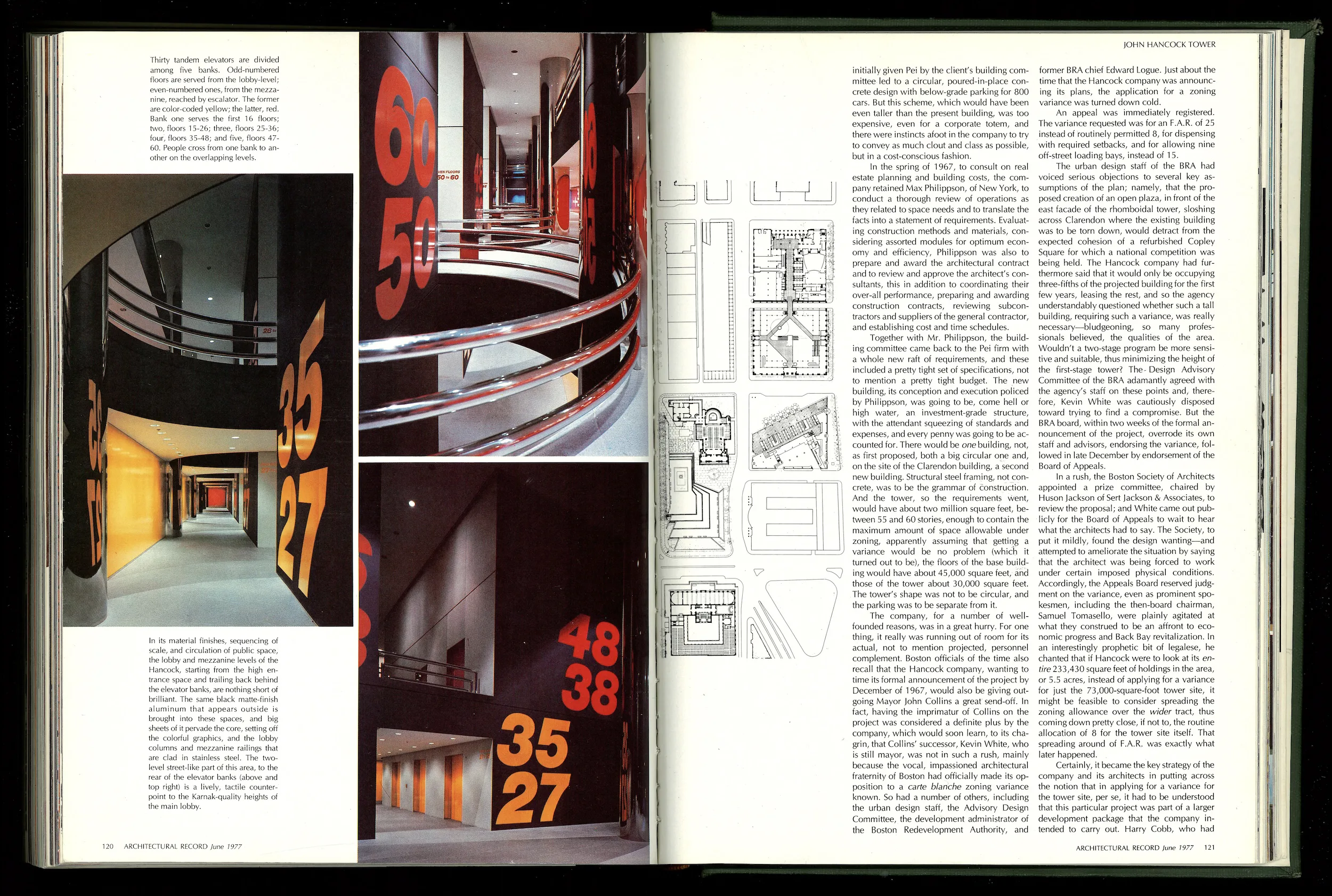
Together with Mr. Philippson, the building committee came back to the Pei firm with a whole new raft of requirements, and these included a pretty tight set of specifications, not to mention a pretty tight budget. The new building, its conception and execution policed by Philippson, was going to be, come hell or high water, an investment-grade structure, with the attendant squeezing of standards and expenses, and every penny was going to be accounted for. There would be one building, not, as first proposed, both a circular one and, on the site of the Clarendon Building, a second new building. Structural steel framing, not concrete, was to be the grammar of construction. And the tower, so the requirements went, would have about two million square feet, between 55 and 60 stories, enough to contain the maximum amount of space allowable under zoning, apparently assuming that getting a variance would be no problem (which it turned out to be), the floors of the base building would have about 45,000 square feet, and those of the tower about 30,000 square feet. The tower’s shape was not to be circular, and the parking was to be separate from it.
© Architectural Record, June 1977, photos by John Cserna
The company, for a number of well-founded reasons, was in a great hurry. For one thing, it really was running out of room for its actual, not to mention projected, personnel complement. Boston officials of the time also recall that the Hancock company, wanting to time its formal announcement of the project by December of 1967, would also be giving out-going Mayor John Collins a great send-off. In fact, having the imprimatur of Collins on the project was considered a definite plus by the company, which would soon learn, to its chagrin, that Collins’ successor, Kevin White, who is still mayor, was not in such a rush, mainly because the vocal, impassioned architectural fraternity of Boston had officially made its opposition to a carte blanche zoning variance known. So had a number of others, including the urban design staff, the Advisory Design Committee, the development administrator of the Boston Redevelopment Authority, and former BRA chief Edward Logue. Just about the time that the Hancock company was announcing its plans, the application for a zoning variance was turned down cold.
An appeal was immediately registered. The variance requested was for an F.A.R. of 25 instead of routinely permitted 8, for dispensing with required setbacks, and for allowing nine off-street loading bays, instead of 15.
The urban design staff of the BRA had voiced serious objections to several key assumptions of the plan; namely, that the proposed creation of an open plaza, in front of the east facade of the rhomboidal tower, sloshing across Clarendon where the existing building was to be torn down, would detract from the expected cohesion of a refurbished Copley Square for which a national competition was being held. The Hancock company had furthermore said that it would only be occupying three-fifths of the projected building for the first few years, leasing the rest, and so the agency understandably questioned whether such a tall building, requiring such a variance, was really necessary––bludgeoning, so many professionals believed, the qualities of the area. Wouldn’t a two-stage program be more sensitive and suitable, thus minimizing the height of the first-stage tower? The Design Advisory Committee of the BRA adamantly agreed with the agency’s staff on these points and, therefore, Kevin White was cautiously disposed toward trying to find a compromise. But the BRA board, within two weeks of the announcement of the project, overrode its own staff and advisors, endorsing the variance, followed in late December by endorsement of the Board of Appeals.
In a rush, the Boston society of Architects appointed a prize committee, chaired by Huson Jackson of Sert Jackson & Associates, to review the proposal; and White came out publicly for the Board of Appeals to wait to hear what the architects had to say. The Society, to put it mildly, found the design wanting––and attempted to ameliorate the situation by saying that the architect was being forced to work under certain imposed physical conditions. Accordingly, the Appeals Board reserved judgment on the variance, even as prominent spokesmen, including the then-board chairman, Samuel Tomasello, were plainly agitated at what they construed to be an affront to economic progress and Back Bay revitalization. In an interestingly prophetic bit of legalese, he chanted that if Hancock were to look at its entire 233,430 square feet of holdings in this area, or 5.5 acres, instead of applying variance for just the 73,000-square foot tower site, it might be feasible to consider spreading the zoning allowance over the wider tract, thus coming down pretty close, if not to, the routine allocation of 8 for the tower site itself. That spreading around of F.A.R. was exactly what later happened.
© Architectural Record, June 1977
Certainly, it became the key strategy of the company and its architects in putting across the notion that in applying for a variance for the tower site, per se, it had to be understood that this particular project was part of a larger development package that the company intended to carry out. Harry Cobb, who had otherwise cogent urban design and historic rationale for his design, what nevertheless moved to stress that, taken all together, the 5.5-acre assembly of parcels would result in an F.A.R. computation for the tower of 80,000 square feet less than the routine zoning allowance.
In late January of 1968, with these fraternal brickbats flying, the national AIA’s Committee on Aesthetics, chaired by Jean Paul Carlhian of Boston, decided to have a go at the issue, and, later that spring, it released what has to be one of the most intelligible evaluations ever directed toward design.
The agreement reached between the city––with White now in the saddle and his BRA Administrator, C. Hale Champion, and Hancock involved––included amending the zoning code to take in so-called “large tract zoning areas” out of which could be carved such special sub-development districts as the Hancock holdings. The company, with the Zoning Commission hearings set for early April, was in a jubilant enough mood to revise its schedule for proceeding with the project, based on expected Commission approval of the amendment.
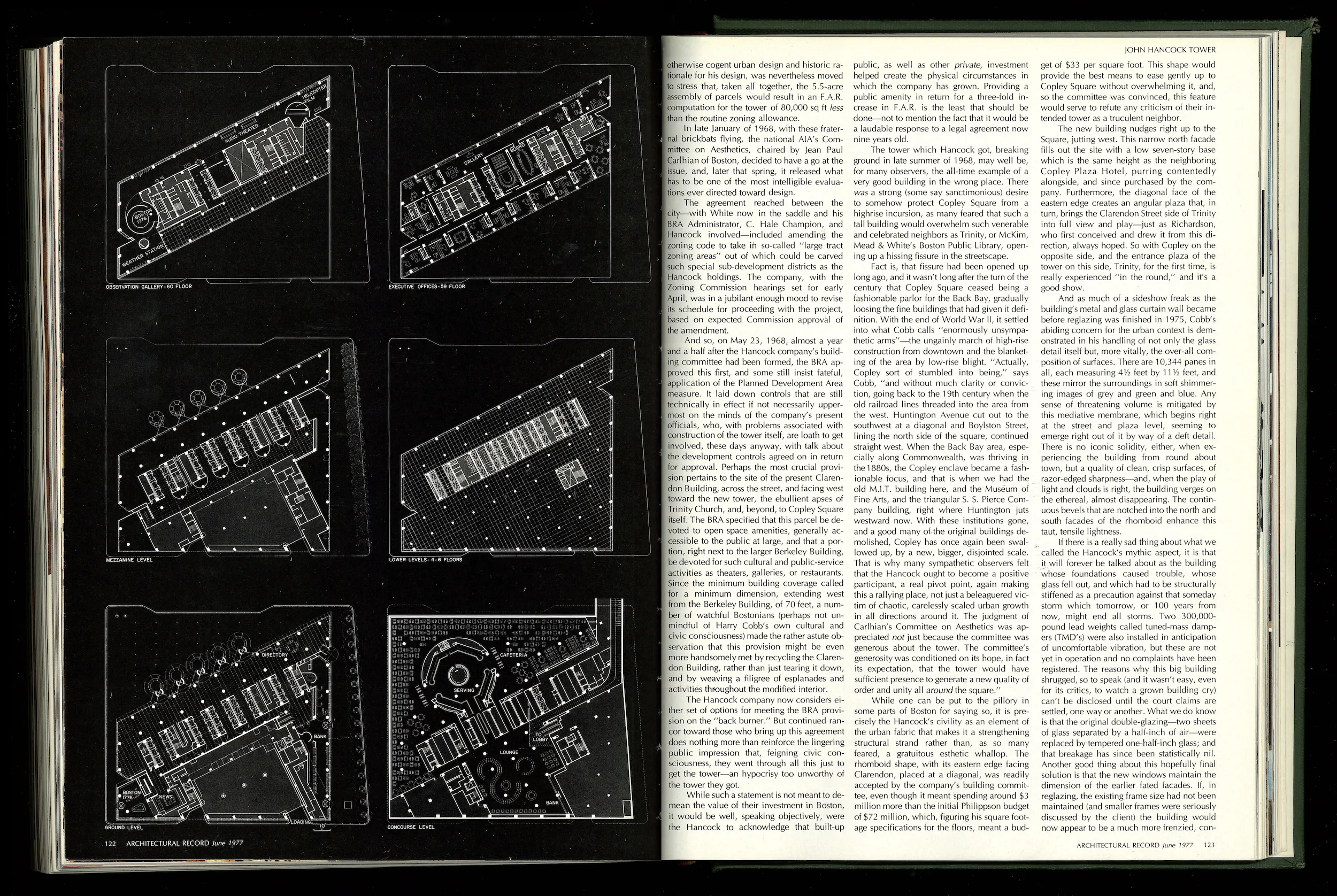
And so, on May 23, 1968, almost a year and a half after the Hancock company’s building committee had been formed, the BRA approved this first, and some still insist fateful, application of the Planned Development Area measure. It laid down controls that are still technically in effect if not necessarily uppermost on the minds of the company’s present officials, who, with problems associated with construction of the tower itself, are loath to get involved, these days anyway, with talk about the development controls agreed on in return for approval. Perhaps the most crucial provision pertains to the site of the present Clarendon Building, across the street, and facing west toward the new tower, the ebullient apses of Trinity Church, and, beyond, to Copley Square itself. The BRA specified this parcel be devoted to open space amenities, generally accessible to the public at large, and that a portion, right next to the larger Berkeley Building, be devoted for such cultural and public-service activities as theaters, galleries, or restaurants. Since the minimum building coverage called for a minimum dimension, extending west from the Berkeley building, of 70 feet, a number of watchful Bostonians (perhaps not unmindful of Harry Cobb’s own cultural and civic consciousness) made the rather astute observation that this provision might be even more handsomely met by recycling the Clarendon Building, rather than tearing it down, and by weaving a filigree of esplanades and activities throughout the modified interior.
The Hancock company now considers either set of options for meeting the BRA provision on the “back burner.” But continued rancor toward those who bring up this agreement does nothing more than reinforce the lingering public impression that, feigning civic consciousness, they went through all this just to get the tower––a hypocrisy too unworthy of the tower they got.
While such a statement is not meant to demean the value of their investment in Boston, it would be well, speaking objectively, were the Hancock to acknowledge that built-up public, as well as other private, investment helped create the physical circumstances in which the company has grown. Providing a public amenity in return for a three-fold increase in F.A.R. is the least that should be done––not to mention the fact that it would be a laudable response to a legal agreement now nine years old.
The tower which Hancock got, breaking ground in late summer of 1968, may well be, for many observers, the all-time example of a very good building in the wrong place. There was a strong (some say sanctimonious) desire to somehow protect Copley Square from a high-rise incursion, as many feared that such a tall building would overwhelm such venerable and celebrated neighbors as Trinity, or McKim, Mead & White’s Boston Public Library, opening up a hissing fissure in the streetscape.
Fact is, that fissure has been opened up long ago, and it wasn’t long after the turn of the century that Copley Square ceased being a fashionable parlor for the Back Bay, gradually losing the fine buildings that had given it definition. With the end of World War II, it settled into what Cobb calls “enormously unsympathetic arms”––the ungainly march of high-rise construction from downtown and the blanketing of the area by low-rise blight. “Actually, Copley sort of stumbled into being,” says Cobb, “and without much clarity or conviction, going back to the 19th century when the old railroad lines threaded into the area from the west. Huntington Avenue cut out to the southwest at a diagonal and Boylston Street, lining the north side of the square, continued straight west. When the Back Bay area, especially along Commonwealth, was thriving in the 1880s, the Copley enclave became a fashionable focus, and that is when we had the old M.I.T building here, and the Museum of Fine Arts, and the triangular S.S. Pierce Company building, right were Huntington juts westward now. With these institutions gone, and a good many of the original buildings demolished, Copley has once again been swallowed up, by a new, bigger, disjointed scale. This is why many sympathetic observers felt that Hancock ought to become a positive participant, a real pivot point, again making this a rallying place, not just a beleaguered victim of chaotic, carelessly scaled urban growth in all directions around it. The judgment of Carlhian’s Committee on Aesthetics was appreciated not just because the committee was generous about the tower. The committee’s generosity was conditioned on its hope, in fact its expectation, that the tower would have sufficient presence to generate a new quality of order and unity all around the square.”
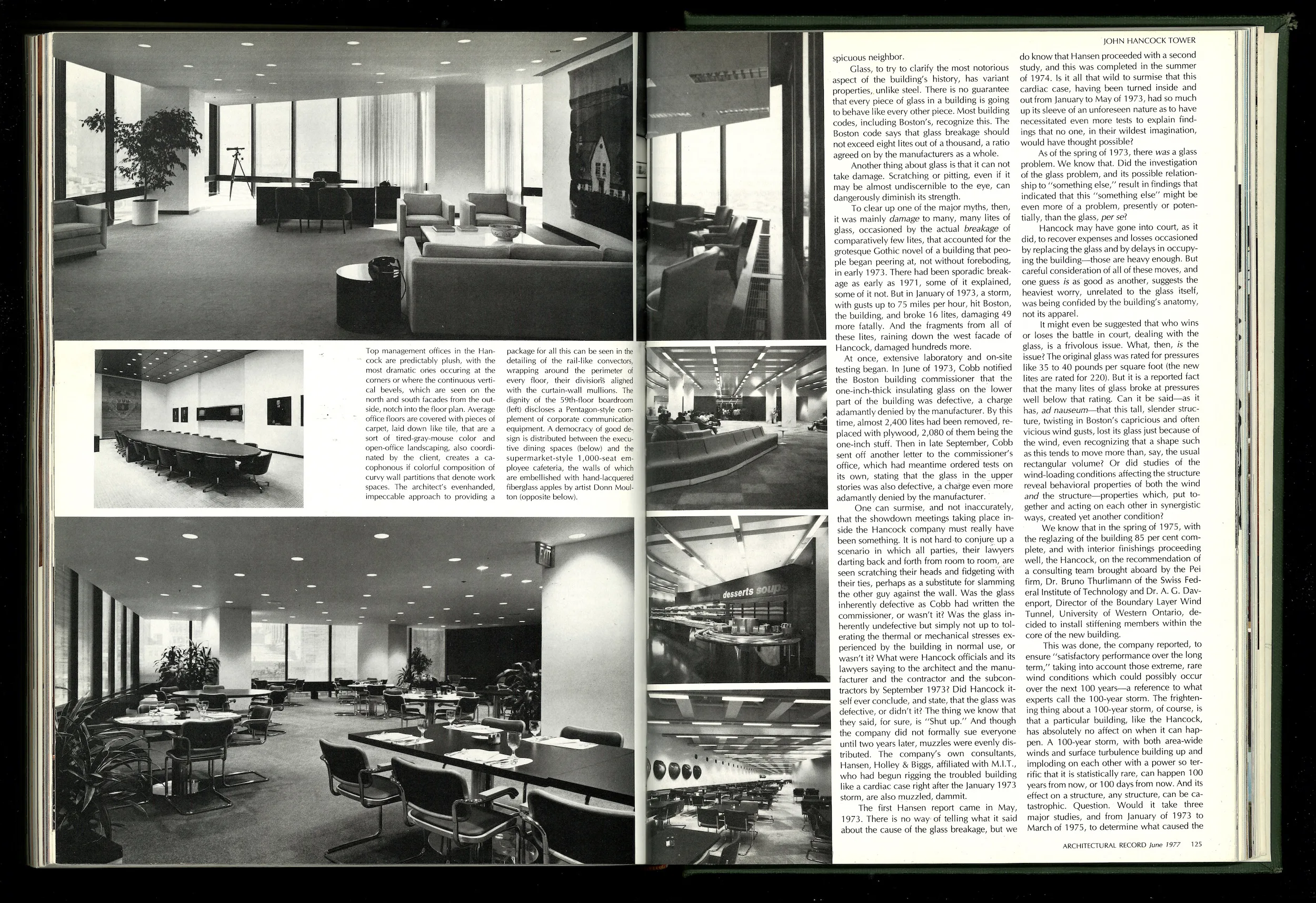
© Architectural Record, June 1977, photos by John Cserna
While one can be put to the pillory in some parts of Boston for saying so, it is precisely the Hancock’s civility as an element of the urban fabric that makes it a strengthening structural strand rather than, as so many feared, a gratuitous esthetic whallop. The rhomboid shape, with its eastern edge facing Clarendon, paced at a diagonal, was readily accepted by the company’s building committee, even though it meant spending around $3 million more than the initial Philippson budget of $72 million, which, figuring his square footage specifications for the floors, meant a budget of $33 per square foot. This shape would provide the best means to ease gently up to Copley Square without overwhelming it, and, so the committee was convinced, this feature would serve to refute any criticism of their intended tower as a truculent neighbor.
The new building nudges right up to the Square, jutting west. This narrow north facade fills out the site with a low seven-story base which is the same height as the neighboring Copley Plaza Hotel, purring contentedly alongside, and since purchased by the company. Furthermore, the diagonal face of the eastern edge creates an angular plaza that, in turn, brings the Clarendon Street side of Trinity into full view and play––just as Richardson, who first conceived and drew it from this direction, always hoped. So with Copley on the opposite side, and the entrance plaza of the tower on this side, Trinity, for the first time, is really experienced “in the round,” and it’s a good show.
And as much of a sideshow freak as the building’s metal and glass curtain wall became before reglazing was finished in 1975, Cobb’s abiding concern for the urban context is demonstrated in his handling of not only the glass detail itself but, more vitally, the over-all composition of surfaces. There are 10,344 panes in all, each measuring 4feet by 11 feet, and these mirror the surroundings in soft, shimmering images of grey and green and blue. Any sense of threatening volume is mitigated by this mediative membrane, which begins right at the street and plaza level, seeming to emerge right out of it by way of a deft detail. There is no iconic solidity, either, when experiencing the building from round about town, but a quality of clean, crisp surfaces, of razor-edged sharpness––and, when the play of light and clouds are right, the building verges on the ethereal, almost disappearing. The continuous bevels that are notched in the north and south facades of the rhomboid enhance this taut, tensile lightness.
If there is a really sad thing about what we call the Hancock’s mythic aspect, it is that it will forever be talked about as the building whose foundations caused trouble, whose glass fell out, and which had to be structurally stiffened as a precaution against that someday storm which tomorrow, or 100 years from now, might end all storms. Two 300,000-pound lead weights called tuned-mass dampers (TMD’s) were also installed in anticipation of uncomfortable vibration, but these are not yet in operation and no complaints have been registered. The reasons why this big building shrugged, so to speak (and it wasn’t easy, even for its critics, to watch a grown building cry) can’t be disclosed until the court claims are settled, one way or another. What we do know is that the original double glazing––two sheets of glass separated by a half-inch of air––were replaced by tempered one-half-inch glass; and that breakage has been statistically nil. Another good thing about this hopefully final solution is that the new windows maintain the dimension of the earlier fated facades. If, in reglazing, the existing frame size had not been maintained (and smaller frames were seriously discussed by the client) the building would now appear to be a much more frenzied, conspicuous neighbor.
Glass, to try to clarify the most notorious aspect of the building’s history, has variant properties, unlike steel. There is no guarantee that every piece of glass in a building is going to behave like every other piece. Most building codes, including Boston’s, recognize this. The Boston code says that glass breakage should not exceed eight lites out of a thousand, a ratio agreed on by the manufacturers as a whole.
Another thing about glass is that it cannot take damage. Scratching or pitting, even if it may be almost undiscernible to the eye, can dangerously diminish its strength,
To clear up one of the major myths, then, it was mainly damage to many, many lites of glass, occasioned by the actual breakage of comparatively few lites, that accounted for the grotesque Gothic novel of a building that people began peering at, not without foreboding, in early 1973. There had been sporadic breakage as early as 1971, some of it explained, some of it not. But in January of 1973, a storm, with gusts up to 75 miles per hour, hit Boston, the building, and broke 16 lites, damaging 49 more fatally, And the fragments from all of these lites, raining down on the west facade of Hancock, damaged hundreds more.

© Architectural Record, June 1977, photos by Gorchev and Gorchev, John Cserna
At once, extensive laboratory and on-site testing began. In June of 1973, Cobb notified the Boston building commissioner that the one-inch-thick insulating glass on the lower part of the building was defective, a charge adamantly denied by the manufacturer. By this time, almost 2,400 lites had been removed, replaced with plywood, 2,080 of them being one-inch stuff. Then in late September, Cobb sent off another letter to the commissioner’s office, which had meantime ordered tests on its own, stating that the glass in the upper stories was also defective, a charge even more adamantly denied by the manufacturer.
One can surmise, and not inaccurately, that the showdown meetings taking place inside the Hancock company must really have been something. It is not hard to conjure up a scenario in which all parties, their lawyers darting back and forth from room to room, are seen scratching their heads and fidgeting with their ties, perhaps as a substitute for slamming the other guy against the wall. Was the glass inherently defective as Cobb had written the commissioner, or wasn’t it? Was the glass inherently undefective but simply not up to tolerating the thermal or mechanical stresses experienced by the building in normal use, or wasn’t it? What were Hancock officials and its lawyers saying to the architect and the manufacturer and the contractor and the subcontractors by September 1973? Did Hancock itself ever conclude, and state, that the glass was defective, or didn’t it? The thing we know that they said, for sure, is “Shut up.” And though the company did not formally sue everyone until two years later, muzzles were evenly distributed. The company’s own consultants, Hansen, Holley & Biggs, affiliated with M.I.T., who had begun rigging the troubled building like a cardiac case right after the January 1973 storm, are also muzzled, dammit.
The first Hansen report came in May, 1973. There is no way of telling what it said about the cause of the glass breakage, but we do know that Hansen proceeded with a second study, and this was completed in the summer of 1974. Is it all that wild to surmise that this cardiac case, having been turned inside and out from January to May of 1973, had so much up its sleeve of an unforeseen nature as to have necessitated even more tests to explain findings that no one, in their wildest imagination, would have thought possible?
As of the spring of 1973, there was a glass problem. We know that. Did the investigation of the glass problem, and its possible relationship to “something else,” result in findings that indicated that this “something else” might be even more of a problem, presently or potentially, than the glass, per se?
Hancock may have gone into court, as it did, to recover expenses and losses occasioned by replacing the glass and by delays in occupying the building––those are heavy enough. But careful consideration of all of these moves, and one guess is as good as another, suggests the heaviest worry, unrelated to the glass itself, was being confided by the building’s anatomy, not its apparel.
It might even be suggested that who wins or loses the battle in court, dealing with the glass, is a frivolous issue. What, then, is the issue? The original glass was rated for pressures like 35 to 40 pounds per square foot (the new lites are rated for 220). But it is a reported fact that the many lites of glass broke at pressures well below that rating. Can it be said––as it has, ad nauseum––that this tall, slender structure, twisting in Boston’s capricious and often vicious wind gusts, lost its glass just because of the wind, even recognizing that a shape such as this tends to move more than, say, the usual rectangular volume? Or did studies of wind-loading conditions affecting the structure reveal behavioral properties of both the wind and the structure––properties which, put together and acting on each other in synergistic ways, created yet another condition?
We know that in the spring of 1975, with the reglazing of the building 85 percent complete, and with interior finishings proceeding well, the Hancock, on the recommendation of a consulting team brought aboard by the Pei firm, Dr. Bruno Thurlimann of the Swiss Federal Institute of Technology and Dr. A.G. Davenport, Director of the Boundary Layer Wind Tunner, University of Western Ontario, decided to install stiffening members within the core of the new building.
This was done, the company reported, to ensure “satisfactory performance over the long term,” taking into account those extreme, rare wind conditions which could possibly occur over the next 100 years––a reference to what experts call the 100-year storm. The frightening thing about a 100-year storm, of course, is that a particular building, like the Hancock, has absolutely no affect on when it can happen. A 100-year storm, with both area-wide winds and surface turbulence building up and imploding on each other with a power so terrific that it is statistically rare, can happen 100 years from now, or 100 days from now. And its effect on a structure, any structure, can be catastrophic. Question. Would it take three major studies, and from January of 1973 to March of 1975, to determine what caused the glass breakage, even if complicated structural and wind-loading factors had been primary? It is difficult to see how, unless those factors, in and of themselves, constituted a separate set of circumstances requiring the extra stiffening. Was this stiffening, put in to ensure “satisfactory performance over the long term,” to provide primarily for the comfort and sense of security of occupants, considering that the acceleration of a building––that is, not how fast it moves but how fast is picks up speed––can cause serious physical and psychological effects? That problem, the public was given to understand, was to be solved by installing those huge TMDs, calming the building, and such lateral sway, too, was to be calmed by deep three-foot beams wrapped around the exterior at every floor. Is it possible that the stiffening, again at the core, ensuring “satisfactory performance,” is related not so much to how the building reacts in terms of structural movement––that is, its period of motion and the extent of its vibrations––as how it reacts in terms of actual structural strength––that is, the ability of its basic framing configuration to tolerate such movement with ample elasticity?
Hancock management must have been on the verge of collapse, even if their building wasn’t, and one can only marvel at the company’s having kept so cool, and of course––perhaps out of pride more than anything else––whatever the true nature of the “satisfactory performance” that they wanted their extra stiffening to ensure. It is not a secret, though, that the stiffening members were installed along the longitudinal dimension of the building, whereas the expectation would be that problems of motion and sway, were they the major concern, would have been handled by lateral reinforcement. The concern was longitudinal, and since the factor of sway is a problem in the narrow direction, that concern clearly must have been for something else––sheer structural stability and strength not expected.
The Hancock story, as indicated at the outset, is not just a dramatic detective story about who did what, in what order––or about who knew what, and when. It is not even a debate about competence frustrated or competence lacking. It is a clear state of the art story––especially so in the sense that, because of this building, we have begun to realize that what the state of the art is may in fact be other than what the profession, its allied consultants in engineering, the manufacturers of materials, and the clients in their infinite wisdom thought it was. Clarity comes hard, and expensively. It may also, as in the John Hancock tower, come beautifully.
Looking for a reprint of this article?
From high-res PDFs to custom plaques, order your copy today!