From the RECORD Archives: ‘To Mannerism Born’
When the Sainsbury Wing of the National Gallery in London debuted in 1991, Venturi, Scott Brown and Associates’ iconoclastic playfulness drew criticism for diluting the gravitas of William Wilkins’s main Greek Revival building. Thirty years later, when Selldorf Architects released its plan to smooth out some of those very quirks, the wing seemed yet again embroiled in controversy. But the revamp, which opened to the public last month, recasts the crypt-like entrance as an airy, light-filled foyer that better welcomes and guides the current six million annual visitors who must now pass through it to access the museum. Selldorf Architects replaced original dark-tinted glazing with clear glass, repositioned supports and—much to the delight of the late John Sainsbury, the benefactor for which the project is named—demolished two imposing false columns in the lobby. Annabelle Selldorf insisted from the start that her work would modernize the visitor experience, and she even drew on Denise Scott Brown’s own terminology to defend the alterations. To see where you stand on the project, dive into the current issue of RECORD as well as the October 1991 edition, which featured then editor-at-large James Russell’s measured first impressions of the Sainsbury Wing alongside an appraisal from London-based critic Martin Pawley, who noted the “chilling claustrophobia” of its interiors.
Editor’s note: This article has been condensed for ease of online reading but reflects the original text.
© Architectural Record, October 1991, click to enlarge
“To Mannerism Born”
By James S. Russell
Architectural Record, October 1991
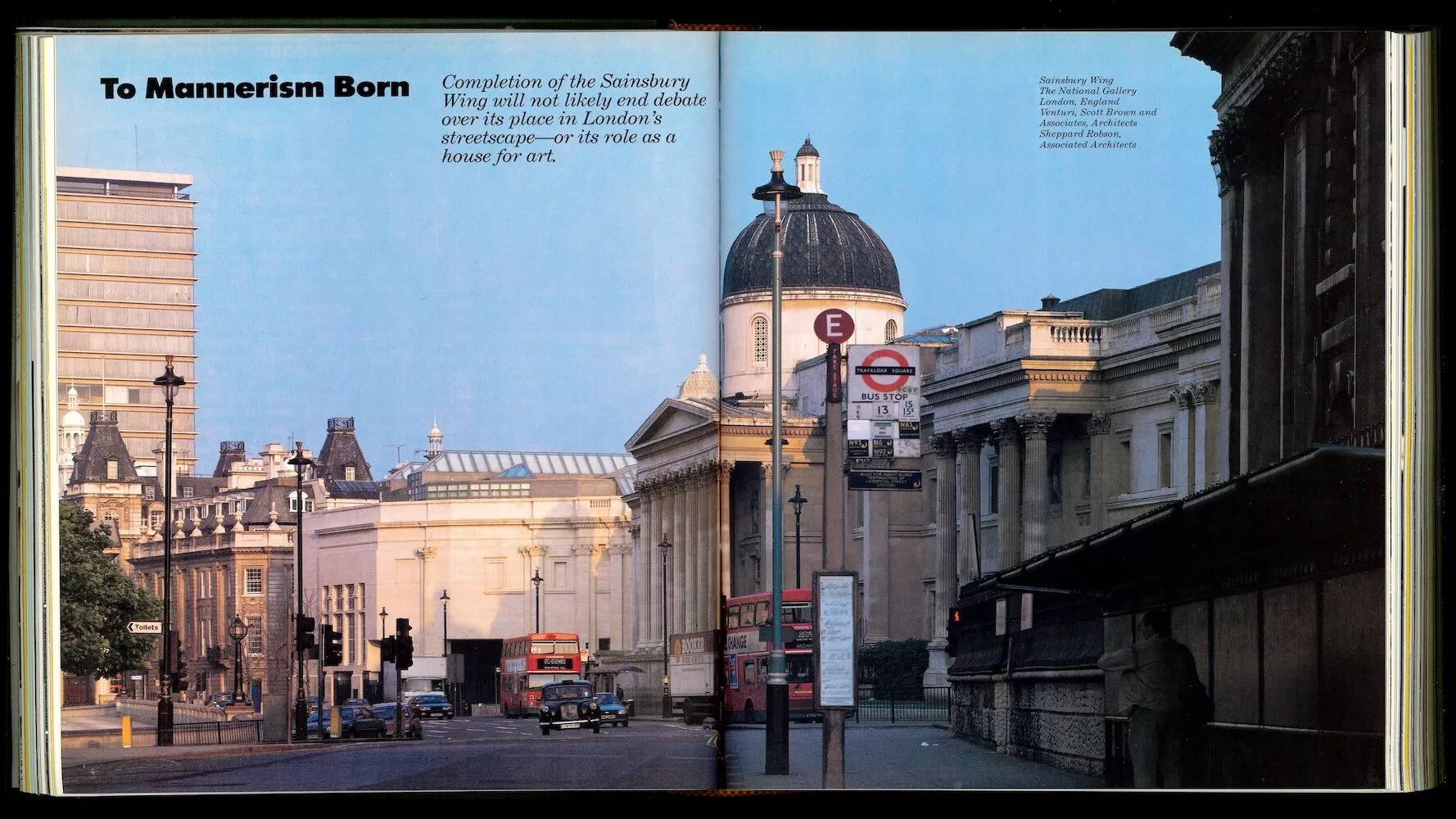
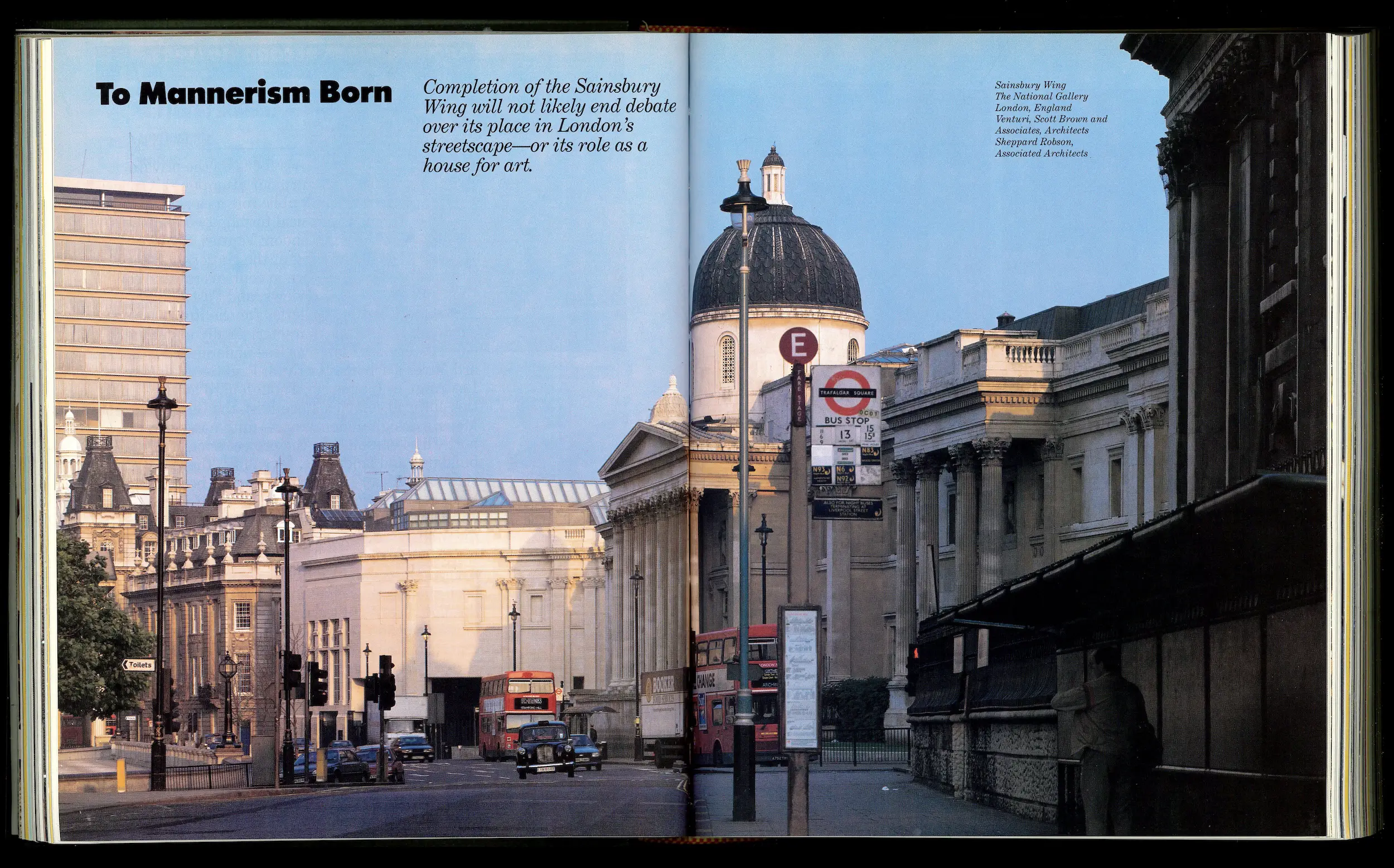
Completion of the Sainsbury Wing will not likely end debate over its place in London’s streetscape––or its role as a house for art.
Throughout the highly public design and construction of the Sainsbury Wing, critics have focused on the project’s role in Trafalgar Square (even though the corner site’s relationship to the square is ambiguous). With the extension to William Wilkins’s 1838 original National Gallery now complete, it is clear that Venturi, Scott Brown and Associates lavished far more of their attention inside on the new galleries. Here they faced the modern conflict between the architect, who wants a room that palpably seems part of the world outside with changing light and views; the curators, who want to control every aspect of light, temperature, and humidity; and 4 million annual visitors, who expect some realistic experience of the collection––in this case, the gallery’s diminutively scaled and extremely precious Early Renaissance holdings. VSB embarked on a daring course by trying to please all three constituencies.
In choosing Sir John Soane’s 1814 Dulwich Gallery as a model for the exhibition rooms, the architects found a way to introduce natural light that visibly changes over time. The rooms are small in plan yet lofty, which lets high clerestories illuminate the overall space while allowing the curator to keep the amount of light that actually falls on the painting low. It works; the rooms do appear well lit. In the galleries the architects have indeed accomplished all that they set out to do––a staggering achievement considering the number of unhappy marriages between art and architecture that have occurred in this century.
Elsewhere, the architects’ intentions seem less clear, and the results more ambiguous. A grand stair, its dark gridded glazing a reference to Mies van der Rohe, according to Scott Brown, carries visitors to the galleries’ under punched-metal arches. While the Dulwich model for the galleries is wonderfully resonant––and doesn’t depend on a prior knowledge of history to be appreciated––both the Mies allusion and the arches are gratuitous. (Incidentally, the arches, if more fully explored, might have become an ingenious take on the 19th-century English engineering that inspired the Modern architects.)
Looking for quick answers on architecture and design topics?
Try Ask RECORD, our new smart AI search tool.
Ask RECORD →
© Architectural Record, October 1991, photo by Richard Bryant/ARCAID
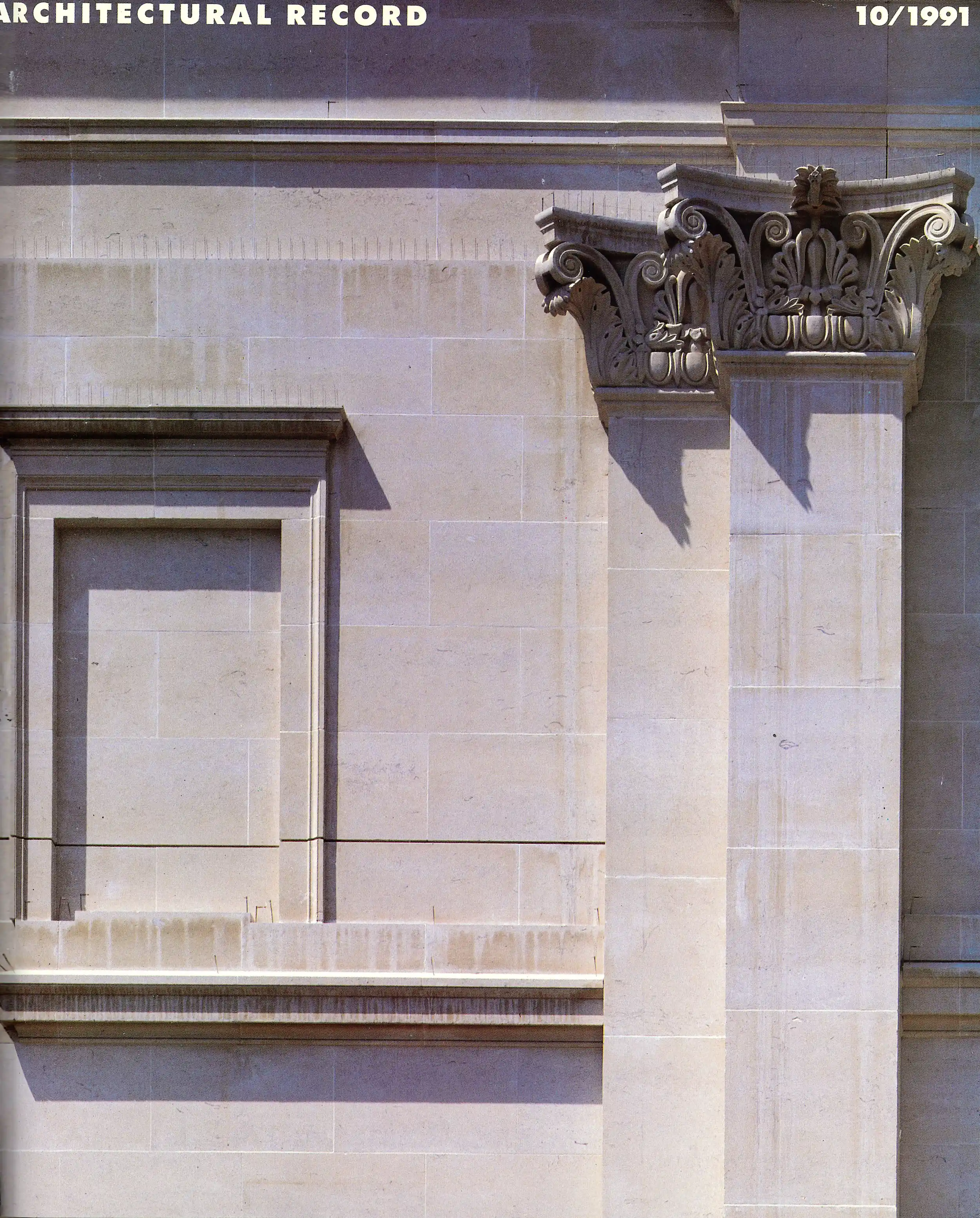
On the outside, the Sainsbury Wing is so self-effacing that it’s hard to imagine what all the noise was about. Deferentially chamfered at the corner, the addition is at its softest and most romantic from the steps of St. Martin in the Fields. Close up, VSB’s patented Mannerist devices are visible––the transformation from Wilkinsian pilaster to engaged column, the transition from decorated to plain entablature, and the progressive flattening of blind windows. Unfortunately, these flourishes do not serve any discernible theme. Even the tension between the interior and exterior is lost because the glass facing Jubilee Walk and within the entrance portico is too deeply tinted, the mullions too dark to be visible. Instead of seeing a gridded-glass conservatory within the Portland-stone envelope (as design models indicate we should), we see only the roof’s light monitors, which look unresolved on the exterior because they follow the order of the interior.
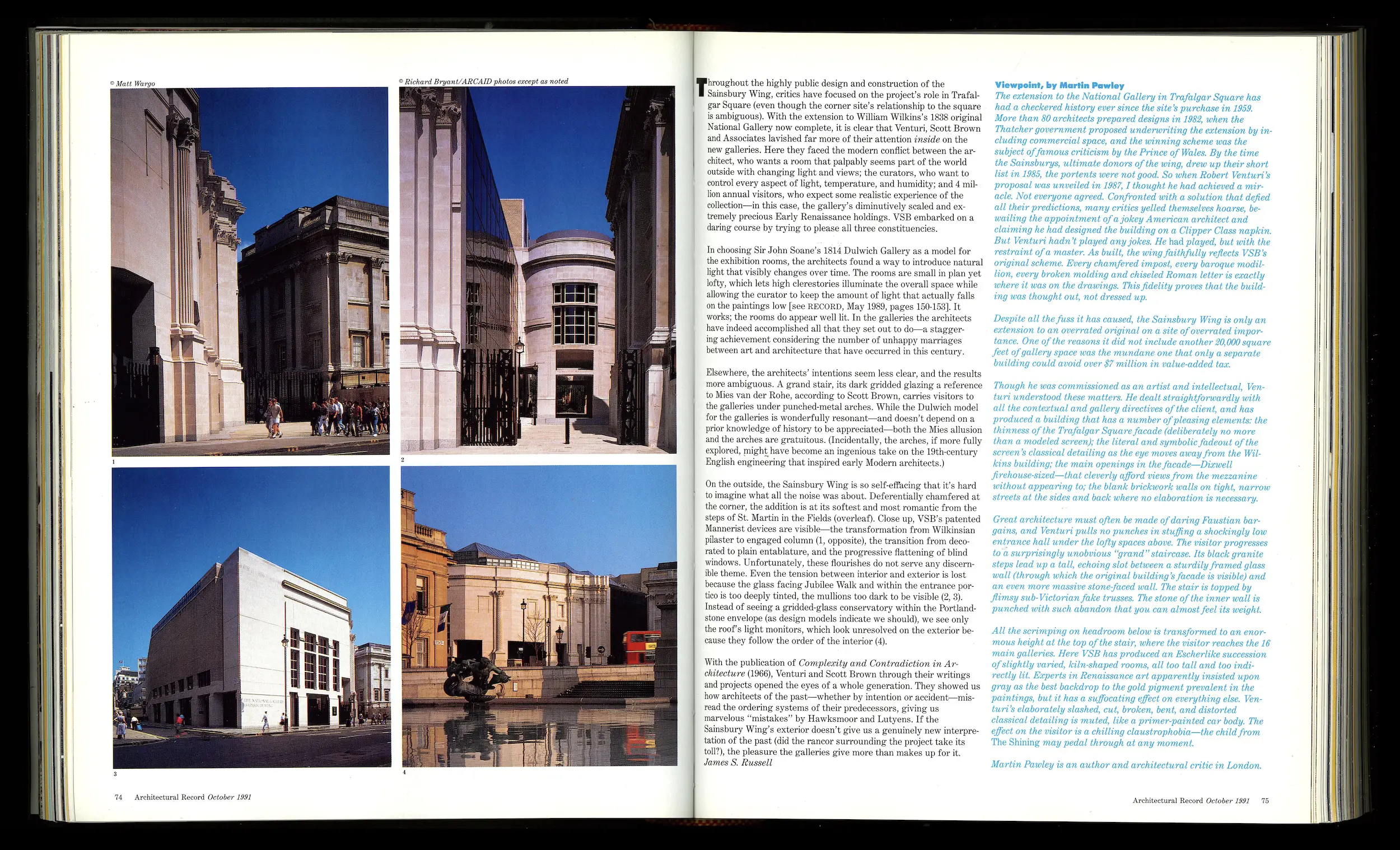
© Architectural Record, October 1991, photos by Richard Bryant/ARCAID, Matt Wargo
With the publication of Complexity and Contradiction in Architecture (1966), Venturi and Scott Brown through their writings and projects opened the eyes of a whole generation. They showed us how architects of the past––whether by intention or accident––misread the ordering systems of their predecessors, giving us marvelous “mistakes” by Hawksmoor and Luytens. If the Sainsbury Wing’s exterior doesn’t give us a genuinely new interpretation of the past (did the rancor surrounding the project take its toll?), the pleasure the galleries give more than makes up for it.
‘Viewpoint’
By Martin Pawley
The extension to the National Gallery in Trafalgar Square has had a checkered history ever since the site’s purchase in 1959. More than 80 architects prepared designs in 1982, when the Thatcher government proposed underwriting the extension by including commercial space, and the winning scheme was the subject of famous criticism by the Prince of Wales. By the time the Sainsburys, ultimate donors of the wing, drew up their short list in 1985, the portents were not good. So when Robert Venturi’s proposal was unveiled in 1987, I thought he had achieved a miracle. Not everyone agreed. Confronted with a solution that defied all their predictions, many critics yelled themselves hoarse, bewailing the appointment of a jokey American architect and claiming he had designed the building on a Clipper Class napkin. But Venturi hadn’t played any jokes. He had played, but with the restraint of a master. As built, the wing faithfully reflects VSB’s original scheme. Every chamfered impost, every baroque modillion, every broken molding and chiseled Roman letter is exactly where it was on the drawings. This fidelity proves that the building was thought out, not dressed up.

© Architectural Record, October 1991, photo by Richard Bryant/ARCAID
Despite all the fuss it has caused, the Sainsbury Wing is only an extension to an overrated original on a site of overrated importance. One of the reasons it did not include another 20,000 square feet of gallery space was the mundane one that only a separate building could avoid over $7 million in value-added tax.
Though he was commissioned as an artist and intellectual, Venturi understood these matters. He dealt straightforwardly with all the contextual and gallery directives of the client, and has produced a building that has a number of pleasing elements: the thinness of the Trafalgar Square facade (deliberately no more than a modeled screen); the literal and symbolic fadeout of the screen’s classical detailing as the eye moves away from the Wilkins building; the main openings in the facade––Dixwell firehouse-sized––that cleverly afford views from the mezzanine without appearing to; the blank brickwork walls on tight, narrow streets at the sides and back where no elaboration is necessary.
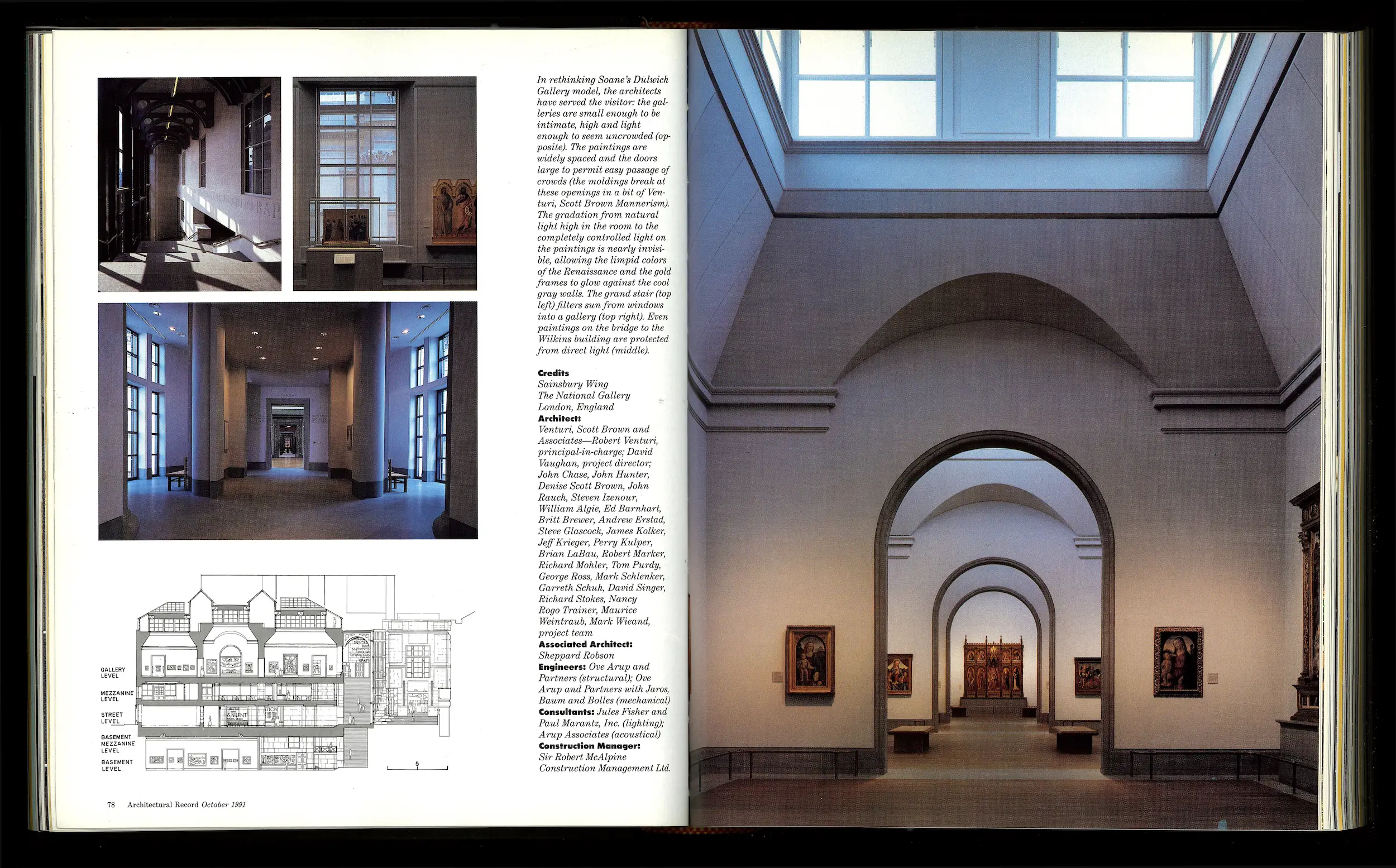
© Architectural Record, October 1991, photo by Richard Bryant/ARCAID
Great architecture must often be made of daring Faustian bargains, and Venturi pulls no punches in stuffing a shockingly low entrance hall under the lofty spaces above. The visitor progresses to a surprisingly unobvious “grand” staircase. Its black granite steps lead up to a tall, echoing slot between a sturdily framed glass wall (through which the original building’s facade is visible) and even more massive stone-faced wall. The stair is topped by flimsy sub-Victorian fake trusses. The stone of the inner wall is punched with such abandon that you can almost feel its weight.
All the scrimping on headroom below is transformed to an enormous height at the top of the stair, where the visitor reaches the 16 main galleries. Here VSB had produced an Escherlike succession of slightly varied, kiln-shaped rooms, all too tall and too indirectly lit. Experts in Renaissance art apparently insisted upon gray as the best backdrop to the gold pigment prevalent in the paintings, but it has a suffocating effect on everything else. Venturi’s elaborately slashed, cut, broken, bent, and distorted classical detailing is muted, like a primer-painted car body. The effect on the visitor is a chilling claustrophobia––the child from The Shining may pedal through at any moment.
Looking for a reprint of this article?
From high-res PDFs to custom plaques, order your copy today!