Anxiety and AI Rule at the 2025 AIA Conference on Architecture & Design

AIA25 was held at the Rafael Viñoly Architects–designed Boston Convention & Exhibition Center in the city's Seaport district. Photo by Nicole Loeb, courtesy AIA
The American Institute of Architects’ 2025 Conference on Architecture & Design (AIA25) kicked off at the Boston Convention & Exhibition Center just a day after the White House announced a doubling of tariffs on aluminum and steel imports from 25 to 50 percent and ended while anti-ICE protests erupted across Los Angeles. Fittingly, a recurring theme was this: we’re all going to be okay. Hopefully.
Faced with legal entanglements, layoffs, and the stress that comes along with major renovations (its radically revamped headquarters is set to open later this year), the AIA has weathered a turbulent year—one that began during last year’s conference in its hometown of Washington, D.C. Currently without a top executive as it searches for one following the December resignation and subsequent departure of Lakisha Woods (she will take over as president and CEO of The National Glass Association in July), the AIA couldn’t not put on an upbeat, optimistic face during its annual gathering, the first held in Boston since 2008. Stephen Ayers, the former Architect of the Capitol who is serving as the AIA’s interim CEO/EVP, referenced Lee Ann Womack’s mawkish, two-decades-old country pop hit “I Hope You Dance” in a call for members to continue to put themselves out there. “It’s a message of hope, courage, and the determination to seize life's moments, refusing to let them pass you by,” Ayers said of the song in a speech leading up to the June 5 keynote. “These lyrics have always resonated with me, not just on a personal level, but also as an architect, when I consider our profession is faced with an uncertain future, with concerns about economic instability, climate change, and a rapidly evolving social fabric.”

View of the Expo floor. RECORD hosted a happy hour and showcased the winners of the 2025 AIA St. Louis National Photography Competition at its booth. Photo courtesy AIA
Evelyn Lee, 2025 AIA President, also encouraged attendees to turn their anxiety about the state of the world into action, noting that the organization’s 13 founders faced an uphill battle back in 1857. ;“They didn't back down as the world shifted around them—they leaned in, they adapted, they dreamed bigger, and now, it's our turn.”
Even headlining keynote speaker, the always-erudite former U.S. Secretary of Transportation Pete Buttigieg, whose presence was welcome but perhaps would have been more impactful during last year’s D.C. conference, spoke to the unease at hand through an optimistic lens during a wide-ranging—and often funny—conversation with Lee.
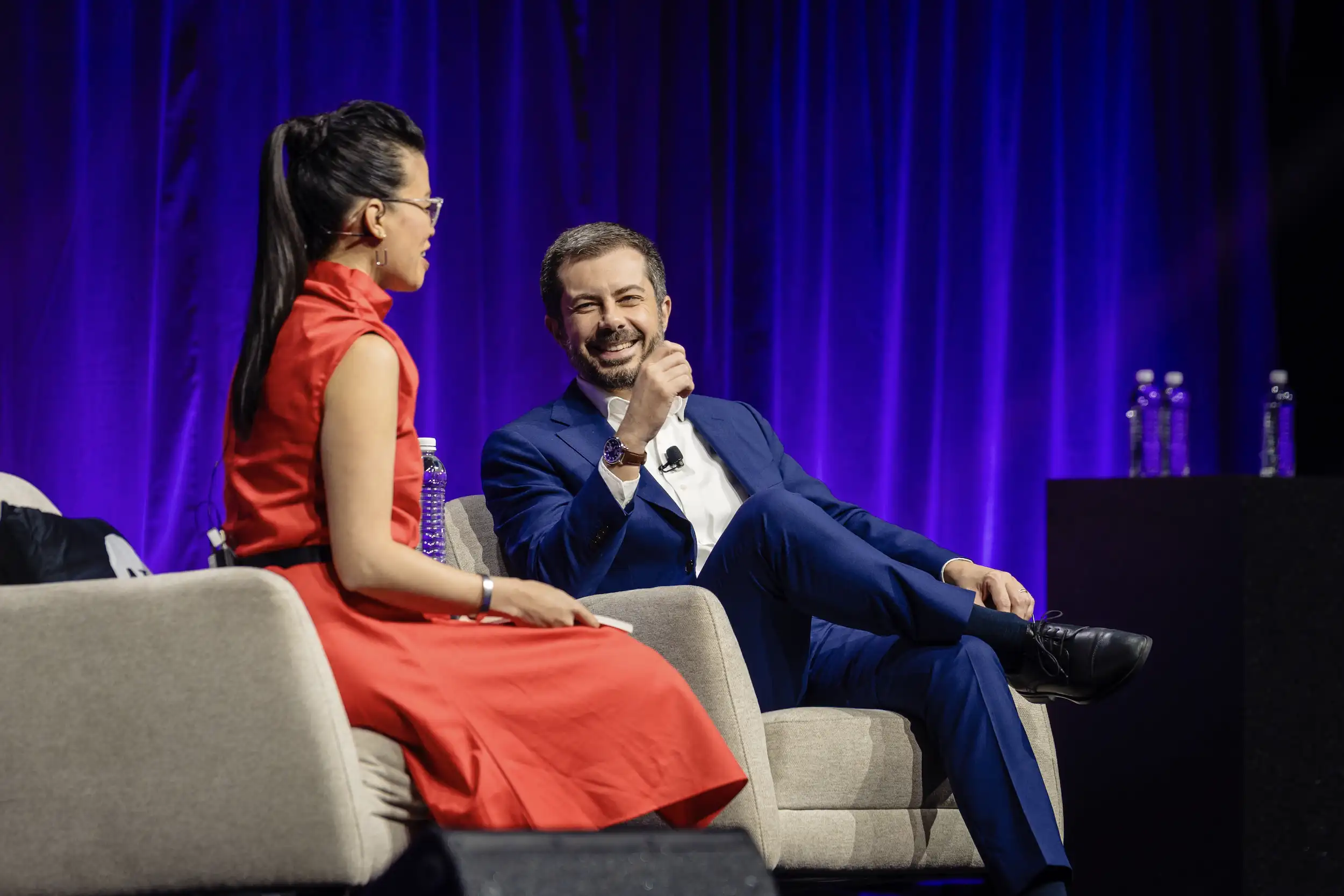
Pete Buttigieg received a warm welcome during his conversation with AIA 2025 President Evelyn Lee. Photo by Nicole Loeb, courtesy AIA
“When everything gets burned to the ground, which in an institutional way kind of is what's happening right now, what is next is really an opportunity,” he said.
Aside from the frequent platitudes meant to cut through the disquietude and offer a sense of hope (“an unfashionable term during this administration, I realize” said Buttigieg), AIA25 was largely business as usual. The expo floor was alive with networking, evening celebrations were held at venues across the Seaport district, and architectural tours commenced across the city at locales ranging from the MIT campus to the Financial District to local love/hate landmark, the Brutalist Boston City Hall. This year’s big award winners, including AIA Gold Medalist Deborah Berke and Whitney M. Young Jr. Award recipient Bryan C. Lee presented impassioned speeches. Wendy Rogers, CEO of Architecture Firm Award winner LPA Design Studios, offered a particularly powerful refrain of “no excuses.”

1

2
Architect and educator Bryan C. Lee of Colloqate Design accepts the Whitney M. Young Jr. Award from AIA interim CEO/EVP Stephen Ayers and 2025 president Evelyn Lee (1). LPA Studios Designs CEO Wendy Rogers and the firm's board of directors accept the Architecture Firm Award (2). Photos by Nicole Loeb, courtesy AIA
“This submission process pushed us to articulate our collective beliefs, and our story demonstrates what a firm of any size can accomplish when we stop making excuses,” Rogers said when accepting the award on behalf of the firm. “Focus on performance to deliver design excellence with every project, every budget, and every scale—no excuses.”
Looking for quick answers on architecture and design topics?
Try Ask RECORD, our new smart AI search tool.
Ask RECORD →
AIA25’s symposia, workshops, and educational seminars, as always, were varied. Sessions on AI and digital technology had a notably robust presence in the schedule, with offerings such as "AI in Architecture & Building Codes: Hiding in Plain Sight,” “Empathetic AI: How AI Can Help You Understand Human Experience,” and “Rethinking the Firm: Could AI Be Your Next Practice Partner?” The AI emphasis extended to the conference’s first keynote, which was delivered to a somewhat muted crowd by artificial intelligence advisor and investor Allie K. Miller. This isn’t to say that there is widespread disinterest in the highly pertitent topic but perhaps attendees were looking for something else to kick off the conference. (Per the AIA, only 8 percent of firm leaders have integrated AI into their practices while 20 percent are in the process of adoption and 35 percent of firms are considering implementation; the figures are similar with individual practitioners.)

3
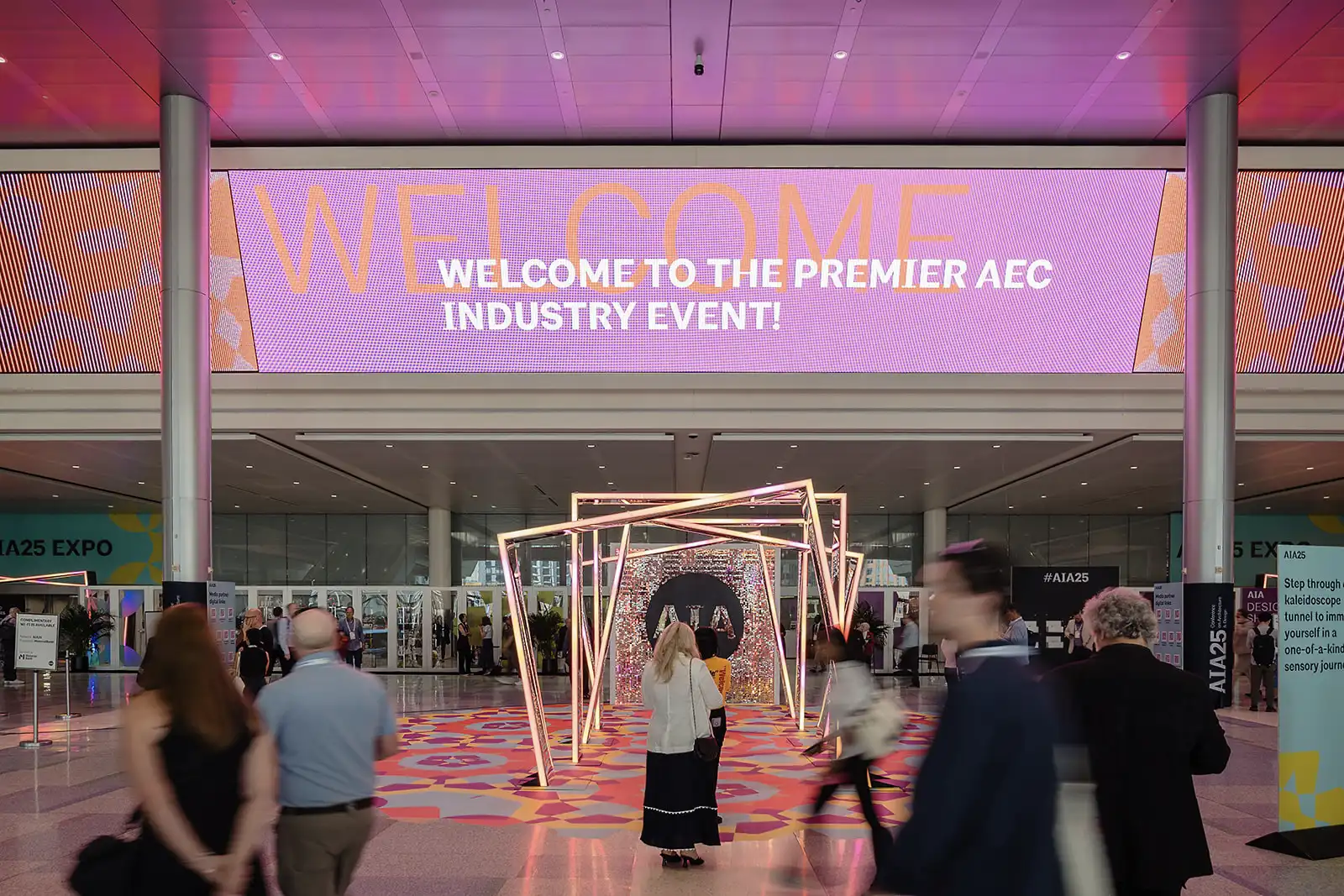
4
More than 450 sessions were held during the course of the conference with close to 13,000 attendees. Photos by Nicole Loeb, courtesy AIA
At the conclusion of AIA25—four slickly produced days of professional insight and inspirational snippets, all with a giant question mark at the end— the clearest takeaway from the conference was everything is a mess but we’re all in this together. As spelled out by Berke in her address to attendees, this moment in time may be chaotic yet the mission of architects does not waver. “For all of us in this room, architects and our compatriots around the world, we're optimists—we build for the future,” she said. “And the world can really, really use our help right now. So, let's go out and build a more beautiful, sustainable world together that does good for all.”
The 2026 AIA Conference on Architecture & Design will be held next June 10–13 in San Diego.
Looking for a reprint of this article?
From high-res PDFs to custom plaques, order your copy today!

.webp?height=200&t=1717782335&width=200 "AIA24_060624_KB-0006_websize (1).jpg")