Building Technology
Davis Partnership Uses Salvaged Steel on a New Colorado Firehouse
Boulder, Colorado
Architects & Firms
A bit like firefighters themselves, the City of Boulder’s new Fire Station #3 resolves a complex assignment with eminent practicality and a touch of pizazz. Located clear of a 100-year floodplain and within range of the growing Colorado district it serves (distinct advantages over the station it replaces), the building, by Denver-based Davis Partnership Architects, combines clear spatial order and expressive tectonics with exemplary environmental performance—including the innovative use of salvaged structural steel.
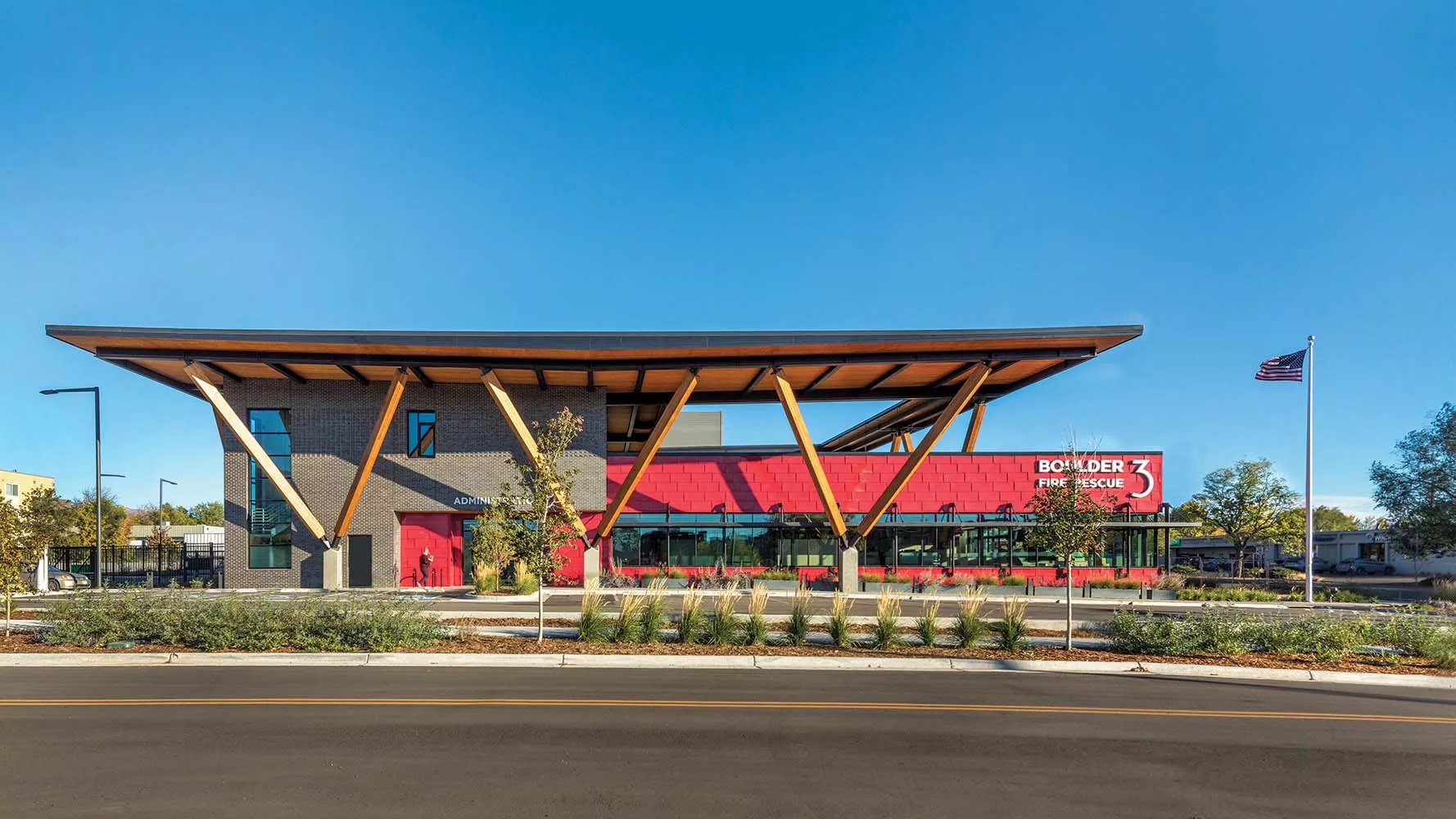
Designed to be replicated, should the city need more stations in the future, the 28,300-square-foot facility has a simple parti: an oversize roof plane unifying disparate programmatic blocks. A strong play of solid and void in the massing of the blocks makes for a legible composition. To the north, a run of brick pilasters defines the apparatus bay—the higher-order garage where fire trucks stand ready to roll out through glass overhead doors. To the south, a red metal-tile-clad volume houses department-wide administrative offices. (For future stations, this volume would be optional.) Behind and between, an L-shaped ancillary block, clad in dark gray ironspot brick, includes a community room, a fitness facility, and spaces for testing, maintaining, and storing the accoutrements of fighting fires. With crews typically serving multi-day shifts, this block’s second floor provides living quarters, with common areas that open on a 6,000-square-foot green roof. Above all this, over a band of clerestory glazing or open air, angled glulam columns support the deep overhangs of the main roof.
In addition to uniting the programmatic blocks, the supersize roof accommodates a photovoltaic system. “That’s the genesis of the design,” says Joe Lear, a principal at Davis. “But unless you have multiple sources of renewables, a net zero energy fire station is very difficult to achieve.” The project did not meet that target, but the photovoltaics, in combination with a low energy use intensity (EUI), mean that the station is well on its way to achieving net zero carbon, if the client decides to purchase emissions-free electricity.
The building’s EUI, estimated at 56.2, is less than half of what’s typical for public-safety facilities. It was achieved through a combination of highly insulated walls and roof, LED lighting, occupancy sensors, and a variable air volume (VAV) rooftop unit with a heat pump. The roof’s sheltering overhangs, combined with a municipal commitment to plowing, made it possible to dispense with electric snow-melting cable in the station’s apron paving. As a result of these conservation measures, the 207-kilowatt PV system is expected to turn Boulder’s 300 or so sunny days a year into about 65 percent of the all-electric building’s energy needs.

Some of the 89 steel members in the station that were salvaged from a deconstructed hospital are visible in the apparatus bay. Photo © Thomas Ellis
Prioritizing embodied as well as operating energy, perhaps the most innovative aspect of the building is its reuse of over 25 tons of salvaged structural steel. During the schematic-design phase, the client alerted the project team to the possibility of reusing framing from the deconstruction of a hospital, which the city also owned. That may sound like a straightforward proposition, but it wasn’t simply a matter of unbolting the hospital framing and delivering it to its new jobsite. During design development, there was some uncertainty as to whether the two projects’ schedules would align. To hold open the possibility of reuse, the structural drawings provided specifications for both new and salvaged members. “It’s a little bit of a change in thought process to say, ‘Well, here’s what I have available to me, and how is that structurally equivalent to what I would choose from scratch,’” says Chris Kendall, a principal at KL&A, structural consultant for both the hospital deconstruction and the new fire station. Organizing the various framing members to form an orderly composition—without, for example, mismatched depths in the exposed beams—also took some doing, says project architect Josh Perrin. “We rearranged things to maximize the steel usage while trying to create visual consistency within a structural bay,” he says.
KL&A also specified and managed a careful process of deconstructing, cataloguing, stockpiling, and testing the material. Fire retardant and other coatings were removed. Each piece was given its own cut sheet, including a picture, dimensions, and additional detail. Shop drawings were generated, and the framing members fabricated—cut to length, with leftover bits and pieces from their previous service selectively removed, and bolt holes drilled—for their new application. Ultimately, the design was able to reuse 89 salvaged pieces (32 percent of the original stockpile) for an embodied-carbon savings of 25,000 kilograms. (The city is offering the remaining steel, in any quantity, for $1.)
The additional labor associated with salvaging the steel meant that cost savings on the material were insignificant, coming in at about $6,000, according to Kendall. The real value lay in reducing the project’s embodied carbon, advancing the city’s ecological mandate, allocating the steel budget to local jobs, and putting a resource to good use. “We’re using 80-year-old material for a new hundred-year building,” says Lear. “We’ve more than doubled its life.”
Click diagram to enlarge

Credits
Architect:
Davis Partnership Architects — Joe Lear, principal in charge; William Bussard, project manager; Josh Perrin, project architect; Animish Kudalkar, job captain; Paul Garland, landscape architect; Jennifer Henry, interior design project manager; Gabrielle Bohlmann, interior designer; Rhiannon Roberson, furniture specialist
Engineers:
KL&A (structural); ME Engineers (m/e/p); Martin/Martin Consulting Engineers (civil)
General Contractor:
Mark Young Construction
Client:
City of Boulder
Size:
28,000 square feet
Cost:
$23 million
Completion Date:
September 2024
Sources
Steel Structure:
Full Metal Iron
Glulam Structure:
RLD
Looking for quick answers on architecture and design topics?
Try Ask RECORD, our new smart AI search tool.
Ask RECORD →
Looking for a reprint of this article?
From high-res PDFs to custom plaques, order your copy today!