The Hopkins Center, Dartmouth’s Wallace Harrison–Designed Arts Hub, Reopens after Transformative Revamp

Architects & Firms
Nelson A. Rockefeller, vice president under Gerald Ford and governor of New York from 1959–1973, is among Dartmouth College’s most notable alumni-benefactors and, as such, has his name attached to a major building on campus: a 1983 red-brick structure that houses the university’s Rockefeller Center for Public Policy and Social Sciences. Erected as part of a campus master plan created by Dartmouth alumni and I.M. Pei protégé Lo-Yi Chan, that building isn’t one of the most remarkable at the school, which is defined by its wealth of Georgian-style edifices like the landmark Baker Library Tower. There’s another building, however, that doesn’t bear Rockefeller’s name but did benefit directly from the politician’s financial largesse—and architectural discernment. Opening in 1962 with a design by Wallace K. Harrison, a friend and frequent client of Rockefeller, the Hopkins Center for the Arts—better known simply as “the Hop”—is one of the 256-year-old university’s finest 20th-century additions.

Sized for solo performances and small ensembles, the new recital hall looks out on the Dartmouth Green, with Baker Tower seen in the distance. Photo © Jeff Goldberg

Exterior view of the original Hop building (left) and new Daryl and Steven Roth Wing, with its lantern-like Morris Recital Hall. Photo © Jeff Goldberg
Home to Dartmouth’s drama and music departments, the Hop celebrated its grand reopening earlier this month following the completion of a $124 million renovation and expansion led by Snøhetta that fortifies its role not just as a campus arts hub but as a cultural destination for the entire Upper Valley community of New Hampshire and Vermont. “It’s not just a great place for art, but a regional gathering place—the rural context makes it even more so,” says Hopkins Center executive director Mary Lou Aleskie of the Hop and its immediate neighbors, the Charles Moore and Chad Floyd–designed Hood Museum of Art, renovated and expanded by Tod Williams Billie Tsien Architects in 2019, and Machado Silvetti’s Black Family Visual Art Center (2012). Upon the Hop’s 1962 debut, multi-disciplinary art centers were a rarity on university campuses. “The collision of having everything under one roof created community,” adds Aleskie.
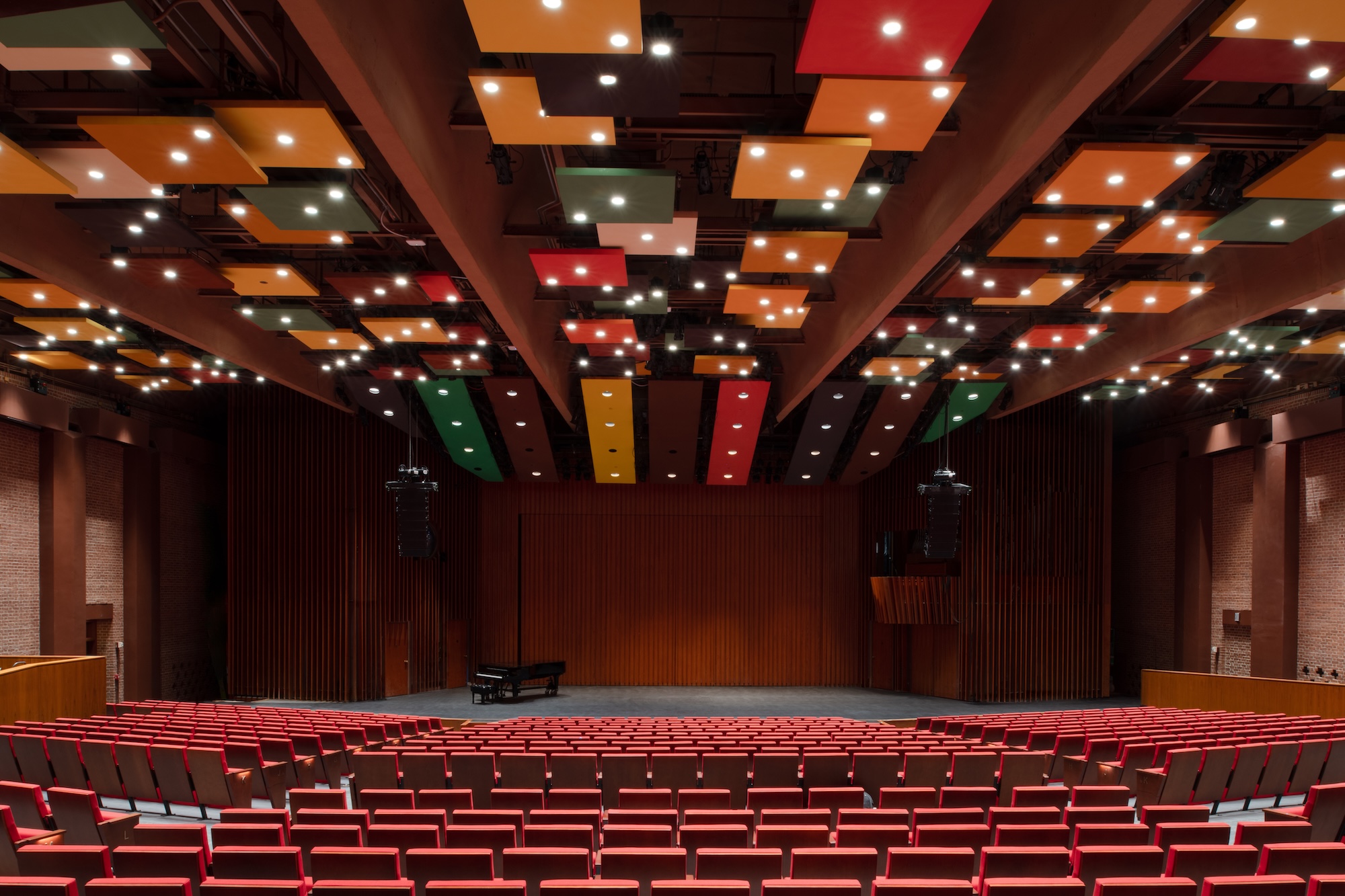
Spaulding Auditorium, a large concert hall and film theater at the rear of the Hop complex, received new seating as well as acoustical and accessibility upgrades. Photo © Alexa Bendek
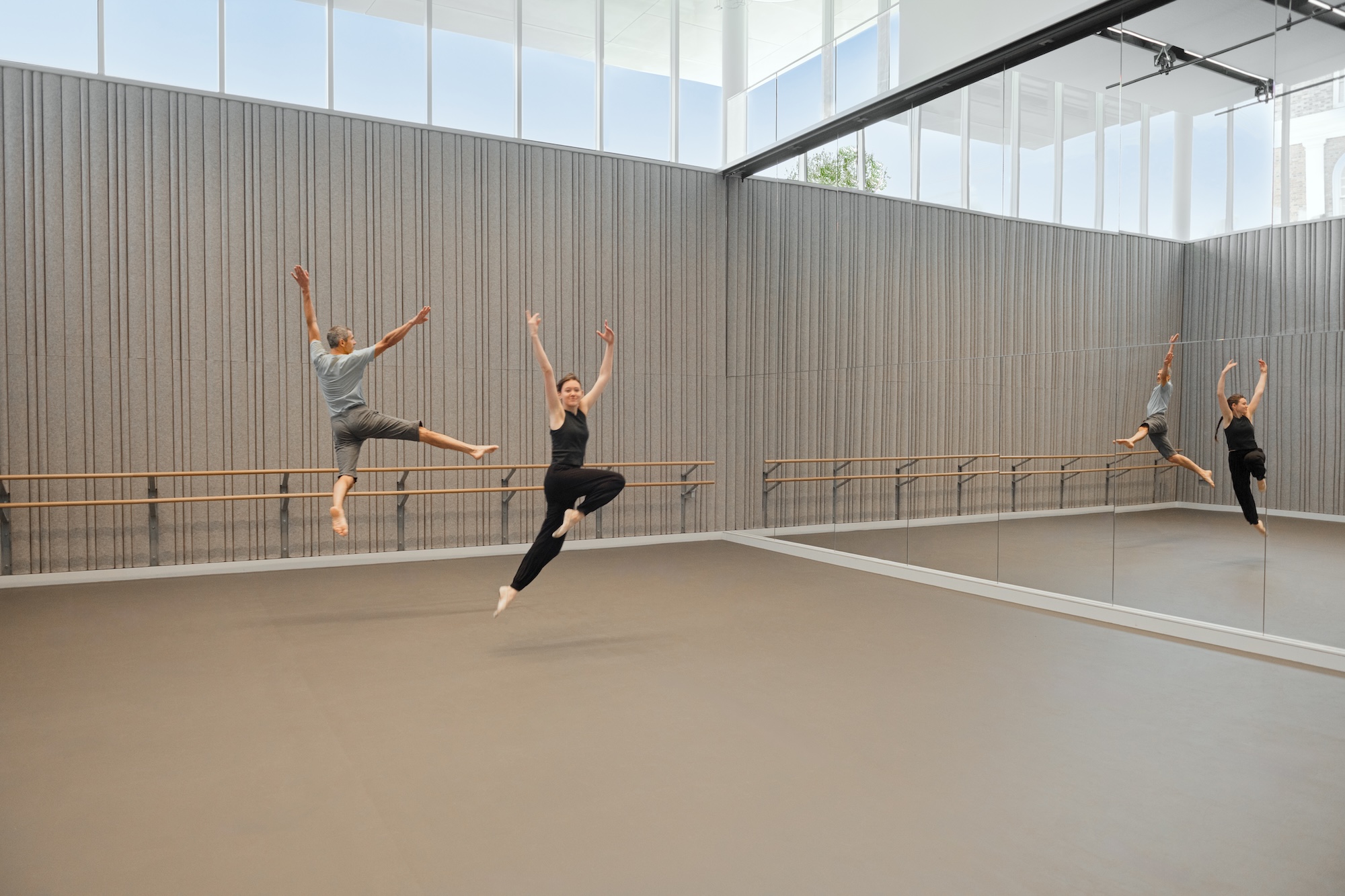
As part of a 15,000-square-foot expansion to the west of the Hop’s existing footprint, where a moribund central courtyard once stood, the center has gained a soaring recital hall overlooking the campus Green; a versatile, state-of-the-art black-box performance lab with seating for 200; a collaborative theater space named after Dartmouth alumna Mindy Kaling; and a professional dance studio, a first for the Hop, with 24-foot-high ceilings and north-facing clerestory windows. Existing spaces including Harrison’s main lobby (a groovy mid-century delight), the Top of the Hop lounge, and the center’s flagship performance venue, the 792-seat Spaulding Auditorium, have also been refreshed. Also renovated were multiple smaller teaching spaces, some located in the Hop’s subterranean warren of specialty workshops and practice rooms. In total, 55,000 square feet of existing space was transformed as part of the project, which broke ground in January 203. Just outside the main entrance is a welcoming new plaza where stone seating nods to the campus’ rugged New Hampshire surroundings. When the weather allows, the plaza will host impromptu performances, concerts, and the like.
1

2
The Hodgson Family Dance Studio (1) and Mindy Kaling Theater Lab (2) are two new signature teaching spaces. Photos © Alexa Bendek
Like the 1928 Baker Tower’s (intentional) resemblance to Philadelphia’s Independence Hall, Harrison’s design for the Hop, specifically its arched, glassed-in north facade facing East Wheelock Street, prompts a sense of the uncanny. That’s because the building is a downscaled prototype of Lincoln Center’s Metropolitan Opera House in New York, another Harrison design completed four years after the Hop in 1966.
As Snøhetta founding partner Craig Dykers explains, the Hop’s expansion, while reverent to Harrison’s original design, doesn’t try in earnest to recreate it. “It almost feels inevitable in its design—like it has always been there and wants to be there. It doesn't copy or try to mimic the Hopkins itself,” he says. “It feels like a nice dancing partner.”

3

4
Views of the Daryl Roth Studio Theater, a new black-box performance venue (3), and entrance to the Morris Recital Hall (4). Photos © Alexa Bendek
Indeed, the new Jack '53 & Mac '11 Morris Recital Hall, with its tapered arch-framed mullion window system, offers a discernible hat-tip to the characteristic curves of Harrison’s building. It also references Dartmouth’s older brick structures, with the maroon-colored coating of the metal mullions acting as a mélange of the different hues found at buildings across campus. “We couldn't just take a red that came from a brick,” says Dykers. “Instead, we merged many together to create something that felt like it belonged but wasn’t a color that you would necessarily see on campus.” Similarly, wooden acoustical walls with rounded rods outside of the performance spaces in the new wing are painted a dark-green in a riff on Dartmouth’s signature color. Even the composite flooring of the new wing, anchored by a dramatic grand stair, harmonizes with the original terrazzo flooring of the lobby. (The ersatz terrazzo-pattern side tables scattered throughout the public areas are less successful.)

An info booth and main staircase on the ground floor of the Hop’s 15,000-square-foot new wing. Photo © Alexa Bendek

The Top of the Hop, a previously underutilized social hub, was extensively renovated. Photo © Alexa Bendek
The most complex aspect of the revamp was improving the building’s circulation. Dykers notes that, from an accessibility standpoint, it was previously convoluted entering the Hop and moving across the various floor levels. “You had to do all these various movements and go through all kinds of odd doors—and most people got lost,” he says. “The biggest challenge was to make it more intuitive and also make it brighter and livelier and allow the back-of-house areas and front-of-house areas to mix a little better.”
Looking for quick answers on architecture and design topics?
Try Ask RECORD, our new smart AI search tool.
Ask RECORD →
Of the existing spaces, Aleskie says it’s the social heart of the building, the Top of the Hop, that’s the most radically transformed. “It was like a Greyhound bus terminal—it wasn’t frequently used,” she says of its pre-renovation state. Here, Snøhetta added a new bar (serving coffee during the day and libations at night) and furnishings, refurbished the 1960s-era wood-burning fireplace, removed an old central staircase, and unearthed the original wood flooring buried beneath decades of glue and staples. New LED lighting has been installed to better showcase Harrison’s signature barrel-vaulted ceiling and an outdoor terrace looking out onto the Green is accessible for the first time in years.

Exterior view of the original main entrance and the Top of the Hop, with its newly reopened terrace. Photo © Chris Turner, Downriver Media
While the Hop’s flexible and acoustically fine-tuned new performance venues are impressive, it’s the spruced-up older spaces like the Top of the Hop that truly demonstrate how Dartmouth’s mid-century architectural star was long overdue for an encore.

Straddling the town/gown divide along E. Wheelock Street, the Hop is flanked by the Hood Museum of Art and Wilson Hall on the left and the historic Hanover Inn, with attached conference center, on the right. Photo © Chris Turner, Downriver Media
.jpg "hopkins center")
Plan courtesy Snøhetta; click to enlarge
Credits
Architect:
Snøhetta — Craig Dykers, founding partner, architect; Alan Gordon, partner, architecture discipline director;
Michelle Delk, partner, landscape architecture discipline director; Nick Anderson, project director; Razvan Voroneanu, design architect; Darlene Montgomery, landscape architect; Isabelle Desfoux, landscape architect;
Anne-Rachel Schiffmann, innteriors director
Architect of Record:
PAGE (now Stantec)
Engineers:
Arup (structural, theater, acoustic, architectural lighting, m/e/p/fp); Engineering Ventures (civil)
Consultants:
Simpson Gumpertz & Hager (buiding enclosure); ENTRO (signage and wayfinding)
General Contractor:
Consigli Construction Company
Client:
Hopkins Center for the Arts
Owner:
Dartmouth College
Size:
15,000 square feet (expansion), 55,000 square feet (renovated existing space)
Cost:
$97 million (construction)
Completion:
September 2025
Sources
Cladding:
seele USA (metal/glass curtain wall, metal panel rainscreen); BPDL (precast concrete); Concreteworks (glass fiber reinforced concrete)
Skylights:
Oldcastle Building Envelope
Entrances:
CRL
Looking for a reprint of this article?
From high-res PDFs to custom plaques, order your copy today!