Books
A New Book Chronicles the Strange Saga of Belgium’s Contribution to the 1939 New York World’s Fair
‘The Belgian Friendship Building: From the New York World’s Fair to a Virginia HBCU’ by Kathleen James-Chakraborty, Katherine M. Kuenzli, and Bryan Clark Green

A forgotten victim of the Second World War is the Belgian Friendship Building, the small European nation’s contribution to the 1939 New York World’s Fair. Unable to repatriate it after the fair’s closure, the Belgian government in exile decided to sell the Henry van de Velde–designed structure, with its 165-foot-tall tower, to Virginia Union University, an HBCU in Richmond. The avant-garde pavilion is an exemplary Modernist work and one of the fair’s few surviving buildings, but it also includes artworks extolling the purported benefits of Belgium’s control of Congo. On the HBCU’s campus, where it was rebuilt and significantly changed by Hugo Van Kuyck, the tower became a memorial and, later, a symbol of the civil rights movement. Today, the 86-year-old building is in need of repair. In this book, historians Kathleen James-Chakroborty, Katherine M. Kuenzli, and Bryan Clark Green chronical this strange saga, the building’s international journey, and its many lives.
In 1946, an article in the Virginia Union Bulletin declared: “The Belgian building is the most modern school building in the country. There is nothing else quite like it anywhere. One artist said that it is 50 years ahead of its time.” By the time these words were written, however, other European architects, including admirers of van de Velde, had begun to contemplate and even to build International Style structures on overwhelmingly white campuses in the North. Attracting far more attention nationally and internationally than the Belgian Friendship Building had, these buildings would come to define the story of the arrival of European Modernism on American shores. Although consumers in the U.S. often made far more conventional choices, these Modern buildings helped pave the way for the political and cultural elite to champion the architecture of Bauhaus émigrés and their acolytes as the face of the democratic capitalism the U.S. claimed to want to export internationally. By 1952, Philip Johnson, the inaugural curator of architecture and design at New York’s Museum of Modern Art (MoMA), could declare, “The battle of Modern architecture has long been won.” The World of Tomorrow had finally arrived, and it now looked less like the Belgian building or almost anything else on display in Flushing Meadows in 1939 or 1940 than any visitor to the New York fair had reason to expect.
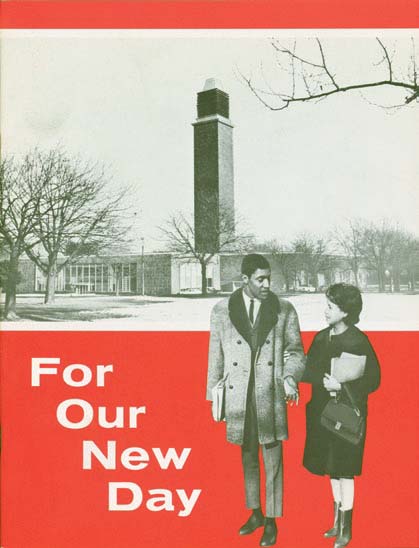
The building was featured on the cover of the Virginia Union University publication in 1965. Image © Virginia Union University Archives and Special Collection, click to enlarge.
The pioneering role of the Belgian Friendship Building was overlooked because it was not an example of the International Style, but also because of confusion about who had designed it. Furthermore, van de Velde’s career during his last years in Belgium did not fit neatly into postwar narratives about Modern architecture. The Belgian building’s location in a Southern city and on an HBCU campus were additional factors that led to its omission from Modern architectural narratives. At the same time, its capacity for supporting African American Richmond’s quest for political equality distinguished it from International Style buildings lauded for their ability to symbolize democratic values. These celebrated buildings stood on Northern campuses that did little in the immediate postwar years to welcome African Americans and that hosted very little campus activism until the anti–Vietnam War protests of the 1960s.
The misunderstanding about who had designed the Belgian Friendship Building was useful for Van Kuyck and the Belgian government in exile in 1940, but it eventually hindered the structure from gaining the widespread recognition it deserved. In 1947, after being charged—but cleared—of collaboration with the Germans in his wartime role in reconstruction planning, van de Velde moved for a second time to Switzerland, where he spent the last decade of his life. In these years, he defined his own contribution largely in terms of his contributions to Art Nouveau and the related design reforms that had flourished at the turn of the 19th into the 20th centuries, rather than on his more recent and far more controversial role as an arbiter of Modern art, architecture, and urbanism in interwar and particularly wartime Belgium. The book tower of his library at Ghent University, completed in 1942, remains one of that city’s most visible structures, but it did not feature in postwar accounts of Modern architecture. These narratives instead stressed Modern architecture’s purportedly socialist origins and democratic present in order to create a usable past for an approach that was now widely seen as offering a useful alternative to classical styles tainted by their associations with fascism and communism. Just over the border from Belgium in West Germany, for instance, many architects who had built successful careers during the Third Reich reinvented themselves as politically acceptable after the war by working in what they described as a Bauhaus style. Van de Velde’s reputation grew over the course of the 1950s and 1960s, but few of those who admired his contributions to Art Nouveau paid much, if any, attention to his late work or were aware that the fruit of one of his most significant final design collaborations actually stood in the U.S.
Victor Bourgeois, Léon Stynen, and Van Kuyck all fared better in postwar Belgium, where there were few challenges left to the International Style, to which all three were then committed. Bourgeois’s most prominent work was a new city hall for the beach community of Ostend. With one short wall devoted to the name of the building and the city’s heraldic shield, and a symmetrical procession of two stories of tall windows set deeply into the main facade and above a recessed ground story, this is a building that regularizes and monumentalizes the more experimental architecture of his youth. Stynen’s BP tower in Antwerp remains one of the most elegant Belgian office buildings of its day. It was the first European building to have its facade literally hung from the roof, and its daring structural system anticipates the High-Tech architecture of the following generation, as well as allowing entirely uninterrupted interiors. Van Kuyck also returned to Belgium, where he renewed his friendship with Egbert Leigh, who briefly worked for U.S. intelligence in Antwerp. Van Kuyck was not as talented an architect as Bourgeois or Stynen, but, possibly because of his work for the Belgian government in exile and the U.S. military, he was extremely good at getting very large commissions. He shared credit for several Brussels office towers. He and Stynen collaborated, for instance, with Marcel Lambrichs on the design of the Finance Tower (1968–82) in Brussels, which is one of the country’s largest and tallest, if not necessarily handsomest, structures. None of the men, however, gained any real recognition in the U.S., despite Van Kuyck’s design of the Belgian embassy in Washington.
Meanwhile, back in the U.S., national and international politics also played a part in the Belgian building’s relative obscurity. The U.S. emerged from the ashes of war as one of the world’s two superpowers. Richmond lay well outside of the national discussion of new approaches to architecture. Championing the International Style as an inherently democratic alternative to fascist monumentality and Soviet Socialist Realism to advance the U.S. side in the Cold War was unconvincing, as communists were quick to point out, if African Americans were denied full political equality. Of the 43 buildings Henry-Russell Hitchcock selected for inclusion in the exhibition Built in USA: Post-War Architecture held at MoMA in 1952, only eight were located in the former Confederacy. None was in Virginia, and none was credited to an architect who was not a white man.
Looking for quick answers on architecture and design topics?
Try Ask RECORD, our new smart AI search tool.
Ask RECORD →
Looking for a reprint of this article?
From high-res PDFs to custom plaques, order your copy today!