Books
‘New York 2020’ Concludes Robert A.M. Stern’s Six-Volume Series Documenting the City’s Built Environment
‘New York 2020: Architecture and Urbanism at the Beginning of a New Century,’ by Robert A.M. Stern, David Fishman, and Jacob Tilove

This review was written prior to Stern's death on November 27.
As far as great endings go, it’s hard to compete with the final line in F. Scott Fitzgerald’s novel The Great Gatsby, where the narrator, Nick Carraway, concludes, “So we beat on, boats against the current, borne back ceaselessly into the past.” The meaning being that our American drive toward an idealized future is always tethered to the circumstances of our history. This is as true for the novel’s titular character as it is for its most important setting—New York City.
It is in this spirit of history as an active participant in the present and a forecaster of our future that Robert A.M. Stern has, for over four decades, been documenting the development and sometimes destruction of New York. His now six-volume series has just concluded with its own great ending: New York 2020, which follows New York 1880, New York 1900, New York 1930, New York 1960, and New York 2000. To call this nearly 7,000-page-long collection a colossus is to understate its scope. It is, without debate, the most comprehensive account of the city’s architecture available, but a case can also be made for its being one of the most significant works of architectural history ever produced.

New York 2020 is the final installment in the now six-book series documenting the city’s architecture. Images courtesy the publisher, click to enlarge.
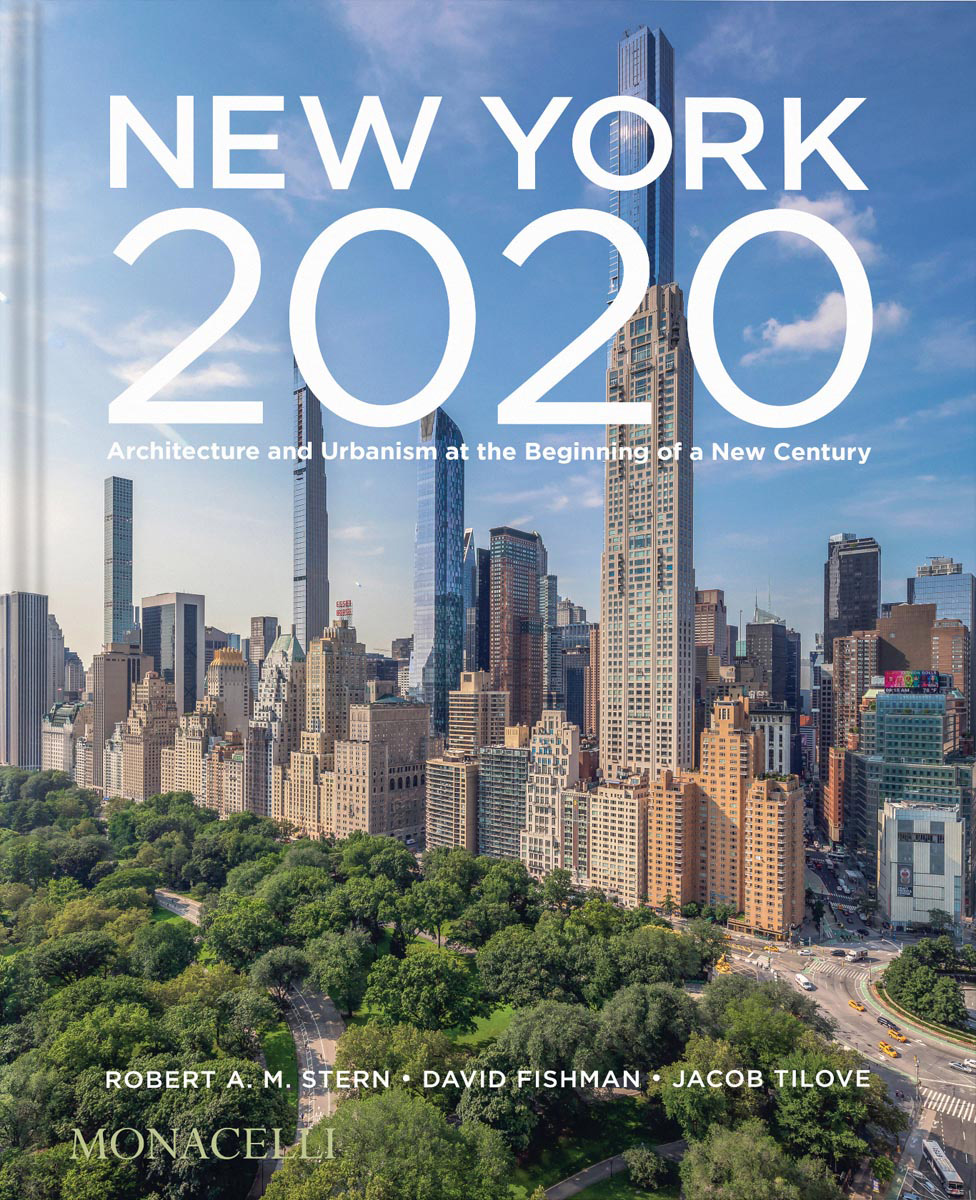
New York 2020: Architecture and Urbanism at the Beginning of a New Century, by Robert A.M. Stern, David Fishman, and Jacob Tilove. Phaidon, 1,488 pages, $150. Image courtesy the publisher
New York 2020, written by Stern with his talented coauthors, David Fishman and Jacob Tilove, documents the city from 2001 to 2020. It is sweeping in its detail, insightful in its selections, and astonishing in its research. While, upon a cursory perusal, one could mistake New York 2020 for a mere encyclopedia of buildings, it is much, much more. A deeper dive reveals that the recent history of our grand city, told through this grandest of books (coming in at nearly 1,500 pages), is peppered with conflict and drama, political intrigue, brilliant and banal architecture by brilliant and banal architects, egotistical critics, strange interlocutors, zealous preservationists, and other behind-the-scenes characters, all of which makes for a readerly odyssey as captivating as anything Homer could have dreamt up.
For many, New York 2020 will also be a more personal journey than most forays into history, as the material exists somewhere in the blurred interstices between the forgotten past and recent memory. This was particularly true for me—I launched my own architectural firm in the same year that the book’s architectural coverage begins with, 2001, just prior to the September 11 attacks that would redefine the trajectory of the city and the nation. The documentation of this harrowing moment in New York is covered in over 100 pages that track the story through destruction, cleanup, and recovery, and through the visionary and idealistic responses of the architectural community that would, like Jay Gatsby, never realize anything close to their original grand ambitions.
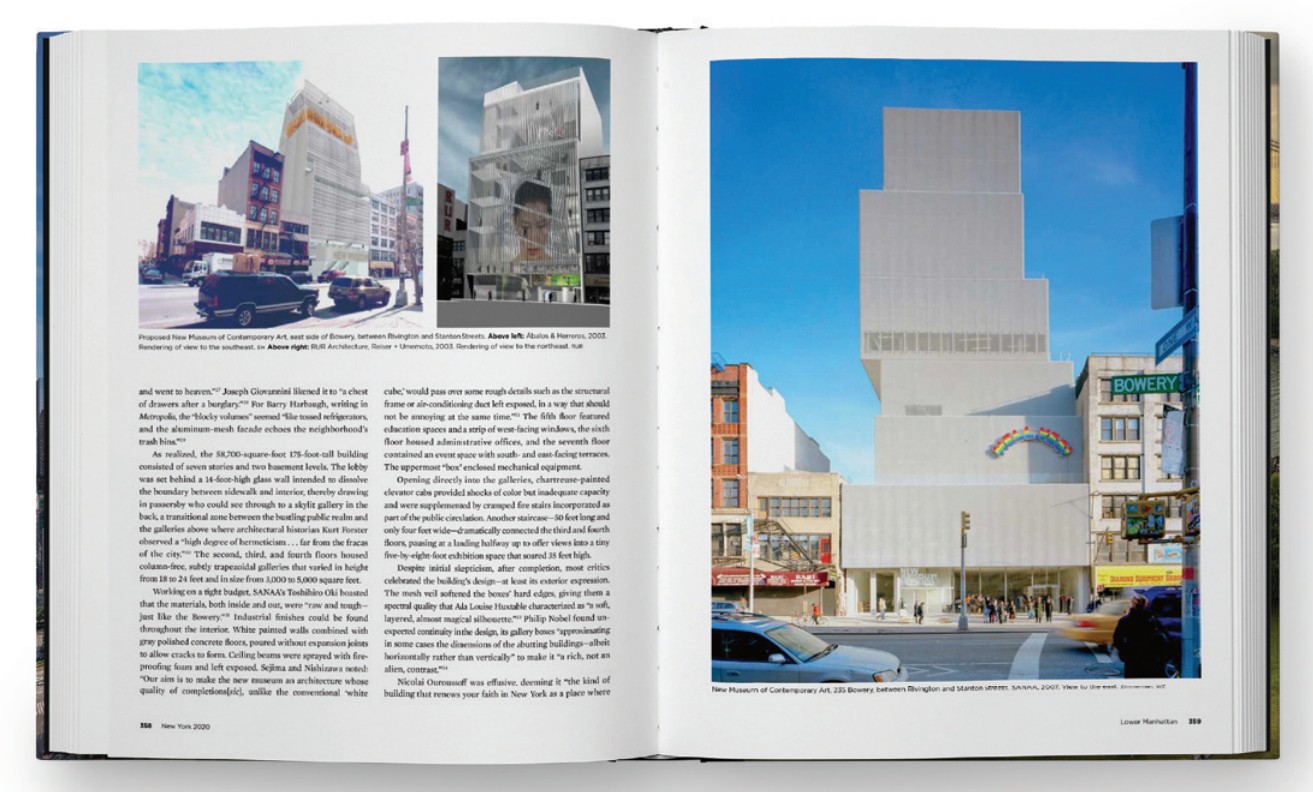
Projects like SANAA’s New Museum are covered in depth. Image courtesy the publisher
Moving out from the World Trade Center story and site, the book unfolds geographically, spiraling through Lower Manhattan into Midtown, Upper Manhattan and—more than the other volumes in the series, given their later development—features projects in Brooklyn, Queens, the Bronx, and Staten Island. It also covers broader city-wide developments in transportation, public spaces, climate-resiliency plans, affordable-housing developments, infrastructural construction, and urban-furniture designs. The volume introduces the emergence of the surprisingly weird typologies that appeared during these two decades, which range in scale from low-cost buildings stuffed with Subaru-size micro-apartments to outrageously expensive supertall residential towers that, like Bauhaus needles, deliriously inject billionaires into the lower atmosphere.
As with nearly all architectural history, another narrative runs silently parallel to the architectural chronology of New York 2020, a story of the uneven distributions of wealth that have reached peak vulgarity in the United States, and especially in New York, over these past two decades. While the current climate of competitive moral outrage in the discipline would normally require red-faced apoplexy at these disparities, the writers take a more neutral approach that, I believe, will serve much better over the longer term and make the book useful for future generations of readers in times beyond our current national shortcomings. In the preface, the authors address this strategy, writing: “Despite the temptation to play critic, we have endeavored to keep the authorial tone down, preferring to let the city tell its own story.” This must have taken a tantric level of restraint, as I found myself frequently charged with the tingly static of unblurted criticism at the relentless documentation of so many of the banal and featureless glass boxes that have come to dominate our cityscape. (In the interest of full disclosure, several of my own office’s designs, often counter-proposals against this particularly mind-numbing trend, are featured in the book.) A depressing aspect of the series is that, as one journeys through them sequentially, it’s hard to not conclude that the design of the architecture of New York has become notably uglier over time. That is not to say that there are not peaks and valleys in each of the prior decades and volumes, only to note that our technological ability to produce individual creative acts has far outpaced our ability to collectively produce beautiful and cohesive communities for cosmopolitan life.
Beyond individual buildings, the authors devote attention to the unique developments that have redefined the city, including everything from the perhaps ethically dubious but delightful Little Island by designer Thomas Heatherwick to the masterful redevelopment of the abandoned West Side Railroad viaduct as the High Line by Diller, Scofidio + Renfro and Field Operations. While becoming a beautiful addition to the city, this sinuous elevated urban park, perhaps unexpectedly, also functioned as an overflowing irrigation trench pumping vast amounts of developer cash into Chelsea and fertilizing a substantial “starchitecture” boom of innovative but not exactly neighborhood-producing buildings—thereby revealing the strengths and weaknesses of concentrating too many brand-name architects in one place. This problem is nearly comically exaggerated at the northern terminus of the High Line, where we encounter one of the largest developments in New York history, Hudson Yards. Like a 30-acre chunk of Dallas that was airlifted and dropped into New York, this mostly flavorless and certainly anti-urban development is a wonder of planned corporate mediocrity, and it is covered in great detail in the book—a blessing for future architects, who will now know how to avoid repeating any aspect of it.
Looking for quick answers on architecture and design topics?
Try Ask RECORD, our new smart AI search tool.
Ask RECORD →
A particularly unique feature of New York 2020 is that its headlining author was duty-bound to include so much of his own work. While normally this would produce a scholarly conflict of interest, there is simply no way around the fact that during this period, Robert A.M. Stern Architects (now RAMSA) had a significant impact on the city’s built fabric. While publishing such detailed histories would, for most, be a full-time job, Stern somehow managed to do it while simultaneously running his often 300-plus-person architecture firm, serving as the dean of the Yale School of Architecture from 1998 to 2016 (where I have also taught since 2001), and publishing numerous other books and articles.
Although I lived in the city for the entire period covered by this final volume, I was surprised by the sheer quantity of what had been built in the last two decades right under my nose—a sentiment that seems to have been shared by the authors, who had originally planned the series to end with the last volume, New York 2000. They note that the “especially robust and architecturally significant building activity through the city during the first two decades of the 21st century convinced us to write New York 2020, carrying the account forward to the immediate past.” We should be glad they did, as they reveal the detailed stories behind not only New York’s recent architectural past, but what its aspirations have been for its future as it charged headlong into the new millennium. Readers are offered insights into multiple possible alternate futures through visionary, if unrealized, proposals including multiple World Trade Centers, the 2012 Olympics plan, reimaginings of Penn Station and Madison Square Garden, and smaller-scale interventions like the subterranean “Lowline” park and the technologically significant competition for the Eyebeam Museum of Art & Technology that introduced a new generation of digital architectural visions to New York by architects including Greg Lynn, Preston Scott Cohen, Thomas Leeser, and Asymptote Architecture.
Of the proposals that were actually built, the coverage of the so-called supertalls is particularly illuminating, given that it’s a building type so new, so visible, and so specific to New York. The authors, in typical high-resolution detail, describe the ritzy history of 57th street, the site of most of the supertall towers (and, accordingly, nicknamed “billionaires’ row”), going back as far as 1873, with Russell Sturgis’s three-building row at 4–8 West 57th Street—the center unit of which was the home of Theodore Roosevelt Sr., father of President Teddy Roosevelt. This auspicious site is also across the street from the incubator of another presidency—the monolithic monument to excess that is Trump Tower—described at the time by Michael Sorkin as “wrong on absolutely every urbanistic count” as covered in New York 2000. This unusual historic backdrop sets the stage for the even more unusual alignment of the structural, political, and financial mechanics that would align in the past decade and yield some of the most dramatic skyscrapers ever built. The Shakespearean dramas of these are told in towering detail, including those of the unfathomably bland supertalls by Adrian Smith + Gordon Gill Architecture and Christian de Portzamparc, and the now crumbling 432 Park Avenue by Rafael Viñoly, that was, presciently, based on the design of a trash can. More elegant contributions to the skyline come from the Steinway Tower by SHoP Architects and the comparatively shorter but no less stately Irish twins by RAMSA at 520 Park Avenue and 220 Central Park South, the latter of which also graces the book’s cover, cheekily eclipsing Smith + Gill’s far taller Central Park Tower.
The publication of New York 2020 is, for the moment, the end of the story of the city’s architecture as told by Stern, Fishman, and Tilove. The authors have quite simply run out of history, and, although superhuman in his accomplishments, Stern, even at a spry and witty 86 years old, is unlikely to be here to tell the tale of New York 2050. But let’s hope someone is. For now, we are armed with our past, ready to imagine, propose, plot, and build the next chapter. Until then, and in the great ending line of the authors themselves, “New York has begun to settle into its familiar patterns—ready for its next roller-coaster ride.”
Looking for a reprint of this article?
From high-res PDFs to custom plaques, order your copy today!