Civic Architecture 2026
A Truss-Filled Floor Floats Amid Towers at a Swiss Broadcasting Complex Designed by Office KGDVS
Lausanne, Switzerland
Architects & Firms
A century ago, early in 1926, the Scottish engineer John Logie Baird unveiled the Televisor, the world’s first mechanical television system. Once perfected, this invention sparked intense fervor within architectural circles. As the historian and critic Mark Wigley has argued, the idea of global broadcasting made possible by boundless invisible waves promised—or perhaps threatened—to either disrupt the built environment or magnify it to the scale of the planet. “Architecture, the field devoted to defining limits, was uncertain how to react,” he wrote in 2024.
Today, at the new Radio Télévision Suisse (RTS) headquarters in Lausanne, Switzerland, the question persists. How does architecture respond to the ongoing evolution of media, and how does it relate to producers and audiences?
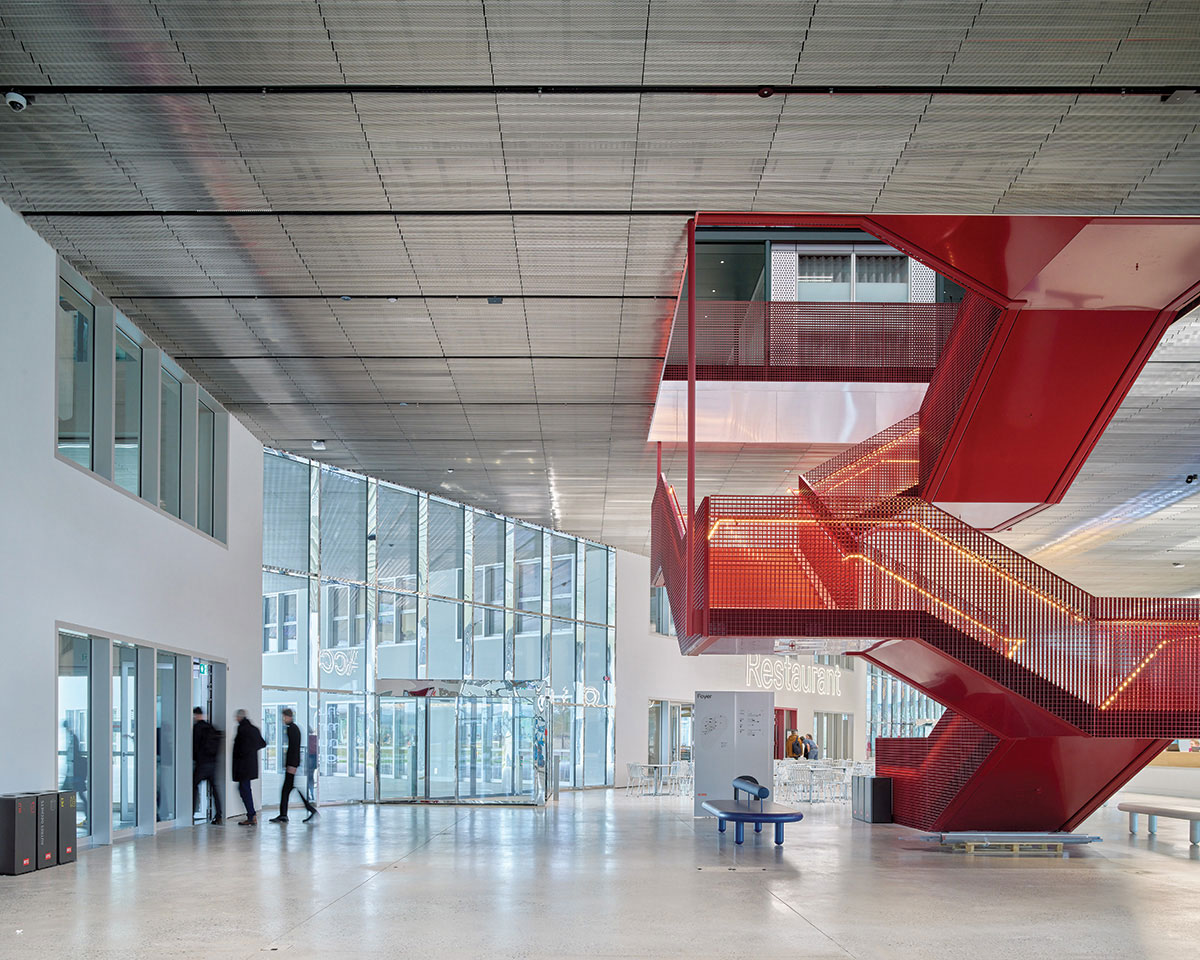
The lobby, enclosed between the towers, includes a café. Photo © Bas Princen, click to enlarge.
RTS is the subsidiary of the Swiss Broadcasting Corporation operating in the French-speaking part of the country. Its headquarters—a broadcasting center combined with public, educational, and research facilities—marks an ambitious undertaking. Costing 164 million Swiss francs [$211 million], the project gathers regionally dispersed functions into an integrated, cross-media building.
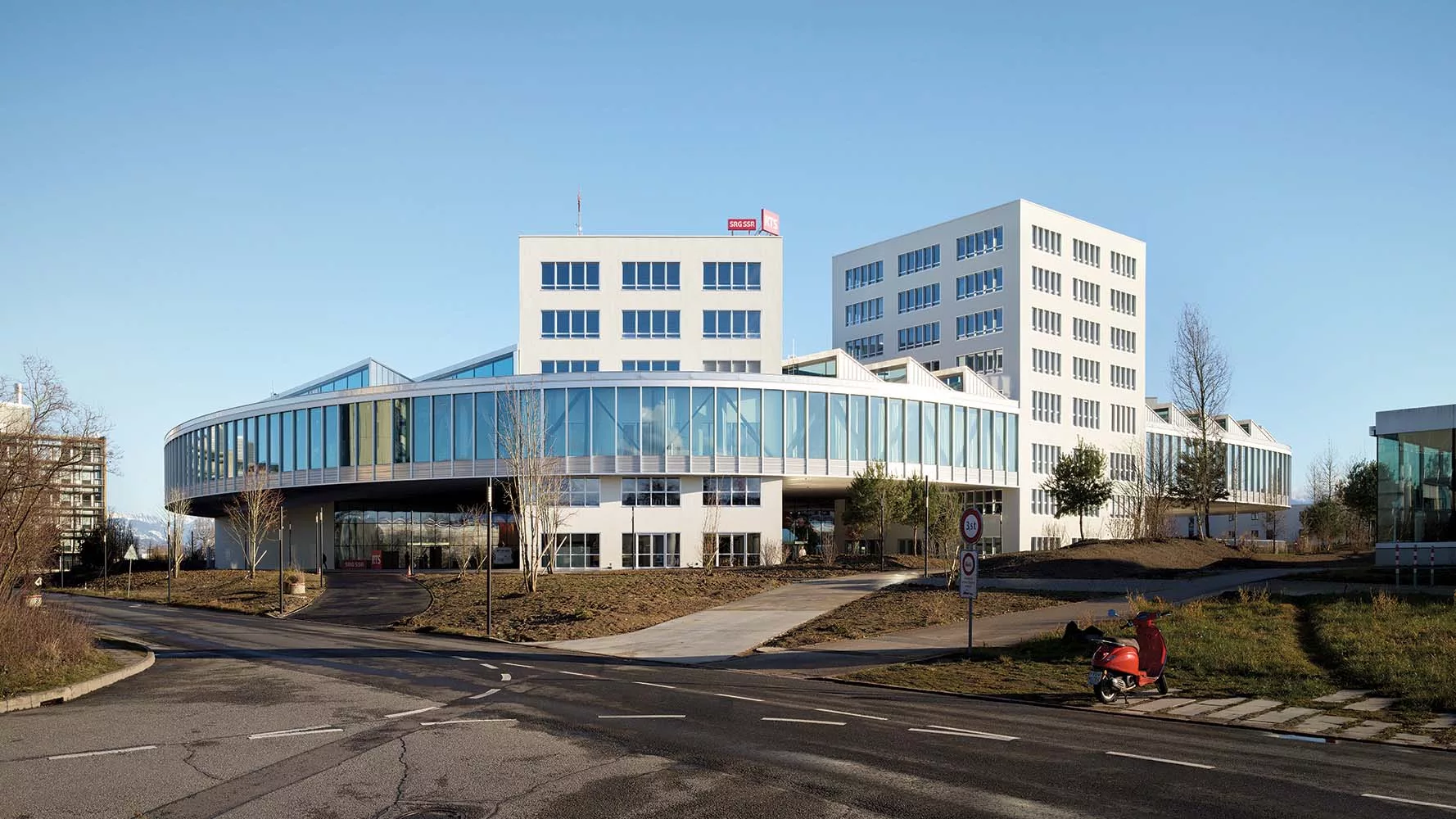
Readers may be familiar with the Rolex Learning Center by Pritzker Prize laureates Kazuyo Sejima and Ryue Nishizawa. The RTS headquarters, designed by Office Kersten Geers David Van Severen (KGDVS), stands adjacent to it on the campus of the École Polytechnique Fédérale de Lausanne along the shores of Lake Geneva. If the Japanese architects’ building, seen in plan, resembles a giant slice of Emmentaler cheese (a slab of concrete perforated by curvilinear holes), its new neighbor presents itself as its formal inverse—a kidney-shaped perimeter enclosing four rectangles. In section, however, these rectangles are box-like towers, each accommodating a distinct program: broadcasting and recording studios, technical and educational facilities, administrative offices, and logistics. The curvilinear outline, instead, materializes 26 feet above ground, forming a plateforme that links the entire complex with a 64,800-square-foot open space with panoramic views.
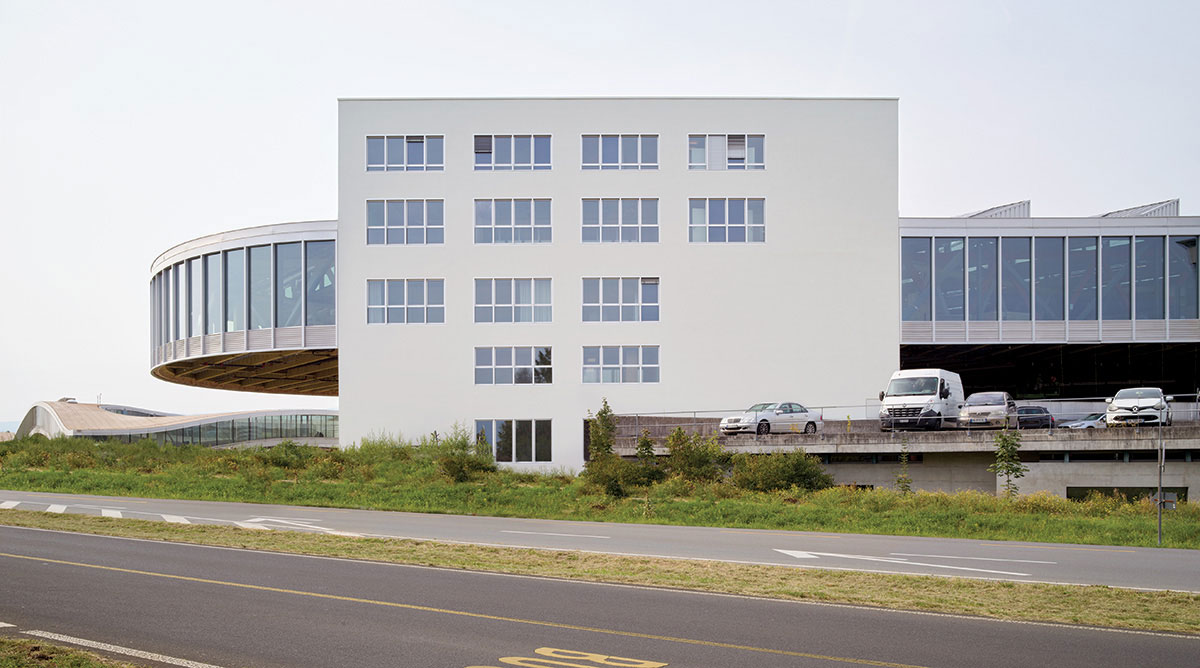
Located on the campus of the École Polytechnique Fédérale de Lausanne, the building sits adjacent to the Rolex Learning Center (pictured left). Photo © Bas Princen
“Four boxes and a field,” the architects say; a diagram that confirms Office KGDVS’s predilection for creating tension with curves and sharp edges, as in its unrealized project for Flemish Radio Television in Brussels (2014), rendered as a square box on a faceted base. Given Kersten Geers’s close engagement with Aldo Rossi—whom he honored with an insightful exhibition and a book—one might expect the four towers of RTS to act as abstract “urban facts,” as the Italian architect would have called them, within the Swiss campus. Unfortunately, they fail to sublimate into metaphysical primary elements of the district, instead conveying a dull industrial character.
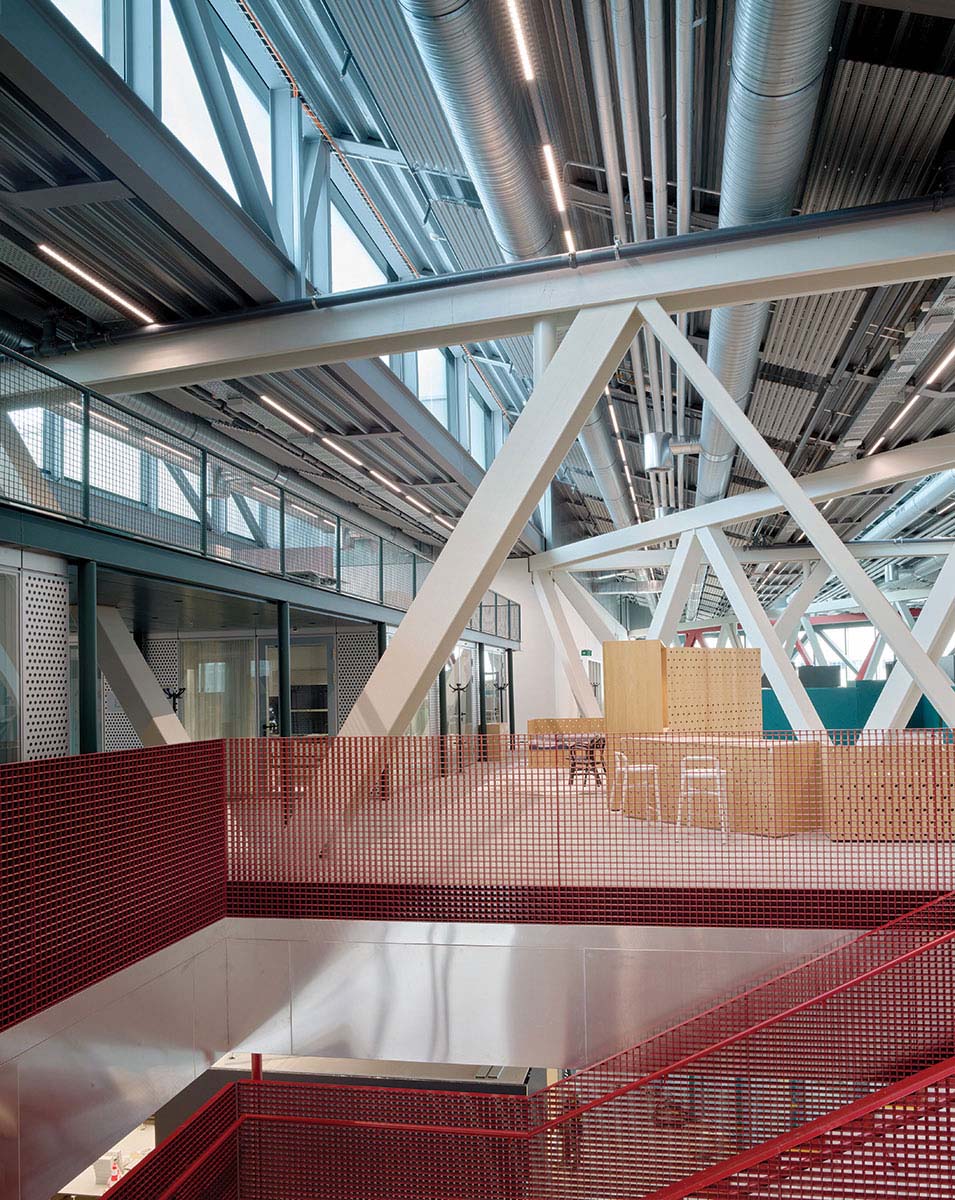
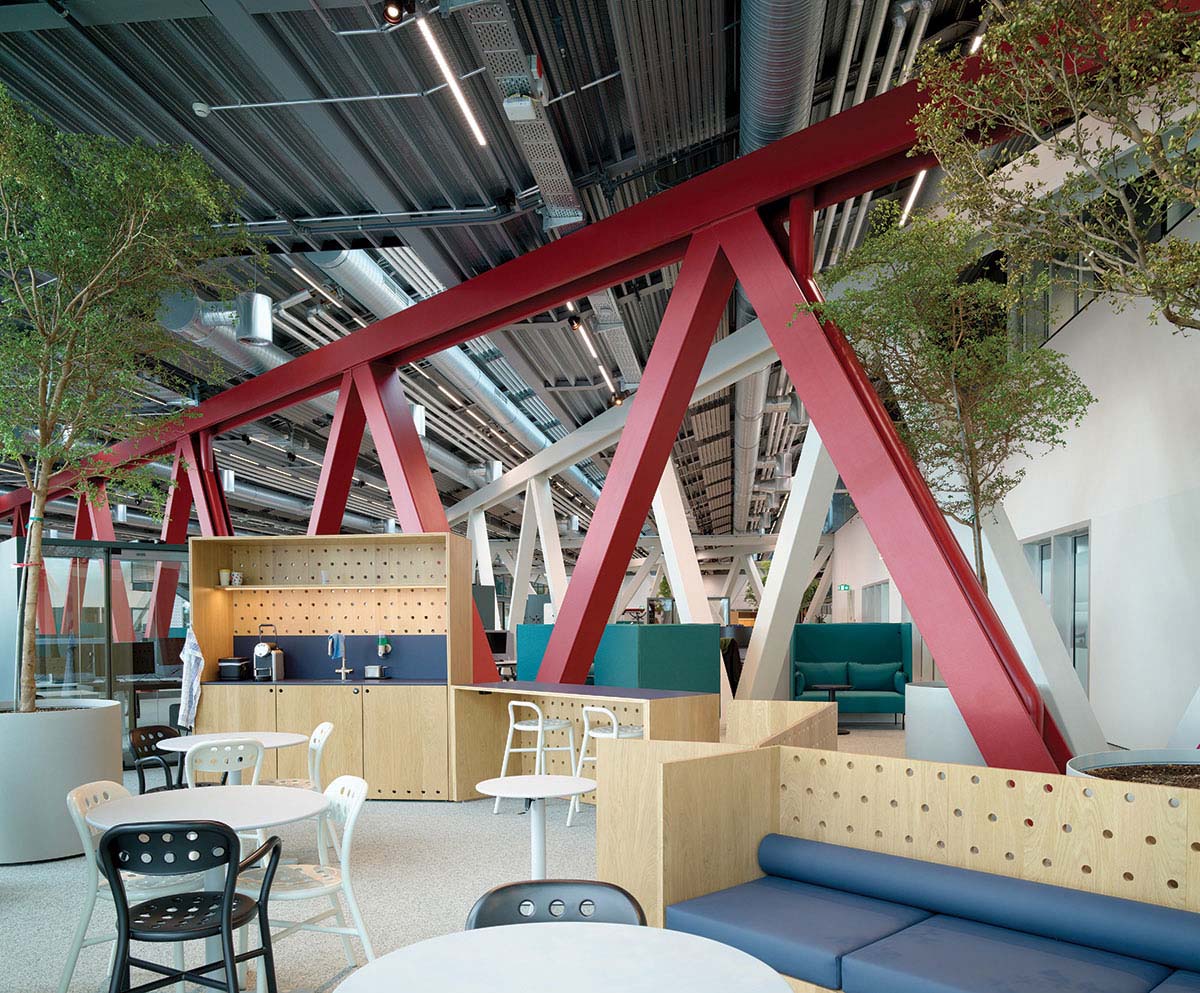
The platform, by contrast, has greater expressive force thanks to a constructivist interweaving of massive Warren trusses into a plan that is topped by shed roofs and solar panels. Up to 200 feet long and alternately painted white or red (the Swiss flag?), the trusses cut through the space, offering both visual permeability and a physical slalom on a sound-dampening floor. Paraphrasing Rem Koolhaas, who spoke of a “Vierendeel concept” for his 1990s projects made with Arup engineers, we might read it as a “Warren syndrome” that gives rise to a gigantic, inhabited truss. The sensation is that of being guests in a collective plaza and, at once, voluntary prisoners of so-called junkspace dominated by a looming exposed ceiling dense with ducts and mechanical devices.
1
2
Red- and white-painted trusses crisscross the platform (1 & 2). Photos © Bas Princen
It is unfortunate that certain details diminish the strength of this idea. From the outside, little of it is perceptible, and the juxtaposition of the box and the field does not appear fully resolved. The platform brushes against, touches, or embraces the towers, but without truly possessing them. Inside, the parti is diluted by a rather chaotic landscape of furnishings (including workstations, booths, mezzanines, shelving, plants, and kitchenettes), which heightens a sense of structural redundancy. Moreover, a key detail—the junction between the trusses and the corners of the towers where they rest—does not appear convincingly designed, with awkward cutouts in the cladding panels.
Looking for quick answers on architecture and design topics?
Try Ask RECORD, our new smart AI search tool.
Ask RECORD →
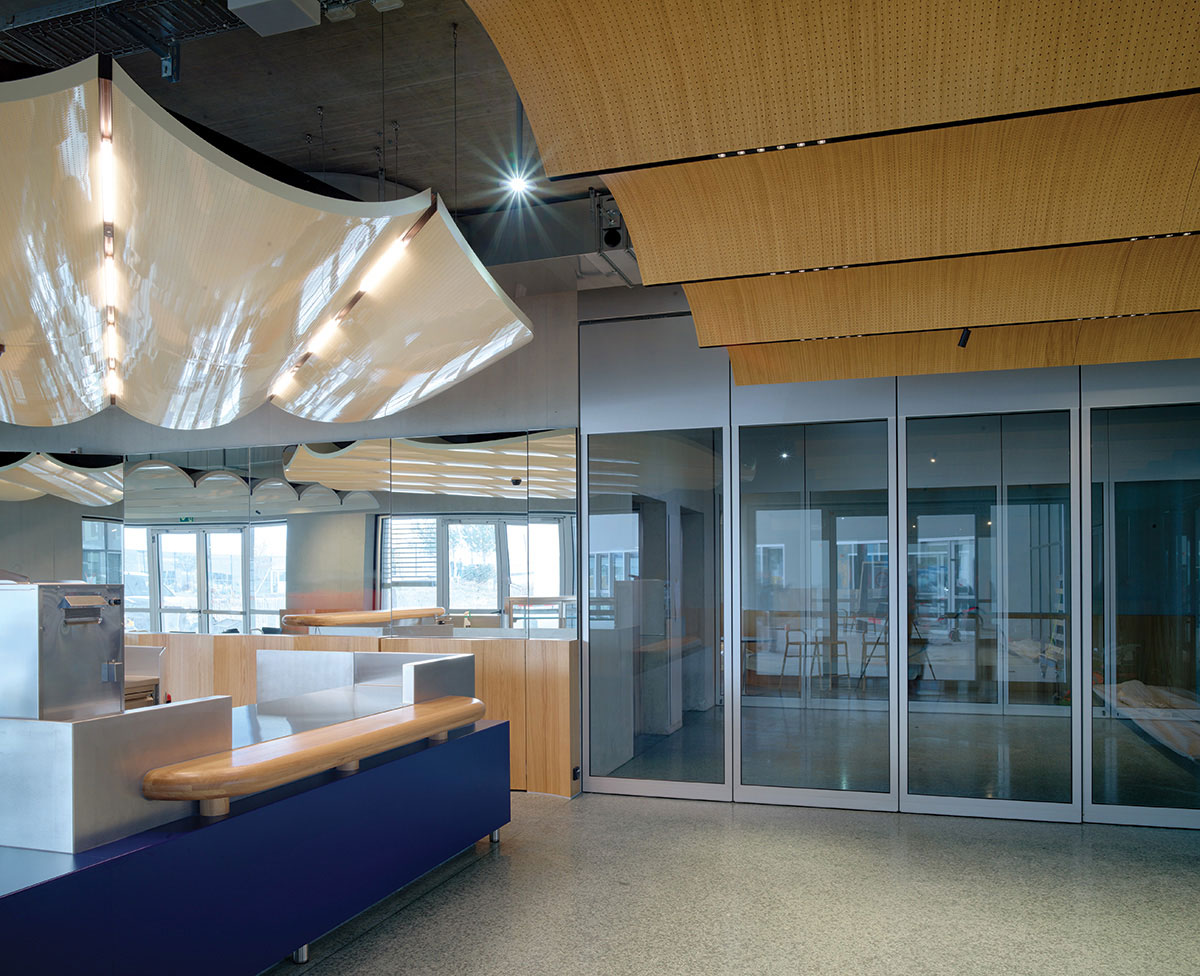
Scalloped acoustic panels dampen interior sounds. Photo © Bas Princen
However, the grand gesture produces intriguing spaces. The platform covers two large outdoor areas beneath it—one for the public, the other for logistics (including deliveries)—creating a horizontal dynamism that draws the eye toward the lake, the mountains, and the nearby Rolex slice. It also shelters a vast, canted glass foyer, open to the public, which offers a welcoming pavilion and illuminated signage directing visitors to the restaurant and to the various departments. Cool tones (perforated metal ceiling panels, aluminum furnishings, exposed concrete flooring), and a lingering sense of emptiness, set off the sculptural staircase that leads employees to the upper level, made of Swiss-red metal grating. In Switzerland, concrete quality rivals that of watches and chocolate, but exposed béton brut is not foregrounded here, partly due to the need for soundproofing. It does appear, however, in the elegant circular and oval staircases inside the towers. The building consists of many functions: studios, offices and exhibition spaces, workshops, meeting rooms, makeup areas, server rooms, and everything else necessary for production.
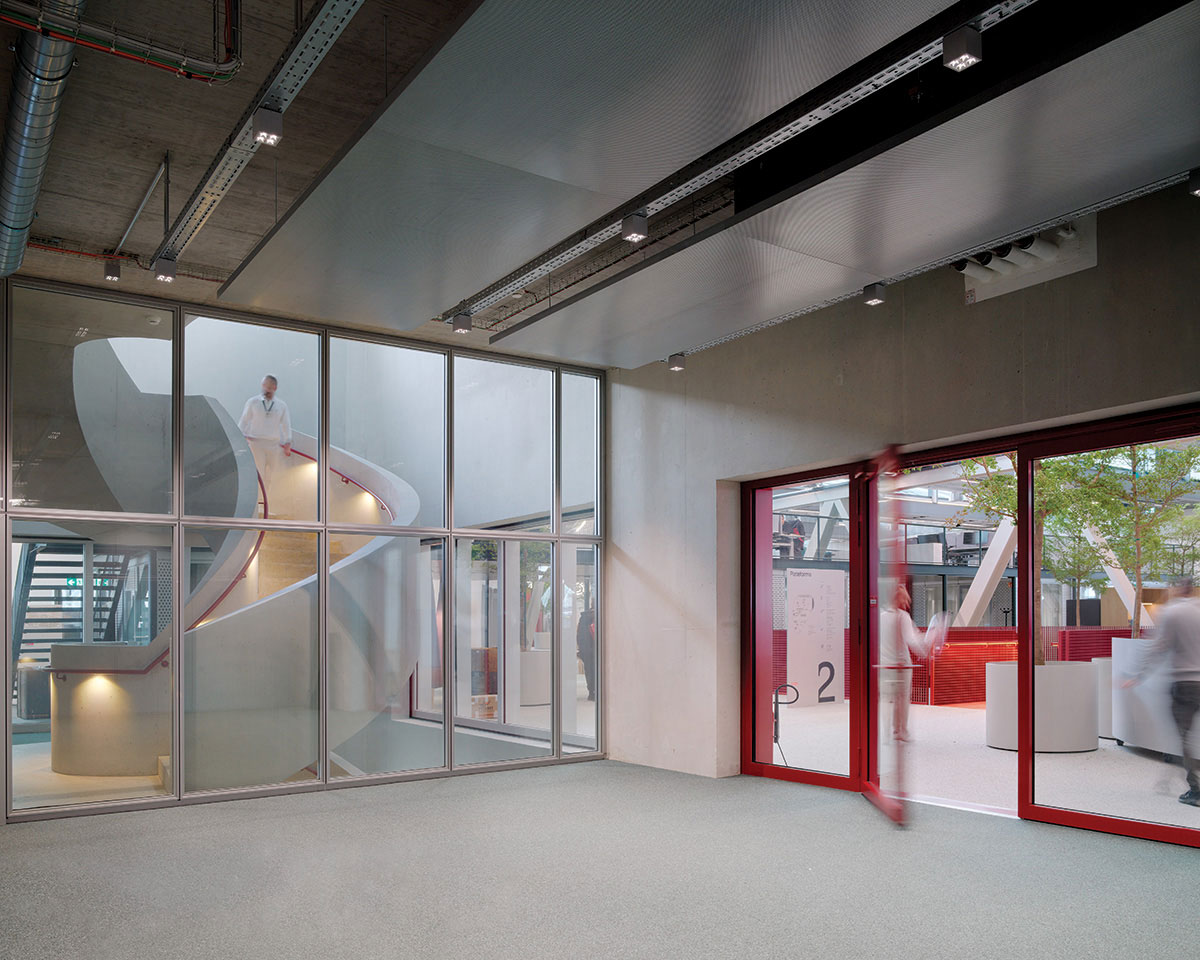
Staircases corkscrew through the office volumes. Photo © Bas Princen
But what of the initial question regarding the relationship among this architecture, the media it houses, and the public that produces and experiences them? The RTS headquarters deliberately refrains from shouting its identity, thus distancing itself from the countless projects—from 1960s Archigram to One Times Square—that equated media and architecture, often reducing buildings to giant screens. Paradoxically, its broadcasting character is instead conferred by the adjacent Odyssea tower, a former relay station of concrete and steel whose antenna lends the RTS building a technological aura now decidedly yesteryear. Instead, the new project pursues a stable form able to accommodate changing media and, above all, its inhabitants. Conceived around 2014, it has already withstood a decade of technical, social, and political shifts, amid sustained debate over public television in Switzerland—this month, a referendum will be held proposing a drastic cut to the public broadcasting license fee.
All this may bring us back to Victor Hugo’s 19th-century cry, “Ceci tuera cela [this will kill that].” Architecture has lost the communicative role it once held in the age of great cathedrals—overtaken, first, by the printing press and today by the smartphone. Yet, as this new project demonstrates, human bodies continue to demand spaces for gathering, despite the pervasive presence of invisible waves that constantly pass through us all.
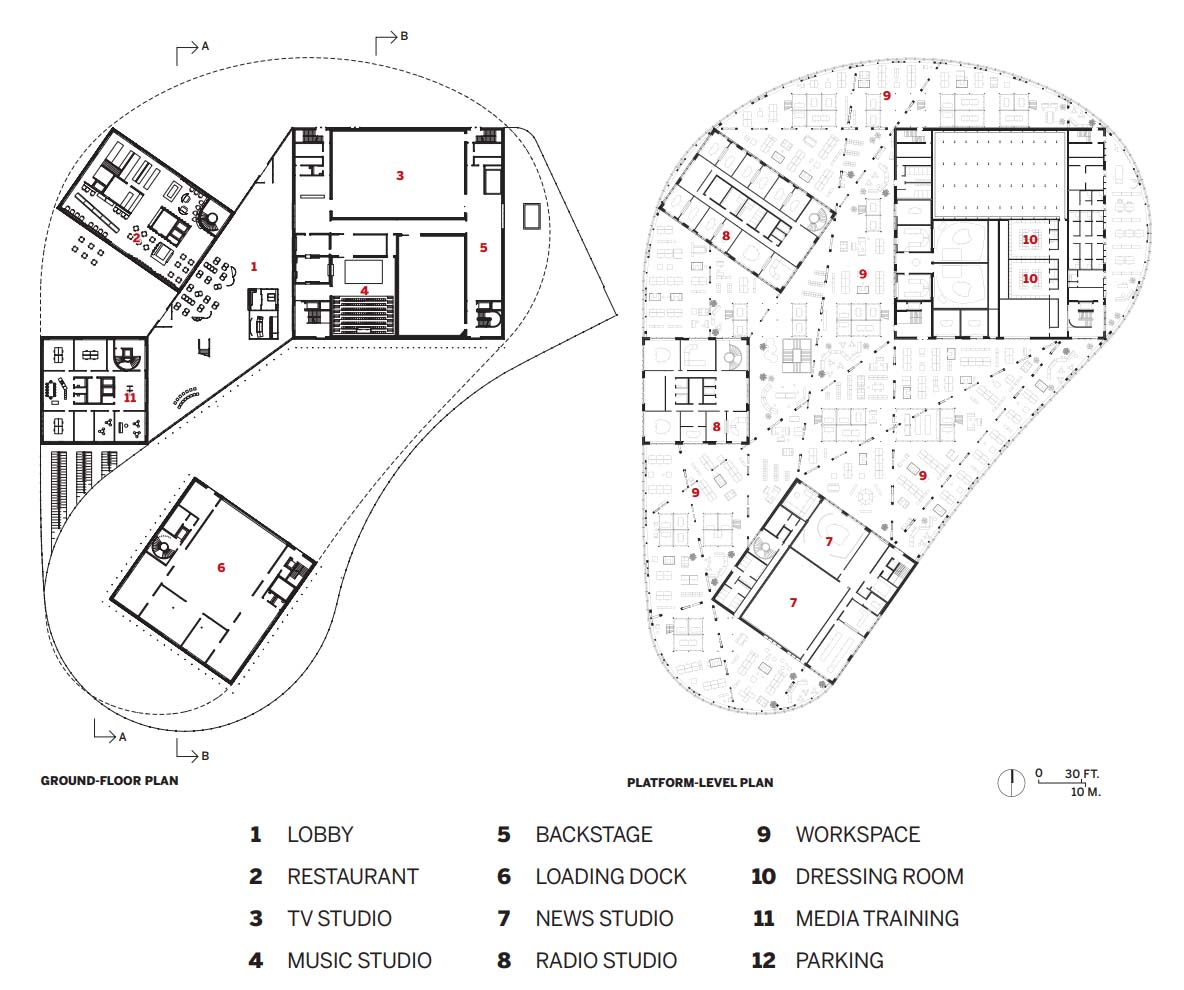
Image courtesy Office KGDVS
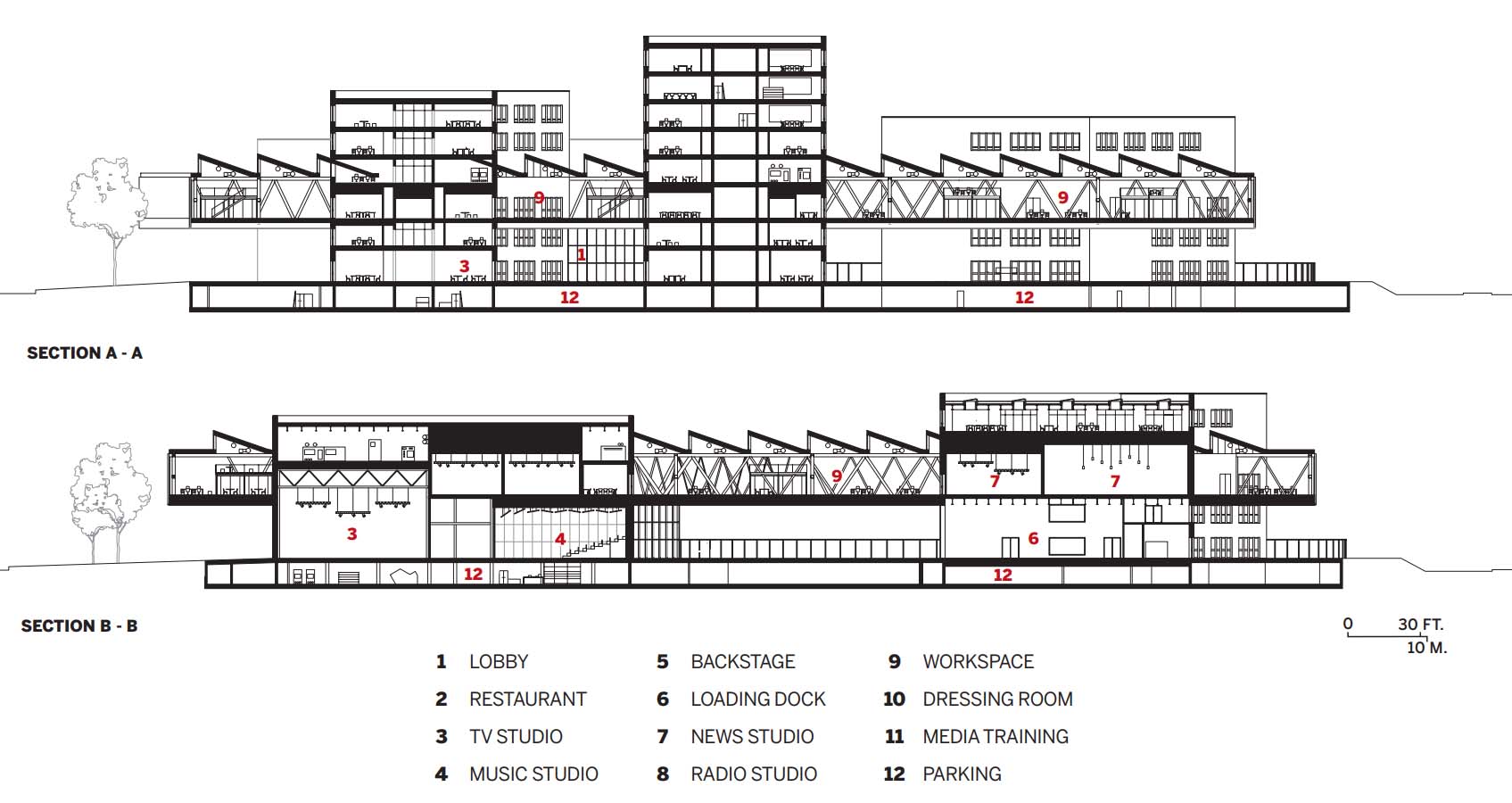
Image courtesy Office KGDVS
Credits
Architect:
Office KGDVS
Associate Architect:
Fehlmann Architectes
Engineers: Bollinger+Grohmann, Ingeni (structural); BCS (facade); AZ Ingénieurs (sanitation); MAB Ingénierie (electrical)
Consultants:
Bureau Bas Smets (landscape); Les Éclaireurs (lighting); Amstein + Walthert, Alweol (automation); Estia (climate); SRG Engineering (safety); Décibel Acoustique, Walters Storyk Design Group Basel (acoustics)
Client:
Société Suisse de Radiodiffusion et Télévision
Size:
435,940 square feet
Cost:
$211 million (total)
Completion:
December 2025
Sources
Structure:
Induni & Cie (concrete); Sottas (metal); Orllati (foundation); Freyssinet (joinery)
Cladding:
Bemo (metal roofing); Sto (insulation)
Lighting:
Smartlux, Neuco, Zumtobel, XAL; Equans (dimming)
Windows/Doors:
Hueck, Jansen, Savoretti, Gilgen, Bator, Delta, Forster
Glazing:
Vetrotech, SageGlass
Hardware:
Assa Abloy, DormaKaba, Siemens
Looking for a reprint of this article?
From high-res PDFs to custom plaques, order your copy today!