Architectural Record
search
cart
facebook twitter linkedin youtube
  • Sign In
  • Subscribe
  • Sign Out
  • My Account
Architectural Record
  • NEWS
    • Latest News
    • Awards
    • Interviews
    • Obituaries
    • Podcasts
      • Design:Ed Podcast
      • Sponsored Podcasts
  • OPINION
    • Book Reviews / Excerpts
    • Exhibition Reviews
    • Forum
  • EXCLUSIVES
    • Videos
    • Design Vanguard
    • Top 300 Firms
    • Sponsored Content
    • Sponsored eBooks
    • From the Archives
  • CONTINUING ED
    • Editorial Continuing Ed
    • CE Center
    • CE Academies
  • PROJECTS
    • Buildings By Type
    • Reuse & Renovation
    • Museums & Arts Centers
    • Colleges & Universities
    • Multifamily Housing
    • Interiors
    • Lighting
    • Kitchen & Bath
  • HOUSES
    • Record Houses
    • House of the Month
    • Featured Houses
  • PRODUCTS
    • Products by Category
    • Record Products of the Year
    • Latest Products
  • EVENTS
    • Dates & Events
    • Record on the Road
    • Innovation Conference
    • Sustainability in Practice
    • Women In Architecture
    • Webinars
    • Ad Excellence Awards
    • Submit an Event
  • CONNECT
    • Ask RECORD AI
    • Newsletters
    • Contact
    • Advertise
    • Editorial Calendar
    • Store
    • Customer Service
  • SUBMIT
    • Submission Guidelines
    • RECORD Competitions
  • MAGAZINE
    • Subscribe
    • My Account
    • Digital Edition
    • Current Issue
    • Firm Pass
    • Historic Archive
Architectural TechnologyArchitect Continuing Education

Alley-Oop: Design Assist
By Matthew Marani
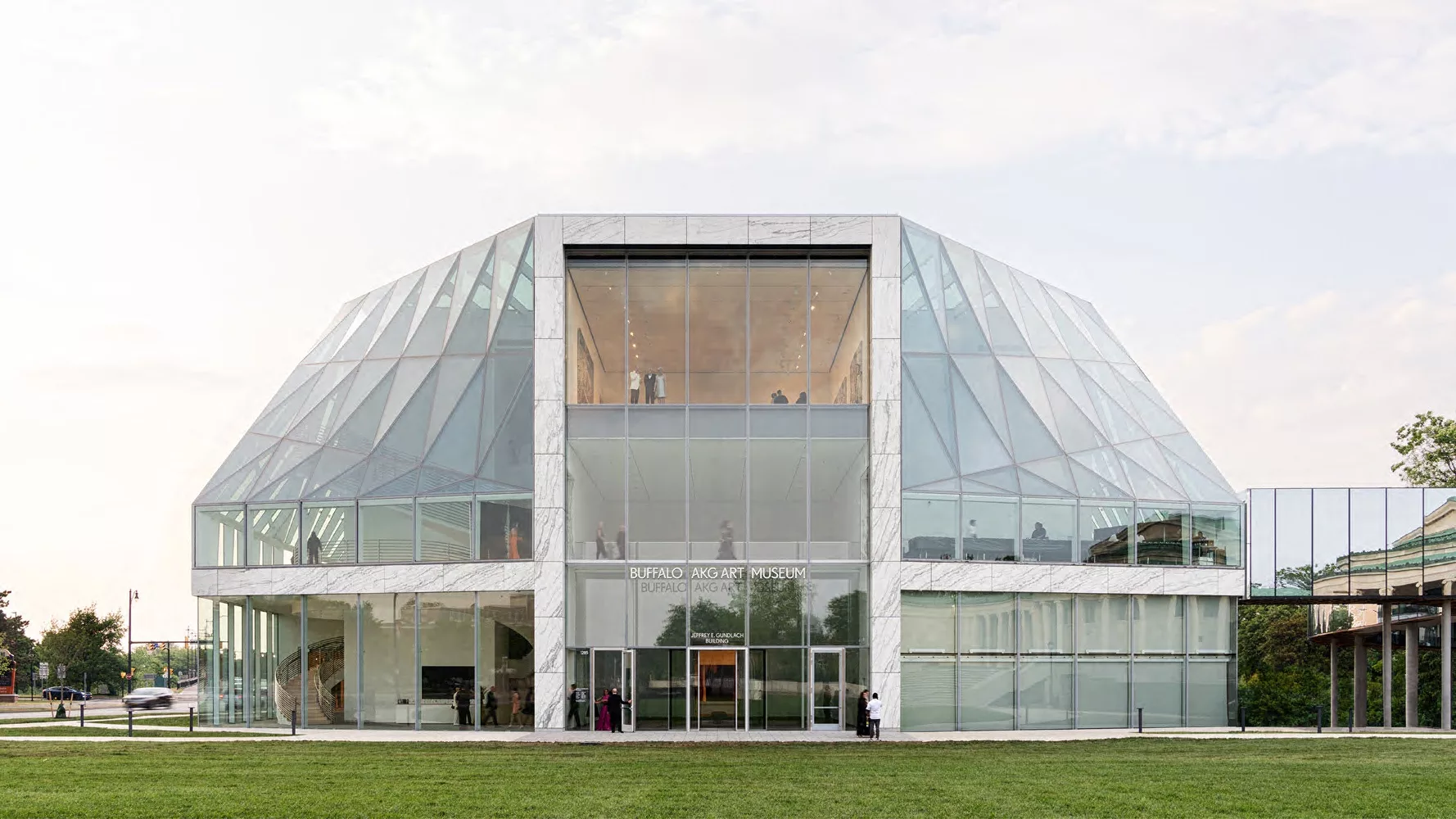
Albright-Knox Gallery.
Photo © Marco Cappelletti

Buffalo AKG Art Museum

June 2, 2026
✕
Image in modal.
When it comes to project delivery, the adage “success has many fathers, while failure is an orphan” often holds true. An incorrect detail or ill-conceived element can easily lead to cost and schedule overruns, with plenty of blame tossed around. But what if there were a different course of action that brought specialty engineers and fabricators, or contractors, into the design phase to lend their expertise? This collaborative approach is loosely denoted as “design assist,” and the method’s potential to provide constructability guidance and budget and timeline certainty, while meeting the demands of increasingly sophisticated building systems, is driving its growing popularity.

In a typical design-bid-build schedule, architects and engineers (of varied stripes) work in relative isolation from fabricators and contractors through the construction-documents phase. Project components—curtain-wall systems, structural steel, and more—are then bid to subcontractors. While this framework clearly delineates responsibilities among the parties involved, lack of early collaboration can lead to expensive change orders down the line, among other issues.

To avoid those problems, design assist brings trade partners into the project schedule during the schematic or design development phases. The process front-loads construction documentation, the shortlisting of vendors for products, and the selection of subcontractors. It is usually conducted under a contract separate from the actual task of fabrication, be it a curtain wall or mass-timber floor plates.

These considerations were high priorities for Ennead Architects while designing Briger Hall, Commons, and School of Engineering and Applied Sciences, at Princeton, which is currently under construction. The 670,000-square-foot precinct comprises four complementary structures connected at ground level. 

Although most of the project is being delivered via design-bid-build, select scopes were identified in which design-assist fabrication could add value. During design development, RFPs were released to calibrate mass-timber elements for the complex’s hybrid steel-and-concrete systems plus four different high-performance building envelopes ranging from panelized brick to unitized glazing with aluminum shading.

“We can draw the most fantastic detail, but it needs to be within budget,” explains Ennead principal Matthew Dionne. “Real-time trade-partner feedback helps to reduce risk, provide schedule certainty, and long-term operational savings.”

LERA Structural Engineers led the overall structural design, while StructureCraft, an engineered-wood design-builder engaged through design assist, played an integral role in fine-tuning and fabricating mass-timber components. The company reduced construction costs by recommending the most efficient dowel-laminated timber (DLT) floor-panel sizes for specific spaces and strategically incorporated lower-grade timber in concealed areas. StructureCraft also provided guidelines for allowable openings in the DLT panels and glulam columns for the seamless integration of MEP infrastructure.

The client sought to exceed the benchmark goals of its campus-wide sustainability action plan. Environmental consultant Atelier Ten played a critical role guiding numerous strategies to reach those ends, including the complex’s high-performance building envelopes. Shanta Tucker, the firm’s U.S. executive director, credits the success of the facade systems that were deployed to the versatility built into early design parameters.

“We established a flexible performance range for insulation and glazing, which allowed the design-assist contractor, Island Facades, and Ennead, to creatively explore solutions to meet overall project requirements,” she notes.

Büro Ehring, a boutique engineering firm based in New York City, often acts as a bridge between the architect and fabricator. Holger Schulze-Ehring, the studio’s principal, states that its design-assist role “usually occurs parallel to a design-bid-build process for the base building, and comes into play for signature or technically demanding pieces.”

One example is the OMA-designed extension to the Buffalo AKG Art Museum. Büro Ehring led the construction-engineering design of the 118,000-square-foot building’s enclosure, including a sweeping glass veil that enshrouds much of the structure. Arup served as the project’s structural engineer and Thornton Tomasetti assisted as the facade consultant.

The studio was engaged toward the end of schematic design, with curtain wall contractor Roschmann Group, to resolve the facade’s complex geometry in a straightforward and cost-effective manner. The elegant solution uses a toggle-clamp detail to integrate glass panes into gaskets that sit atop the veil’s steel frame. It tolerates geometric variation and movement, without point-stressing the glazing, and uses a standardized set of hardware.

In conversation with Karen Brandt and Daniel Vos, principals at Heintges, a façade consultancy based in New York City and San Francisco, both noted that design assist is a strategy to help realize novel and complex enclosures. “It is most useful when there is an architectural ambition beyond normal fabrication capacities,” Brandt says.

She cites two projects developed with German fabricator Josef Gartner: the Whitney Museum of American Art, designed by Renzo Piano Building Workshop and clad in steel panels that are up to 65 feet tall, and Uber San Francisco Headquarters by SHoP Architects, which features expanses of 15-foot-tall operable windows that fold automatically to between 6 and 30 inches in response to thermal conditions. “There are a limited number of contractors that can do this type of work, and design assist helped to hit the mark,” Brandt adds.

Brandt and Vos caution that this collaborative approach is not a panacea for every ill that besets projects. Both contend that in the absence of specific goals or milestones, design assist can err in the direction of mission creep. “Some­ times it is as straight-forward as a successful visual mock-up or as detailed as five curtain wall types, but there needs to be a road map,” says Brandt.

For Vos, a particular concern is that an unqualified or under-resourced fabricator will land a design-assist commission, especially if the fabricator’s in-house design team poorly understands the contracting arm. “It is a real pitfall if they cannot execute later in a timely and efficient manner,” he warns. “And everyone needs to come to the table having done their homework. Otherwise, it is a waste.”

For Roger Chang, a partner at engineering-services practice Buro Happold, securing trade partners through design assist has proved beneficial in keeping complex projects on schedule. The arrangement may include an additional up-front cost, but it provides a better estimate of pricing and availability, to avoid what he calls “bid-day shock.” Chang also cites the proliferation of advanced model-sharing platforms, like Revizto, as expanding the potential for collaboration by design-assist partners, who are now able to easily mark up 3D mock-ups in real time.

However, that level of integration can be a double-edged sword. Chang notes that in one recent circumstance, an MEP subcontractor backed out of a major educational project halfway through the production of construction documents in favor of higher-margin data-center work. “That was an exceptional case, and they left knowing too much about the project,” he says.

Despite its flaws, design assist remains a key strategy for ensuring feasibility and afford­ ability, while, as Tucker puts it “serving as a valuable tool for projects seeking to push the limits of performance and expression.”

Back to Continuing Education: Practice Matters 2026
KEYWORDS: architecture firms

Share This Story

Looking for a reprint of this article?
From high-res PDFs to custom plaques, order your copy today!

Matthew marani

Matthew Marani is a senior editor at Architectural Record. Previously, he served as program manager at The Architect’s Newspaper and has several years of experience as a freelance writer specializing in urban planning, historic preservation, and architectural technology. Matthew is a born and raised New Yorker and holds an MSc in Architectural Conservation from the University of Edinburgh.

Post a comment to this article

Report Abusive Comment

Subscription Center
  • Create an Account
  • Start a Subscription
  • Manage My Account
  • Sign Up for Newsletters
  • Visit Customer Service
  • Update Preferences

More Videos

Sponsored Content

Sponsored Content is a special paid section where industry companies provide high quality, objective, non-commercial content around topics of interest to the Architectural Record audience. All Sponsored Content is supplied by the advertising company and any opinions expressed in this article are those of the author and not necessarily reflect the views of Architectural Record or its parent company, BNP Media. Interested in participating in our Sponsored Content section? Contact your local rep!

close
  • cold storage facility
    Sponsored byCarlisle SynTec Systems

    How Architects Can Design More Continuous Cold Storage Envelopes

  • TAMLYN XtremeTrim Exterior Trim
    Sponsored byTamlyn

    Designing Cleaner Panel Facades: Why Exterior Trim Details Matter

  • Building with Vapor Barriers
    Sponsored byReef Industries, Inc.

    Vapor Barriers Help Control Moisture in Tighter Building Designs

DESIGN:ED Podcast
Listen to Architectural Record’s DESIGN:ED Podcast

Events

June 23, 2026

Enhancing Fire Resistance with Advanced PVC Solutions

Credits: 1 AIA LU/HSW; 1 AIBD P-CE; 0.1 ICC CEU; 1 IIBEC CEH

Evaluate advanced PVC solutions that improve fire resistance, support WUI compliance, and enhance resilience in residential and commercial building design.

June 25, 2026

Designing Glass Railing Systems that Enhance Aesthetics and Meet Code

Credits: 1 AIA LU/HSW; 1 AIBD P-CE; 0.1 ICC CEU

Upon course completion, participants will possess a deeper understanding of glass railings to help ensure that safety, aesthetic, and performance objectives are achieved.

View All Submit An Event

Products

2026 Architect's Square Foot Costbook

2026 Architect's Square Foot Costbook

See More Products

Popular Stories

Lorcan O' Herilhy

California Architect Lorcan O’Herlihy Has Died, Age 66

Obama Presidential Center, Chicago

The Obama Presidential Center Opens on Chicago’s South Side

Spoonbill Ranch

Johnsen Schmaling Architects Integrates Spoonbill Ranch into a Pristine Landscape

Image of Bruce Springsteen Center for American Music

The CookFox-designed Bruce Springsteen Center for American Music Opens in New Jersey

Three Courtyards House

Design Vanguard 2026: Balsa Crosetto Piazzi

Enhancing Fire Resistance with Advanced PVC Solutions - Free Webinar - June 23, 2026

Related Articles

  • Limusina

    GRT Architects’ Design for a Manhattan Garage-Turned-Restaurant Impresses with Extravagant Finishes

    See More
  • Image of HBF's Rhine

    Highlights from the Latest Edition of Boutique Design New York

    See More

Related Products

See More Products
  • 0470126736.gif

    Modern Sustainable Residential Design: A Guide for Design Professionals

  • book5.jpg

    Contemporary Market Architecture Planning and Design

  • 1444336282.gif

    The Handbook of Interior Design

See More Products

Events

View AllSubmit An Event
  • March 25, 2026

    Rewards and Challenges of Design-Assist: Lessons for Students in Collaborative Project Delivery

    NOW ON DEMANDCredits: 1 AIA LU/HSW; 1 AIBD P-CE;  0.1 ICC CEU; 0.1 IACET CEULearn how design-assist collaboration among architects, engineers, and contractors improves efficiency and constructability through real-world case studies and expert insights.
  • July 10, 2025

    Predictive Design: How Architects Can Incorporate CFD Into the Design Process to Improve the Occupant Experience

    NOW ON DEMANDCredits: 1 AIA LU/Elective; 1 AIBD P-CE; 0.1 ICC CEU; 0.1 IACET CEUIn this session, we’ll explore how Computational Fluid Dynamics (CFD) can be used as a practical, design-forward tool to support your vision.
View AllSubmit An Event
×

The latest news and information

#1 Source for Architectural Design, News and Products

SUBSCRIBE
  • RESOURCES
    • Advertise
    • Contact Us
    • Submit
    • Store
  • ACCOUNT CENTER
    • Create an Account
    • Start a Subscription
    • Manage My Account
    • Sign Up for Newsletters
    • Visit Customer Service
    • Update Preferences
  • PRIVACY
    • PRIVACY POLICY
    • TERMS & CONDITIONS
    • DO NOT SELL MY PERSONAL INFORMATION
    • PRIVACY REQUEST
    • ACCESSIBILITY
  • SERVICES
    • Marketing Services
    • Reprints
    • Market Research
    • List Rental
    • Survey/Respondent Access
  • STAY CONNECTED
    • Linkedin
    • Facebook
    • Instagram
    • YouTube
    • X (Twitter)

Copyright ©2026. All Rights Reserved BNP Media, Inc. and BNP Media II, LLC.

Design, CMS, Hosting & Web Development :: ePublishing