This website requires certain cookies to work and uses other cookies to help you have the best experience. By visiting this website, certain cookies have already been set, which you may delete and block. By closing this message or continuing to use our site, you agree to the use of cookies. Visit our updated privacy and cookie policy to learn more.
This Website Uses Cookies By closing this message or continuing to use our site, you agree to our cookie policy. Learn MoreThis website requires certain cookies to work and uses other cookies to help you have the best experience. By visiting this website, certain cookies have already been set, which you may delete and block. By closing this message or continuing to use our site, you agree to the use of cookies. Visit our updated privacy and cookie policy to learn more.
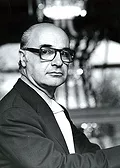
Romaldo “Aldo” Giurgola was born in Rome, Italy, and died this week in Canberra, Australia, the site of his most famous work: a government complex surrounded by bermed earth that made it possible for visitors to walk on and around the building.
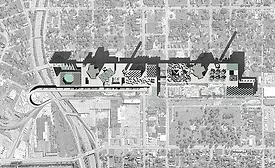
When he was named director of the 15th Venice Architecture Biennale, Chilean architect Alejandro Aravena asked curators to focus on projects that “improve the quality of the built environment and life and consequently people’s quality of life.”
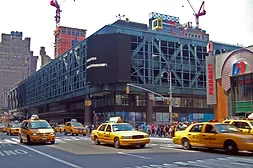
Architects often find competitions — which require large amounts of work for little or no pay – exploitative. The Port Authority of New York and New Jersey did little to improve that situation when, on March 11, it announced a competition to replace Manhattan’s 65-year old Port Authority Bus Terminal.
Since the 1990s, the U.S. State Department has been barred from spending public funds on world expo pavilions. The result has been a series of disasters: the U.S. was a no-show at the expo in Hanover, Germany, in 2000; it then built lackluster, overly commercialized pavilions for the 2005 and 2010 expos in Aichi, Japan, and Shanghai, China.
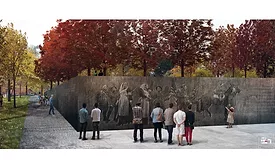
The United States got in and out of World War I in well under two years. The U.S. World War I Centennial Commission hopes it can move as quickly. Yesterday, it chose a design for the National World War I Memorial by Joseph Weishaar, a 2013 graduate of the Fay Jones School of Architecture at the University of Arkansas.
Lincoln Center spent more than $1 billion on a series of renovations by Diller Scofido + Renfro, while leaving two of its largest buildings untouched. Now it plans to spend $500 million to renovate the interior of David Geffen Hall.
Design fairs are crawling with collectors ready to drop thousands of dollars on objects that promise immediate gratification. Case in point: The charming beaded sculptures made by the Los Angeles brothers Nikolai and Simon Haas with the help of women from South Africa’s Khayelitsha Township. The objects—oversized mushrooms and Sendak-like animals—sold out within a half hour of the opening of Design Miami last Tuesday, at up to $150,000 apiece.