Architectural Record
search
cart
facebook twitter linkedin youtube
  • Sign In
  • Subscribe
  • Sign Out
  • My Account
Architectural Record
  • NEWS
    • Latest News
    • Awards
    • Interviews
    • Obituaries
    • Podcasts
      • Design:Ed Podcast
      • Sponsored Podcasts
  • OPINION
    • Book Reviews / Excerpts
    • Exhibition Reviews
    • Forum
  • EXCLUSIVES
    • Videos
    • Design Vanguard
    • Top 300 Firms
    • Sponsored Content
    • Sponsored eBooks
    • From the Archives
  • CONTINUING ED
    • Editorial Continuing Ed
    • CE Center
    • CE Academies
  • PROJECTS
    • Buildings By Type
    • Reuse & Renovation
    • Museums & Arts Centers
    • Colleges & Universities
    • Multifamily Housing
    • Interiors
    • Lighting
    • Kitchen & Bath
  • HOUSES
    • Record Houses
    • House of the Month
    • Featured Houses
  • PRODUCTS
    • Products by Category
    • Record Products of the Year
    • Latest Products
  • EVENTS
    • Dates & Events
    • Record on the Road
    • Innovation Conference
    • Sustainability in Practice
    • Women In Architecture
    • Webinars
    • Ad Excellence Awards
    • Submit an Event
  • CONNECT
    • Ask RECORD AI
    • Newsletters
    • Contact
    • Advertise
    • Editorial Calendar
    • Store
    • Customer Service
  • SUBMIT
    • Submission Guidelines
    • RECORD Competitions
  • MAGAZINE
    • Subscribe
    • My Account
    • Digital Edition
    • Current Issue
    • Firm Pass
    • Historic Archive
Architecture News

A Friendlier, More Intimate David Geffen Hall Makes its New York Debut

By James S. Russell, FAIA Emeritus
Geffen-Hall-1.jpg
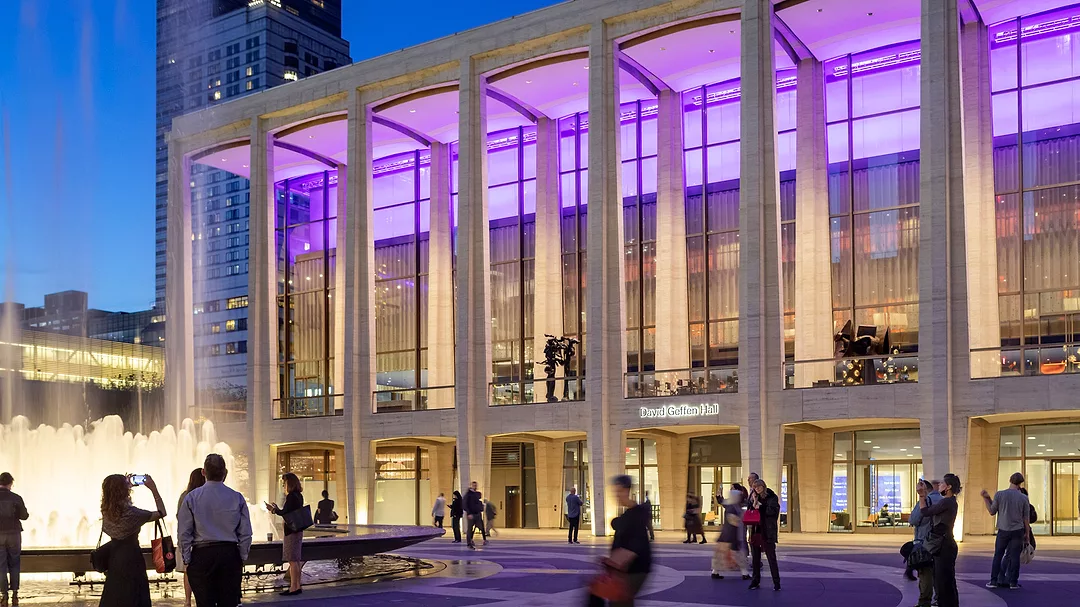
The reimagined David Geffen Hall illuminates Lincoln Center’s Josie Robertson Plaza. A 12-foot-tall fritted glass band by Bendheim Architectural Glass allows for one-way visibility from top level offices and provides a canvas for lighting. Photography © Michael Moran
Geffen-Hall-2.webp
The new LeFrak Family Lobby is double the size of the former space and features a 50-foot digital wall that greets visitors as they enter and will be programmed with commissioned digital art and live streams of New York Philharmonic concerts and other events from within the auditorium. Photography © Michael Moran
Geffen-Hall-3.webp
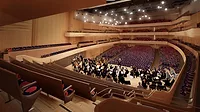
Superior acoustics and a more intimate experience for audiences were overriding goals of Diamond Schmitt Architects when designing the new Wu Tsai Theater. They reduced the seat count 500 seats and adjusted the rake at the orchestra level for improved sightlines. Beech wood cladding on a solid substrate improves the sound. On the side tiers, seats are angled towards the stage for enhanced sightlines and comfort. Photography © Michael Moran
Geffen-Hall-4.webp
The curvilinear scheme for the concert hall removes the proscenium separating the audience from the performers, and brings the stage forward by 25 feet, thereby allowing the audience to wrap around the stage. the stage has multiple configurations, for a variety of events including orchestra, solo performances, film, pop concerts, and staged opera. Photography © Michael Moran
Geffen-Hall-5.webp
500-square-foot extensions on each side of the first tier overlook the Grand Promenade. Bronze petal-motif “chandeliers” by Brooklyn-based designers Chen Chen + Kai Williams adorn the structural suspension cables of these overlooks; A felt wallcovering—designed by Tod Williams Billie Tsien and produced by Liora Manne—enlivens the walls of the upper levels with a rose-petal motif. Photography © Michael Moran
Geffen-Hall-1.jpg
Geffen-Hall-2.webp
Geffen-Hall-3.webp
Geffen-Hall-4.webp
Geffen-Hall-5.webp
October 24, 2022

Architects & Firms

Diamond Schmitt Architects
Tod Williams Billie Tsien Architects
✕
Image in modal.

The audience for the inaugural public concerts at the overhauled David Geffen Hall at New York’s Lincoln Center passed through a raised garage-style glass door and—instead of what had been a cramped, beige lobby—entered a soigné space, twice as large, furnished with serpentine couches and club chairs upholstered in orange, chartreuse, and bold stripes. Beyond this relaxed seating area, a digital artwork, entitled, “An Eclectic Dance to the Music of Time,” by artist Jacolby Satterwhite, played on a 50-foot wide high-definition video screen.

Lincoln Center, and the New York Philharmonic, its tenant, undertook this daunting $550-million gut renovation primarily to remedy the acoustic shortcomings of its auditorium, which had defeated the efforts of architects and consultants for decades. These welcoming architectural alterations suggest how radically the latest design team—Diamond Schmitt and Tod Williams Billie Tsien Architects—has transformed the entire concert-hall experience.

The 1962 classically proportioned glass box, fronted by a portico of tapering travertine columns, designed by Harrison & Abramovitz remains unchanged. Inside, however, Tod Williams and Billie Tsien, responsible for all of the spaces outside the auditorium, doubled the size of the lobby, and removed a pair of escalators that had impeded circulation. They moved the box office that had confronted patrons just inside the entrance to a high visibility corner location near the street. This new “welcome center,” complete with coffee bar, sells tickets, offers information, and aspires to attract newbies to Lincoln Center.
ALT TEXT.

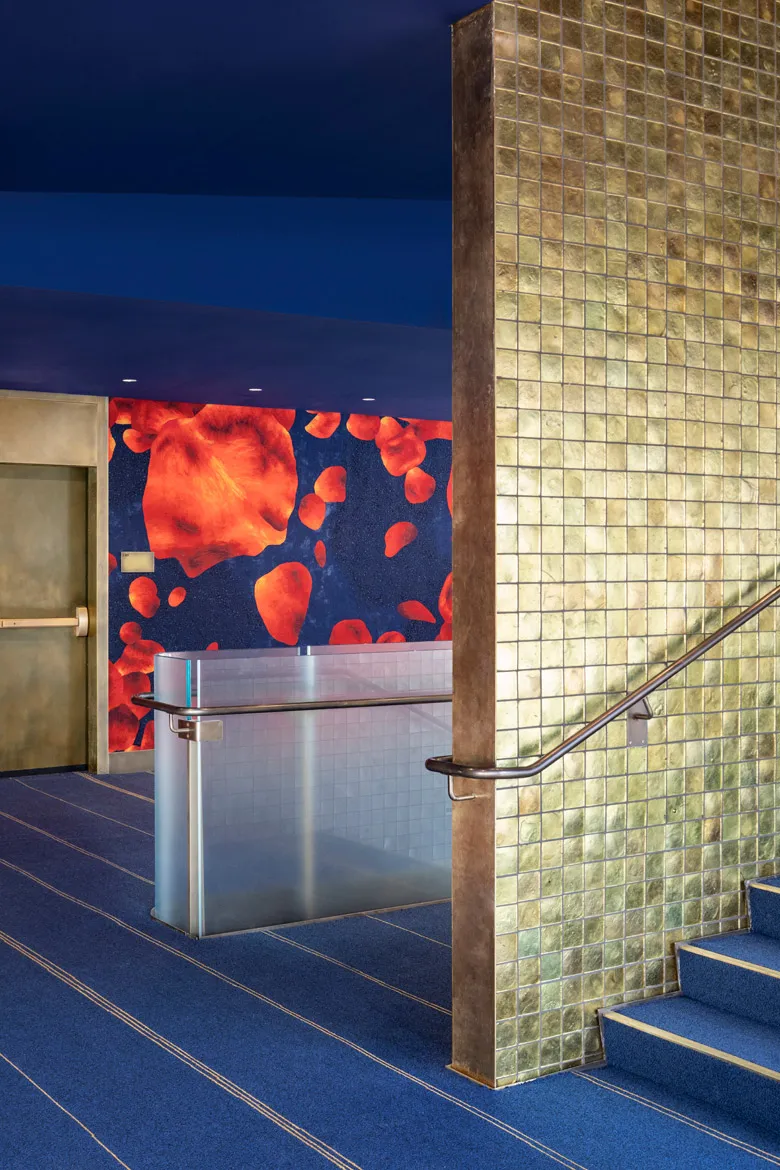
From the Grand Promenade, two ornamental stairs on either side are clad with Italian glass tiles. On one side is yellow gold leaf, on the other an antique white gold. Photography © Michael Moran

Upstairs, the three concourse levels, once colorless, now envelope patrons in deep cobalt, with frosted-glass railings that pick up the glow of the textured blue wall-covering scattered with what Tsien calls oversized “falling flower petals” in shades of red, fuchsia, and orange. Expanded and reconfigured, these spaces not only build anticipation in contrast to the neutral lobbies that preceded them, they also untangle long-time circulation bottlenecks.

In contrast to the buoyant work of Williams and Tsien, the auditorium redesign, led by Diamond Schmitt principal Gary McCluskie following the dictates of sound consultant Akustics, expresses a restrained yet warm purposefulness. The stage has been thrust forward 25 feet into the audience and the hall has 500 fewer seats (2,200), which aids both the acoustics and the closeness of the audience to the performers.

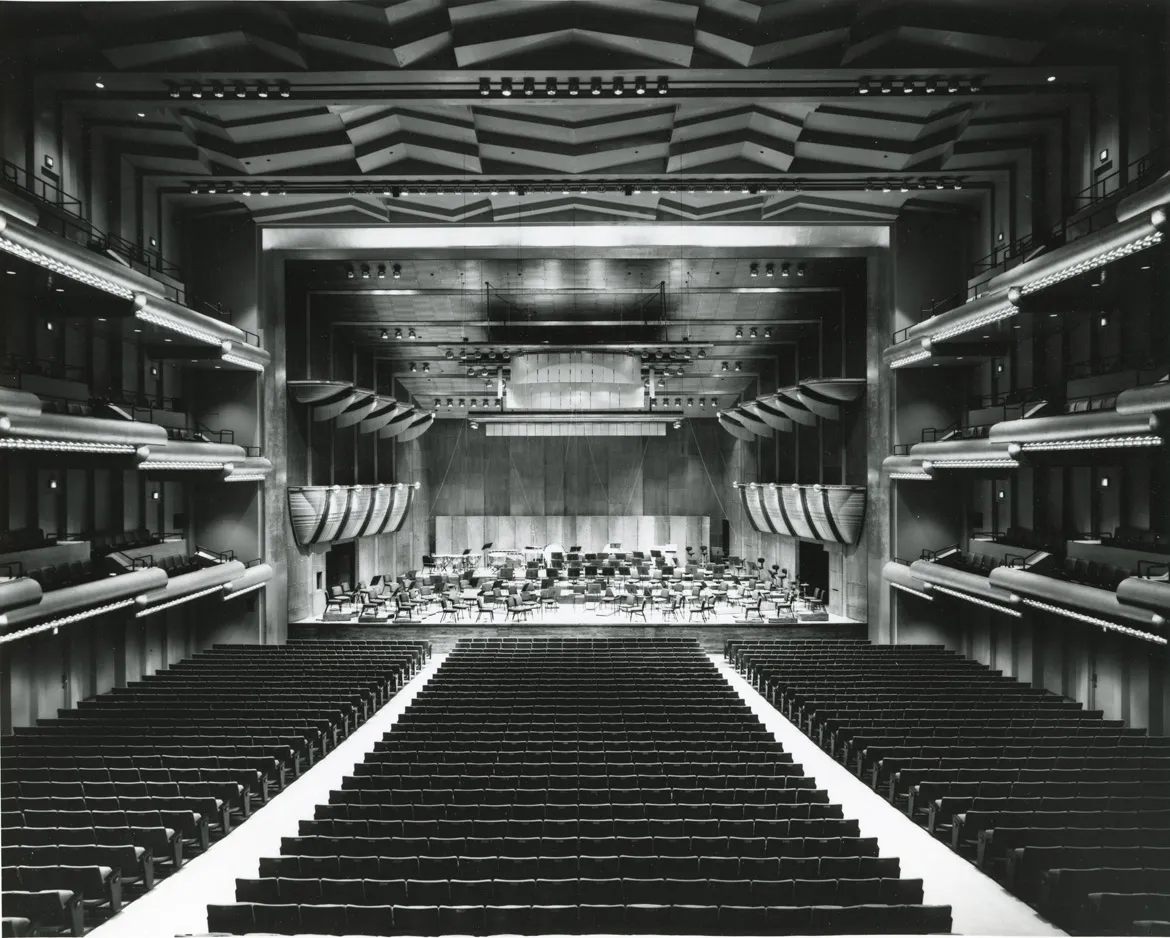
Rebuilt within the original envelope, it replaces the austere 1976 renovation by Philip Johnson with acoustician Cyril Harris, a rigidly rectangular “shoebox” in sober grey plaster. Though it emulated many of the world’s admired halls, the Johnson-Harris design as executed contributed greatly to the estrangement between players and listeners. The most common complaint was that musicians seemed to be playing in a separate room. The side walls of Diamond Schmitt’s reconfigured hall gently bulge outward, clad largely in rippling panels of beechwood attached to a solid substrate, instead of the airspace that existed, and which reduced bass response. Ribbonlike balconies, faceted to scatter sound, curve around the sides of the stage to meet seven rows of seats behind it.
Philip Johnson design, 1970s historic photo.

The 1976 Philip Johnson revamp of the then-Avery Fisher Hall in 1992 after an acoustic enhancement to the stage. Sandor Acs/New York Philharmonic, courtesy of the New York Philharmonic Shelby White & Leon Levy Digital Archives

Early reviews were positive, with critics describing a new wealth of instrumental intensity, detail, color, and timbre. Given the many previous critical raves the hall received in past renovations before the substandard reality set in, critics were wary. Justin Davidson, in New York magazine, wrote, “The results from the first noises were provisionally encouraging and firmly inconclusive.” Writing in the New York Times, Zachary Woolfe was relieved to find the hall “mightily improved,” yet feared that it was marred by “an objective, almost clinical feeling.” He noted that the sound was consistent throughout the hall (a rarity even in the best halls), whether in the rear balconies where the hall’s resonance most noticeably kicks in or at the sides, from the newly created seats around the stage, where listeners exchange limited views for an exciting closeness to the players.

Looking for quick answers on architecture and design topics?
Try Ask RECORD, our new smart AI search tool.
Ask RECORD →

The Philharmonic made a daring choice in commissioning “San Juan Hill: A New York Story,” a 90-minute work from jazz trumpeter and composer Etienne Charles for the first public concerts. His sextet Creole Soul presided downstage surrounded by the orchestra—all below a large retractable movie screen. Accompanied by a documentary-style film, the piece sped through several musical styles to remind the audience of the rich cultural and musical life of the thousands of largely Black and Puerto Rican families who were displaced by the building of Lincoln Center.

The presentation also demonstrated a greater use of theatrical lighting, improved amplified sound, and video technology in what had been a temple to un-enhanced instruments. David Geffen Hall is embracing these technologies, given its ambition to broaden its repertoire and appeal.
1960s historic photo.

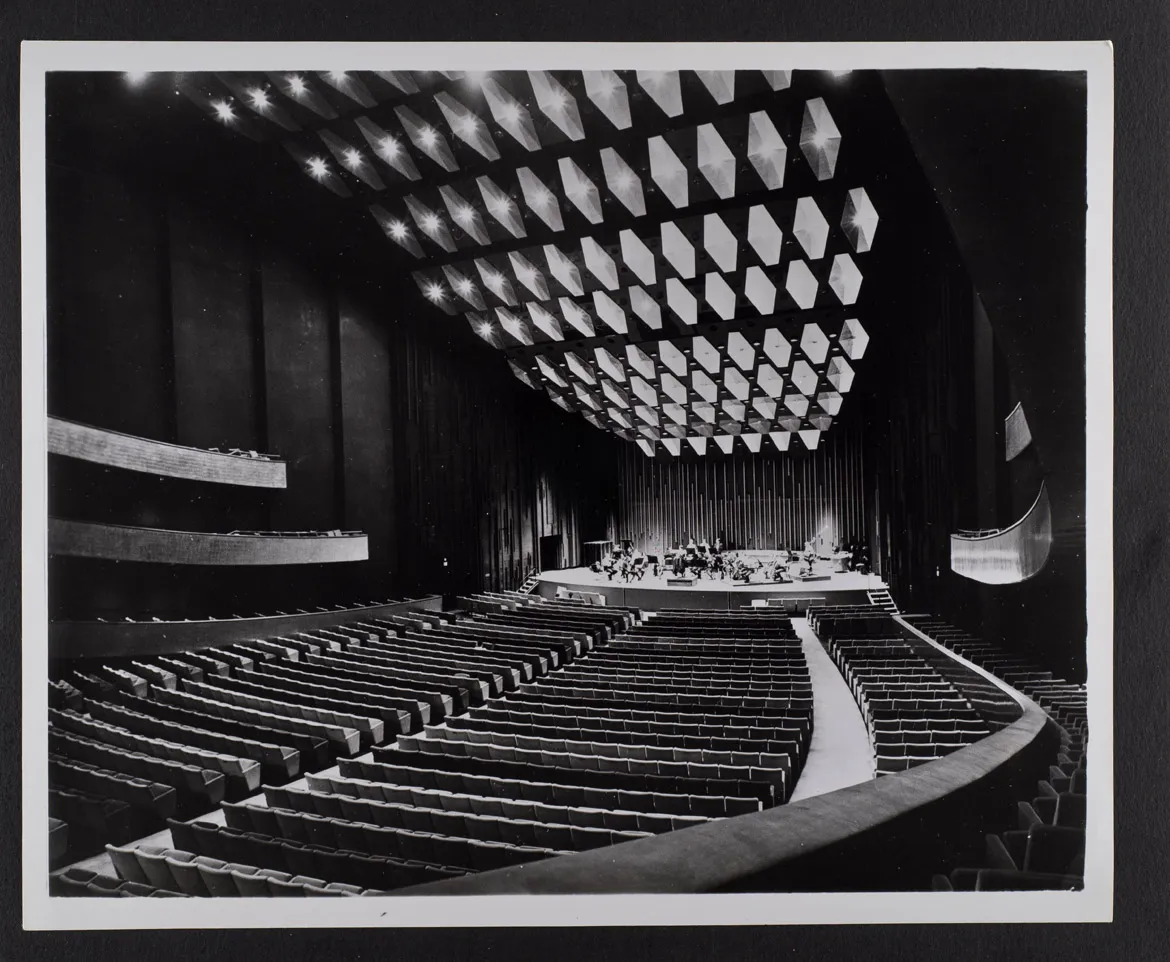
. The then-Philharmonic Hall by Harrison & Abramowitz in 1963, a year after it opened in 1962. Photography by Bob Serating, courtesy of the New York Philharmonic Shelby White & Leon Levy Digital Archives

An ebullient and diverse audience gave Charles a thunderous ovation and crowded excitedly into the orchestra-level lobby afterward (supplied with inviting and ample bars by Williams and Tsien), suggesting that the hall was welcoming the very audiences that had been put off by programs that weren’t inclusive, uninspired sound, and esthetic austerity. Critics, players, and audiences are not finding glaring flaws—as they did when Geffen opened in 1962 as Philharmonic Hall. It may take months or longer for a consensus to form about whether the experience delivers the world-class excellence that Lincoln Center hoped it was buying.

KEYWORDS: Lincoln Center New York City

Share This Story

Looking for a reprint of this article?
From high-res PDFs to custom plaques, order your copy today!

James S. Russell, FAIA Emeritus, a journalist who often focuses on sustainability and resilience, is the author of­­­­­ ­­­The Agile City: Building Well Being and Wealth in an Era of Climate Change (Island Press, 2011).

Post a comment to this article

Report Abusive Comment

Subscription Center
  • Create an Account
  • Start a Subscription
  • Manage My Account
  • Sign Up for Newsletters
  • Visit Customer Service
  • Update Preferences

More Videos

Sponsored Content

Sponsored Content is a special paid section where industry companies provide high quality, objective, non-commercial content around topics of interest to the Architectural Record audience. All Sponsored Content is supplied by the advertising company and any opinions expressed in this article are those of the author and not necessarily reflect the views of Architectural Record or its parent company, BNP Media. Interested in participating in our Sponsored Content section? Contact your local rep!

close
  • TAMLYN XtremeTrim Exterior Trim
    Sponsored byTamlyn

    Designing Cleaner Panel Facades: Why Exterior Trim Details Matter

  • Building with Vapor Barriers
    Sponsored byReef Industries, Inc.

    Vapor Barriers Help Control Moisture in Tighter Building Designs

  • Duct Interior with Prodeq System
    Sponsored byHenry, a Carlisle Company

    Designing Resilient Water Containment Systems

DESIGN:ED Podcast
Listen to Architectural Record’s DESIGN:ED Podcast

Events

June 10, 2026

Rethinking Stormwater – The Power of Porous Paving

Credits: 1 AIA LU/HSW; 1 AIBD P-CE; 0.1 ICC CEU

Learn how porous paving systems support stormwater management, reduce heat island effects, and enhance sustainable site design performance.

June 11, 2026

Very Early Warning Fire Detection for Mission-Critical Facilities

Credits: 1 AIA LU/HSW; 1 AIBD P-CE; 0.1 ICC CEU

Examine advanced fire detection strategies that support uptime and enhance safety in data centers and other mission-critical facilities.

View All Submit An Event

Products

2026 Architect's Square Foot Costbook

2026 Architect's Square Foot Costbook

See More Products

Popular Stories

Practice Matters illustration

What’s in a (Firm’s) Name? Thinking About Succession and Legacy

Practice Matters illustration

By the Numbers: Counting America's Architects

Riverdale House by Studio Lau

Riverdale House by Studio Lau

House on a Hill

Design Vanguard 2026: Forma

Crane Cove, ONO

Design Vanguard 2026 Winners

Broader Sustainability of CMU - Free Webinar - May 21, 2026

Related Articles

  • TheGingerbreadCityNYC_11152023©LeandroJusten_001.jpg

    Ain’t That Sweet: ‘The Gingerbread City’ Makes Its New York Debut

    See More
  • Geffen-Hall-3.jpg

    New York’s David Geffen Hall Plans a Fall 2022 Reopening

    See More
  • Geffen-Hall-Opening-2.jpg

    Williams and Tsien Bring Colorful Reconfigured Public Spaces to Lincoln Center’s David Geffen Hall

    See More

Related Products

See More Products
  • Architectural Record - May 2026

    Architectural Record May 2026 Issue

See More Products
×

The latest news and information

#1 Source for Architectural Design, News and Products

SUBSCRIBE
  • RESOURCES
    • Advertise
    • Contact Us
    • Submit
    • Store
  • ACCOUNT CENTER
    • Create an Account
    • Start a Subscription
    • Manage My Account
    • Sign Up for Newsletters
    • Visit Customer Service
    • Update Preferences
  • PRIVACY
    • PRIVACY POLICY
    • TERMS & CONDITIONS
    • DO NOT SELL MY PERSONAL INFORMATION
    • PRIVACY REQUEST
    • ACCESSIBILITY
  • SERVICES
    • Marketing Services
    • Reprints
    • Market Research
    • List Rental
    • Survey/Respondent Access
  • STAY CONNECTED
    • Linkedin
    • Facebook
    • Instagram
    • YouTube
    • X (Twitter)

Copyright ©2026. All Rights Reserved BNP Media, Inc. and BNP Media II, LLC.

Design, CMS, Hosting & Web Development :: ePublishing