Spiritual Projects 2025
Trahan Architects Designs a Circular Hub for Interfaith Congregation at Loyola University New Orleans
New Orleans
Architects & Firms
Trahan Architects is no stranger to eccentrically shaped houses of worship in Louisiana, be it the firm’s octagonal Catholic church in Baton Rouge or a domed New Orleans stadium, famed for its hourglass silhouette, where the Saints regularly come marching in.
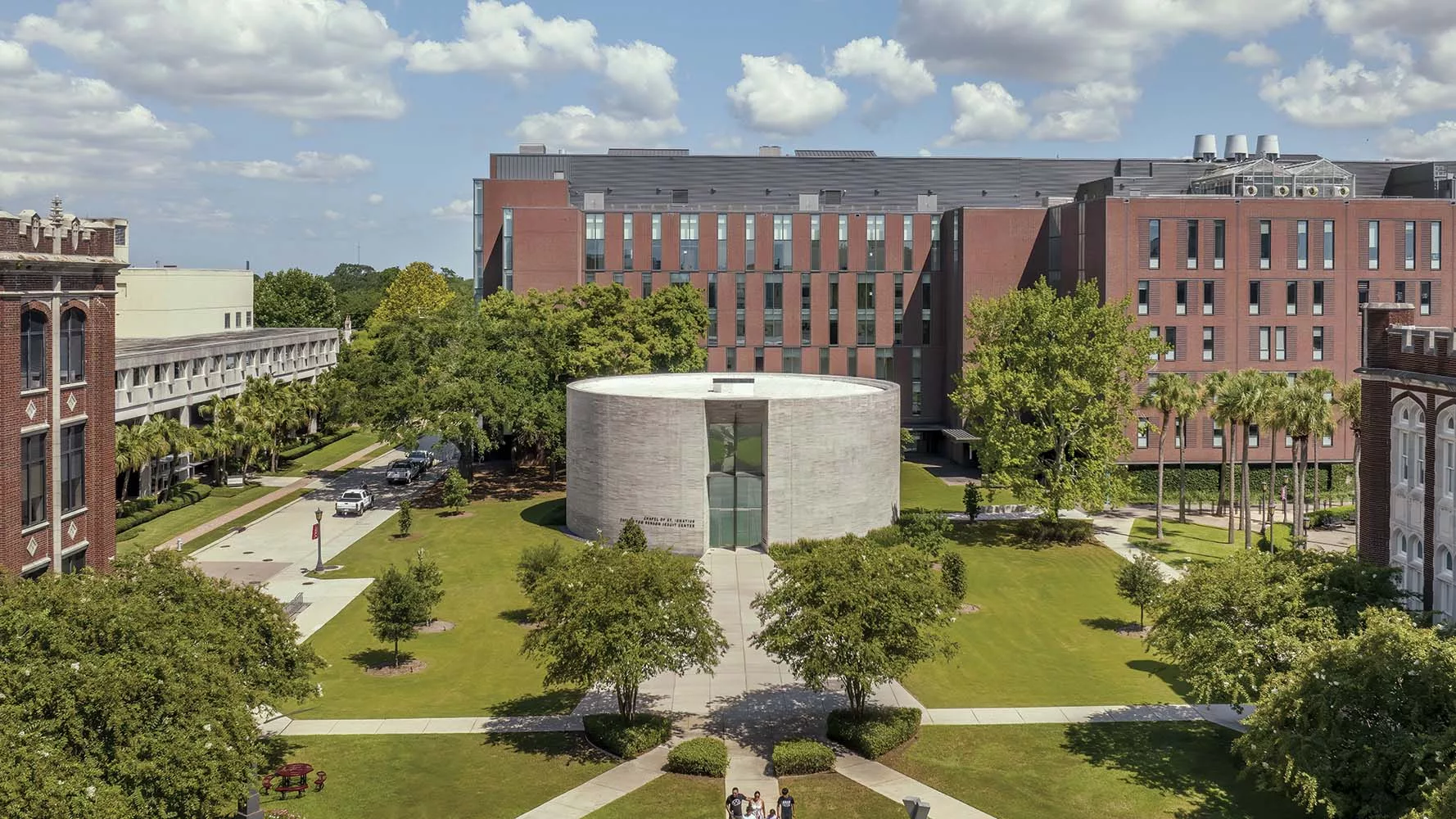
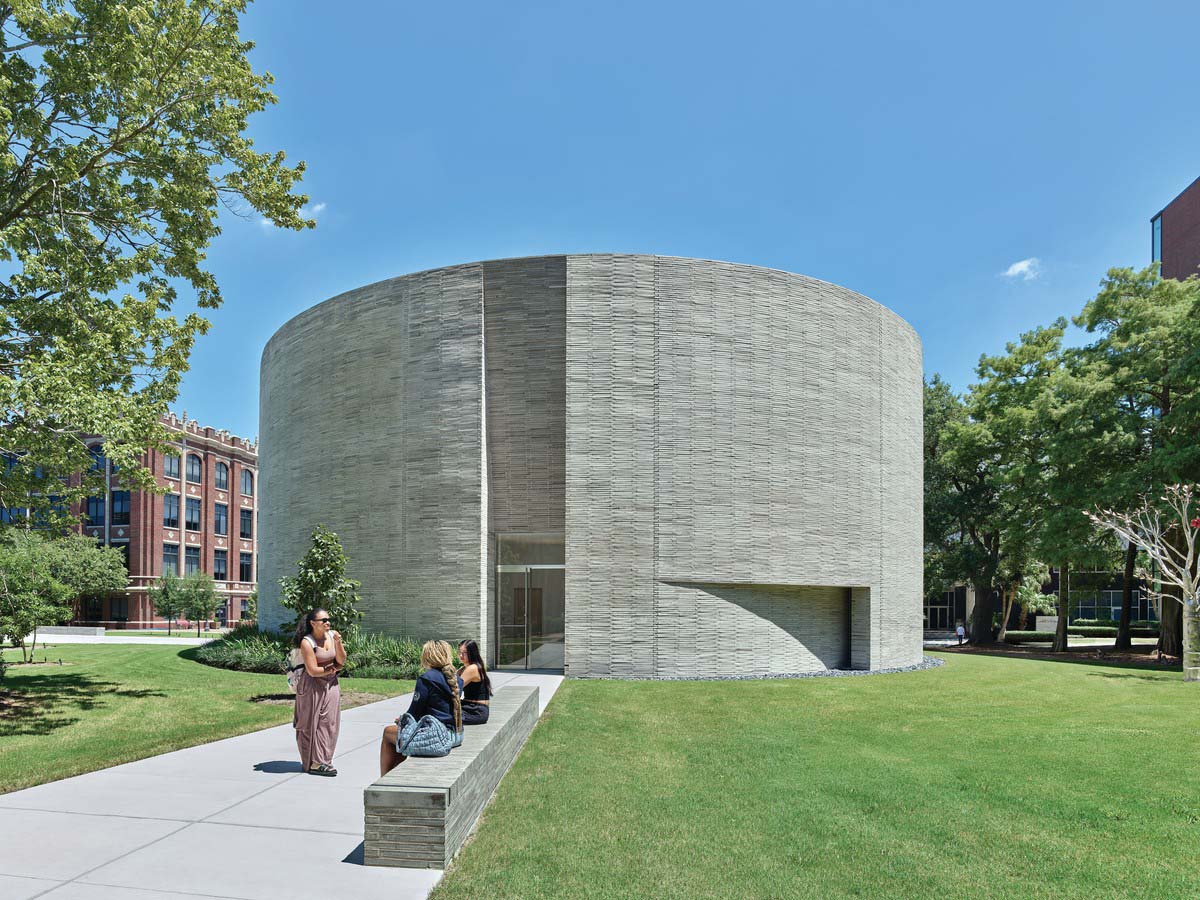
At 4,620 square feet, Trahan’s new Chapel of St. Ignatius and the Gayle and Tom Benson Jesuit Center at Loyola University New Orleans is more modest in scale than these two previous projects—particularly the Caesars Superdome, which just last year emerged from an exhaustive renovation led by Trahan. But the chapel has no less a presence. Flanked by a smattering of Tudor-Gothic academic halls on the east end of the school’s leafy quad, the compact cylindrical building, clad in thin San Selmo clay brick, exudes a quiet monumentality making it impossible to miss.
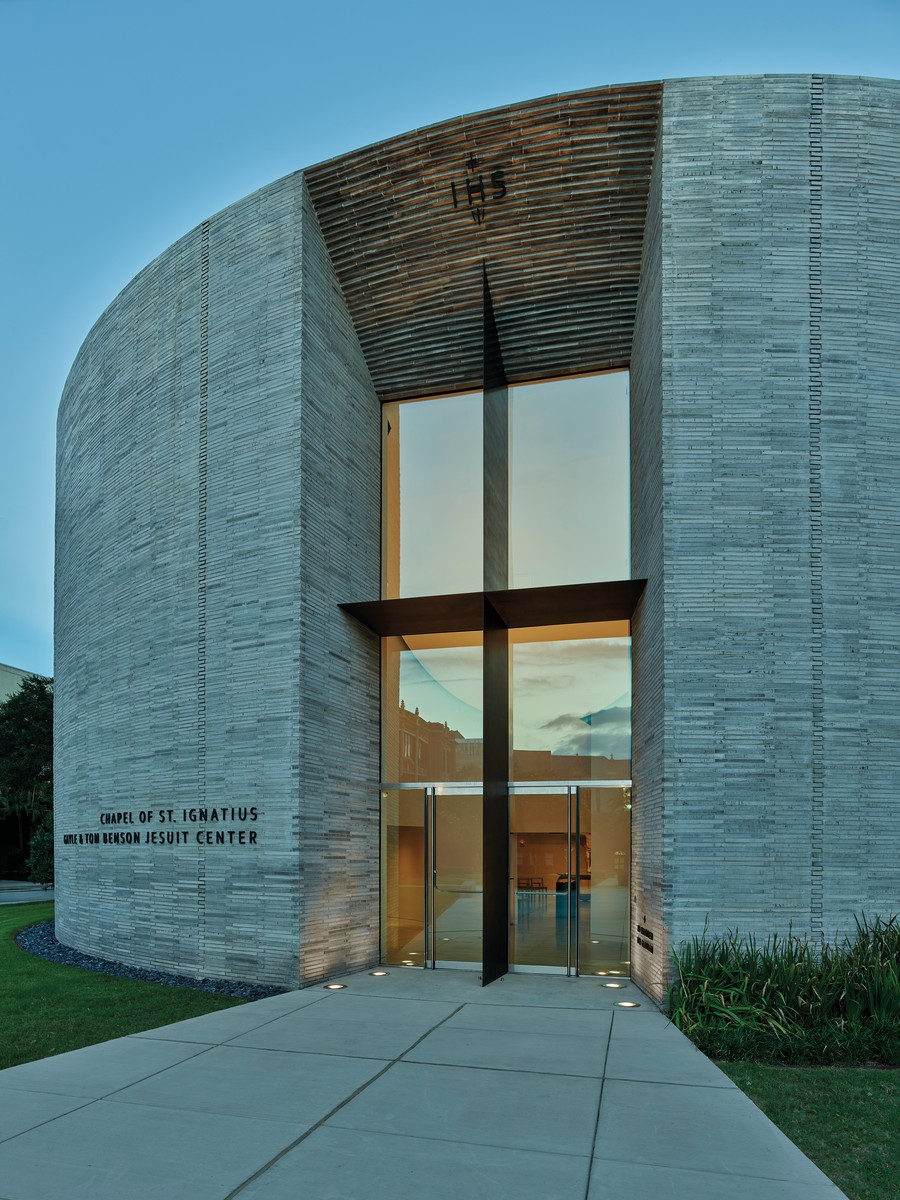
A blackened-brass entry cross functions as a brise-soleil to shade the glazed west-facing chapel entrance (above) on Loyola’s main academic quad (top of page). Photo © Timothy Hursley, click to enlarge.
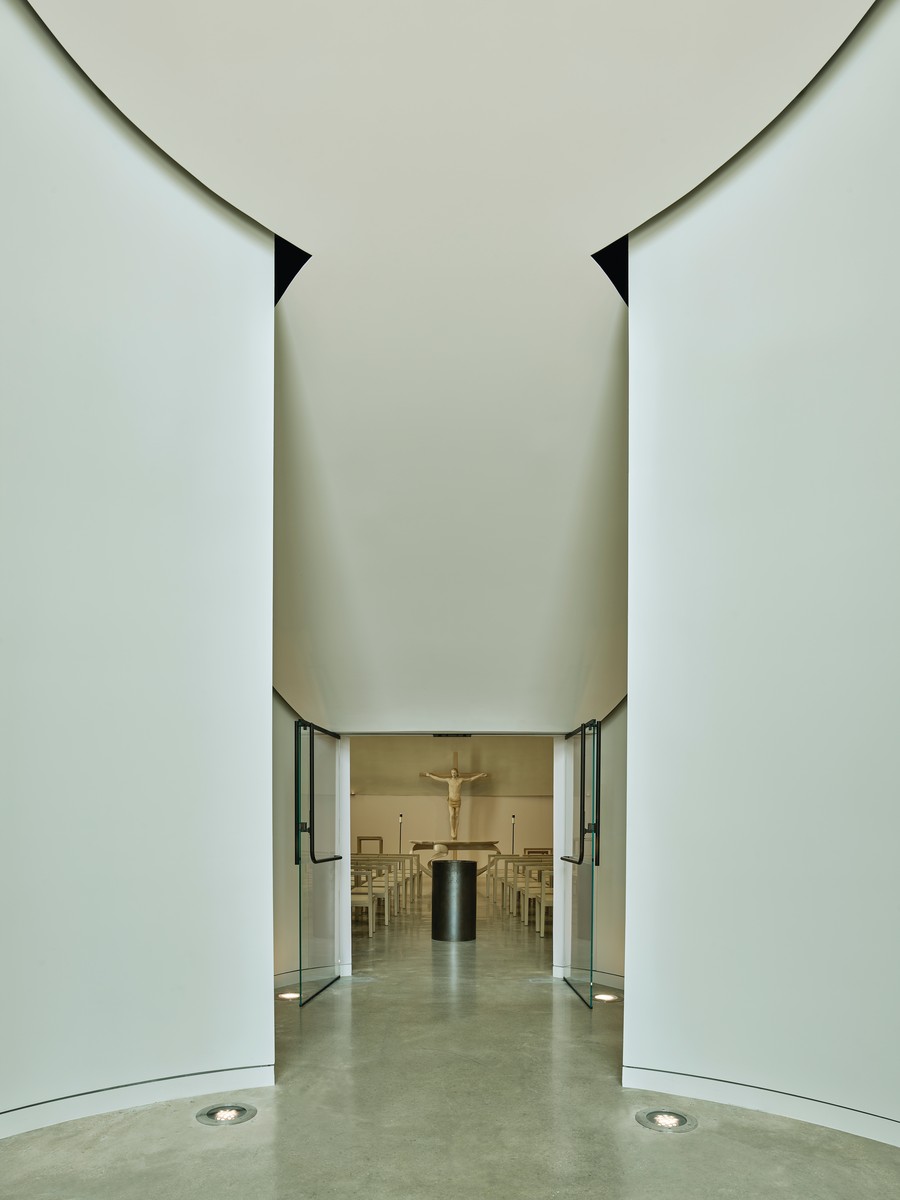
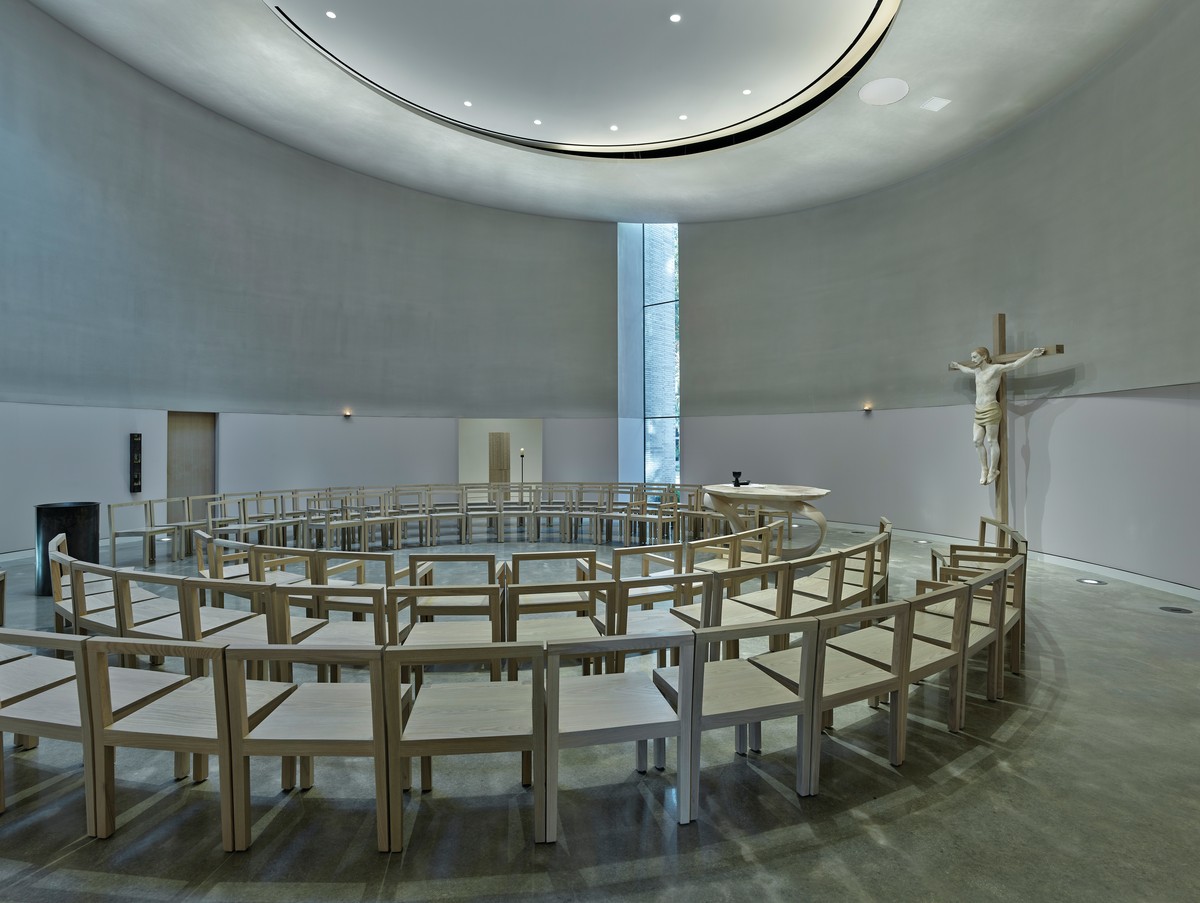
With its plan of interlocking circles, the building supports a commingling of the interfaith and the Catholic. There are just two main spaces: a community gathering hall and a soaring daylit sanctuary that holds regular Mass services. Firm founder and CEO Trey Trahan calls it a “contemporary sacred space.” Each area is set in plan in equal radii. The sanctuary, narthex, and side chapels follow a traditional cruciform axis and are encircled by the nonecclesiastical areas, including the community space, a multipurpose room, and restrooms. There are also smaller interstitial spaces, like an interfaith prayer room, which is adjacent to the community hall and can be accessed via a secondary entrance at the south of the building.
1
Interfaith spaces can be accessed via a secondary entry (1) without entering the narthex (2) or sanctuary (3). Photos © Timothy Hursley
2
3
The interiors of the chapel are elegant and muted. The airy, stripped-down sanctuary, featuring a large rooftop oculus and a soft-gray acoustical wall system, is populated by custom white ash furnishings, designed by Parisian studio Goons in collaboration with Trahan. The liturgical items are designed by the firm with local and national artisans, including black ceramic chalices and plates and various blackened-brass objects such as candle stands, dedication crosses, and the baptismal font placed in the geometric center of the building. The striking movable altar is by Irish furniture-maker Joseph Walsh. Ringing the perimeter of the sanctuary is statuary by noted Italian woodcarver Bruno Walpoth—a hobbled Saint Ignatius of Loyola, a pregnant Mary, and Jesus on the cross. The liturgical art and objects all respond to a central design concept of “formation”—a sense of what Trahan design director Robbie Eleazer calls “stillness and action”—that meets college students on their own formative journeys.
“The interior’s very quiet palette makes it almost feel like an art museum,” says Eleazer, who is based in the New Orleans firm’s satellite studio in New York. “The objects feel more precious because the architecture is quiet and still. It makes moments of encounter [with the liturgical art] feel more intense.”
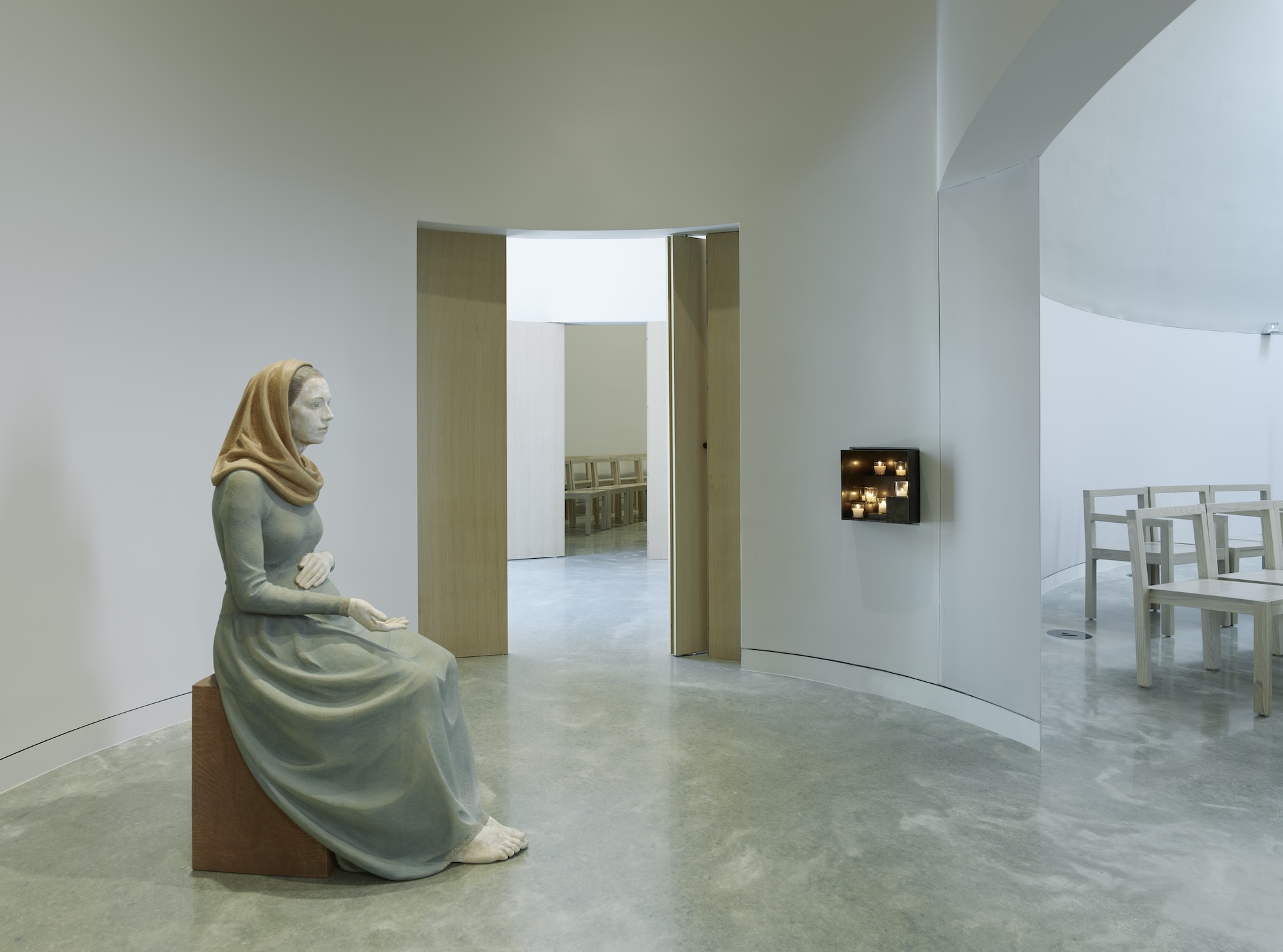
The chapel statuary is by Italian artist Bruno Walpoth. Photo © Timothy Hursley
With 38 percent of Loyola students identifying as non-Christian or “other” during the 2021–22 academic year, the chapel was created as a more intimate, inclusive alternative to the Jesuit university’s largest worship space, Holy Name of Jesus Church. That building was dedicated in 1918 to replace a smaller wood church relocated several years prior from a nearby site along St. Charles Avenue.
“It feels inviting to some who have grown up nonreligious, but not at the expense of those who are religious and resonate with the traditional church,” says Trahan of the project’s dual focus on worship and community. “It resides in that space almost in between.”
Looking for quick answers on architecture and design topics?
Try Ask RECORD, our new smart AI search tool.
Ask RECORD →
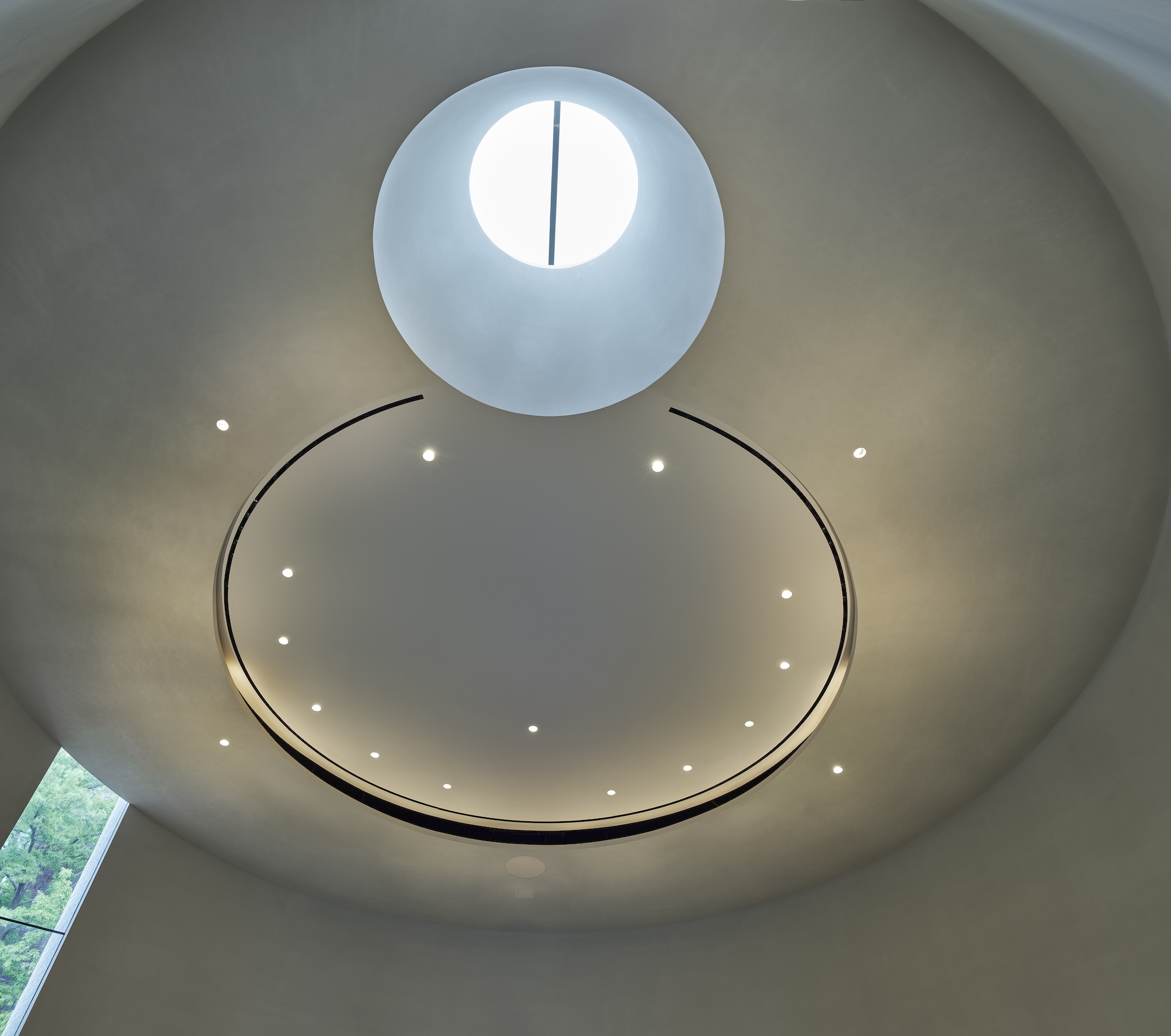
A circular skylight floods the chapel with daylight. Photo © Timothy Hursley
Although it distinguishes itself from the primary place of worship on campus, the chapel has more in common with Loyola’s original wood church than meets the eye. Beneath the handsome brickwork isn’t a steel frame but a cross-laminated timber (CLT) drum comprising 32-foot-tall, 8-foot-wide panels—35 wall panels and three soffit panels in total—produced with southern yellow pine. (The roof structure, however, is steel.) Giving new meaning to “mass” timber, the chapel is the first CLT structure in Louisiana. While the contractor initially proposed hanging the brick from a steel frame, CLT ended up being the most economical—and time-efficient—choice while being able to withstand hurricane-force winds. “Once the contractor stopped thinking about it as a bespoke mass-timber thing, they realized that this could be erected in about two weeks, versus the months it would take for a steel frame,” says Eleazer. “The structural ingenuity and sustainability that the CLT gave the project is amazing.” (Eleazer and Trahan Architects partner Brad McWhirter credit late project designer Conner Bryan with pushing for the use of mass timber at the firm; he died in 2021, at the age of 34, before the CLT design for the chapel was conceived.)
Apart from the use of CLT and the pared-back approach to liturgical design, the most remarkable thing about the chapel is its stillness, free of the faint hums, whooshes, and whistles emitted by modern buildings. Sitting in the hushed sanctuary—the quiet comes courtesy of a small HVAC system, tucked away in an acoustically isolated mechanical mezzanine—it’s easy to imagine St. Ignatius himself sequestered in a Catalonian cave, praying and contemplating in silence.
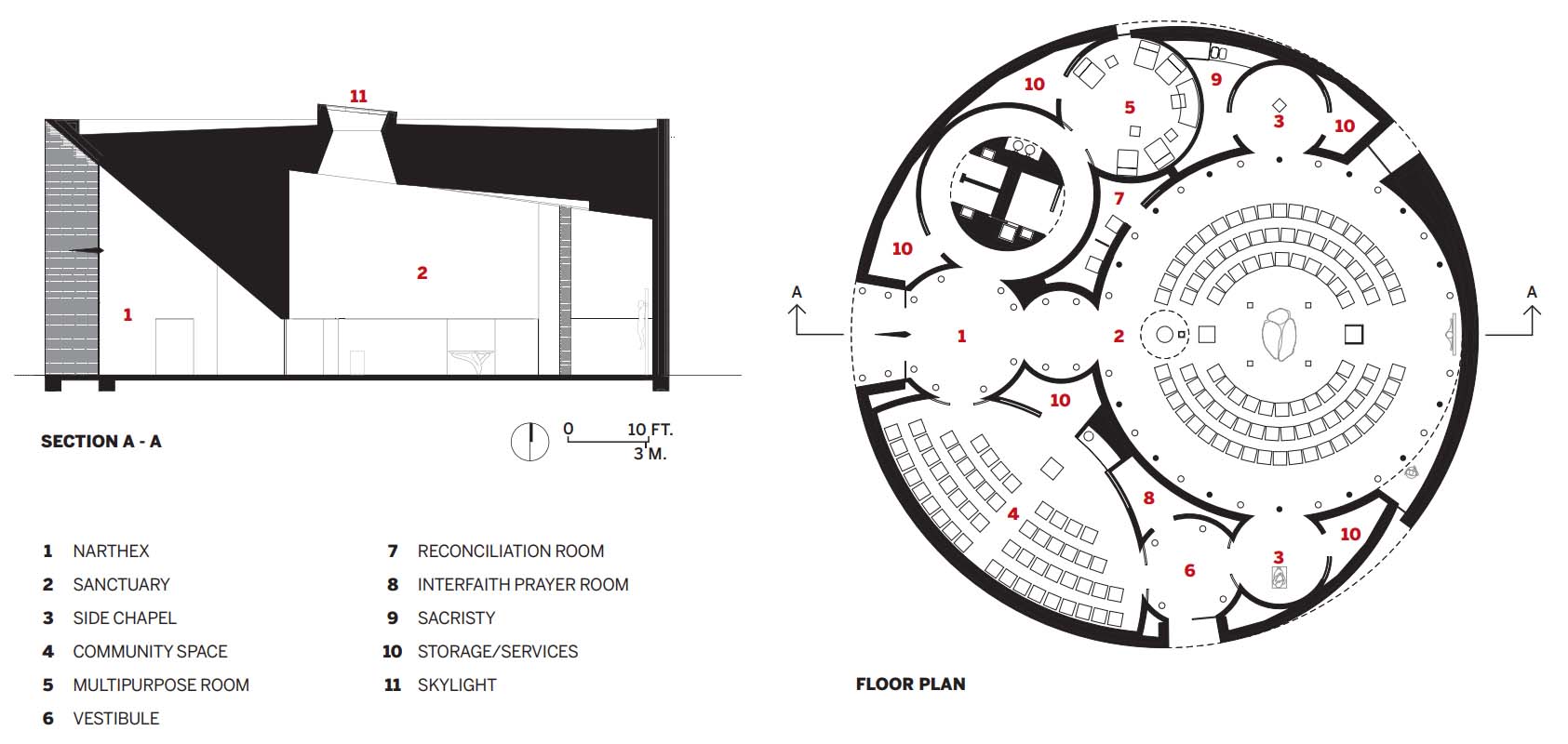
Images courtesy Trahan Architects
Credits
Architect:
Trahan Architects – Trey Trahan, founder/CEO; Brad McWhirter, partner; Robbie Eleazer, design director; Conner Bryan, lead designer (in memoriam); David Sweere, James Babin, design architects; Ryan Barnette, Jarri Hasnain, Nader Wallerich, Charles Weimer, designers; Sheena Garcia, visualizer
Engineers:
Morphy Makofsky (structural, civil); Introba (m/e/p)
Interior Designer:
Trahan Architects
Consultants:
Spackman Mossop Michaels (landscape); Threshold Acoustics; Tillotson Design Associates (lighting); Marchita Mauck (liturgical advisor); Cost Plus (cost estimater)
General Contractor:
MAPP
Owner's Representative:
The Tobler Company
Client/Owner:
Loyola University New Orleans
Size:
4,620 square feet
Cost:
Withheld
Completion Date:
July 2025
Sources
Cross-Laminated Timber:
SmartLam North America
Exterior Cladding:
S.Anselmo – Corso (masonry); E. Kraemer (ornamental metals blackened brass entry cross);Georgia-Pacific (moisture barrier); Telling (cold formed metal framing)
Roofing:
DuroLast (polyvinyl-Ccloride roof); Burt Steel (structural steel roof framing)
Entrances, Pulls:
CRL
Glazing:
Kingspan (skylights); Vitro (glass); Southern Walls & Windows (all-glass openings)
Interior Finishes:
Armstrong (acoustical ceilings and walls); Certainteed (suspension grid); Gulf Coast Woodwork (cabinetwork and custom woodwork); Roppe (resilient base); Sherwin-Williams (paints and stains); Fabritrak (wall coverings); Dupont Corian (solid surfacing); National Gypsum, Georgia-Pacific (wall sheathing); Gordon (wall trim and accessories); Radium Track (curved metal wall framing); Lapeyre Stair (alternating tread stairs)
Furnishings
White ash furniture designed by Trahan Architects in collaboration with GOONS, produced by Sentient
Liturgical Art and Furnishings
Joseph Walsh (white ash altar); Bruno Walpoth (statuary); Trahan Architects in collaboration with E. Kraemer (blackened brass objects:baptismal font, candle stands, Stations of the Cross, dedication crosses); Trahan Architects in collaboration with Jerry Nance of NOME Manufacturing (blackened brass objects: sanctuary lamp, baptismal bowl, sacred oil vessel stands); Trahan Architects in collaboration with Malcolm Kriegel (blown-glass sacred oil vessels)
Lighting:
Uplights: WE-EF (uplights); USAI (downlights); preciseLED, iGuzzini (cove lighting);
Concealite (exit lights and fire alarm devices); B-K Lighting (landscape lighting);
Landscape Lights: B-K Lighting; Creston (lighting controls)
Looking for a reprint of this article?
From high-res PDFs to custom plaques, order your copy today!