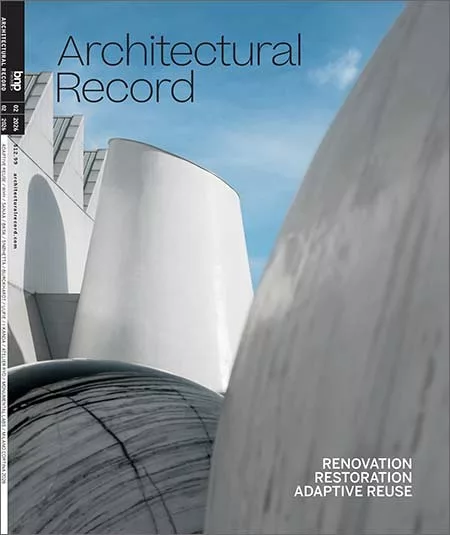
February 2026 Editor’s Letter
Age Limits

During a recent meeting to review projects for an upcoming issue, RECORD’s editors came across a contender that was newly built from salvaged parts of a structure previously occupying the site. Admirable enough. The odd thing was that the architects called the deconstructed pile a temporary building. Yet the “temporary” building—whose marble and sandstone were repurposed for the new one—was over 90 years old!
Often when a building is torn down, the reason given is that it had lasted “beyond its useful lifespan.” I have often wondered about that excuse, since so many buildings around the globe are hundreds of years old. A recent report, Lifetimes of demolished buildings in US and European cities, which looked at close to 15,000 buildings in nine U.S. and four European cities razed in the 21st century, found that a building typically lasts only 71 years. The investigation, published in the academic journal Buildings & Cities, also revealed that, on average, European buildings have similar if not shorter lifetimes than U.S. examples. The data for U.S. cities show that buildings have a mean age of 81 years, while those in European cities have a mean of 65 years. (The eerie correlation to human lifespans seems to imply that steel and concrete don’t necessarily last longer than skin and bones.)
The authors of the study—Juliana Berglund-Brown, Isaac Dobie, Jordaina Hewitt, Catherine De Wolf, and John Ochsendorf, three of whom have spoken at RECORD events—go on to point out that, with proper maintenance, assessment, and repair, buildings could last nearly indefinitely. However, many structurally viable buildings are deemed obsolete before their projected lifetimes are over—often because of code incompliance, changing tastes, or market forces. The result is sheer profligacy: In the U.S. in 2018, 600 million tons of construction and demolition waste were produced.
We’ve packed this issue with exemplary old buildings that have received proper maintenance and repair to keep them going. They include a nearly 300-year-old Japanese farmhouse that found new life in a suburb of Boston and a symphony hall in St. Louis that has undergone a renovation and addition for its centennial. But most inspiring of all is the architectural solution for this month’s Winter Olympics in Italy. Here the host nation had promised that 93 percent of its venues be existing or refurbished, and it came close. Most notably, its closing ceremonies will take place in Verona’s famous Arena. The age of that gem from antiquity? Just shy of 2,000 years old!
Looking for quick answers on architecture and design topics?
Try Ask RECORD, our new smart AI search tool.
Ask RECORD →
Looking for a reprint of this article?
From high-res PDFs to custom plaques, order your copy today!