January 2026 Editor’s Letter
For the Ages

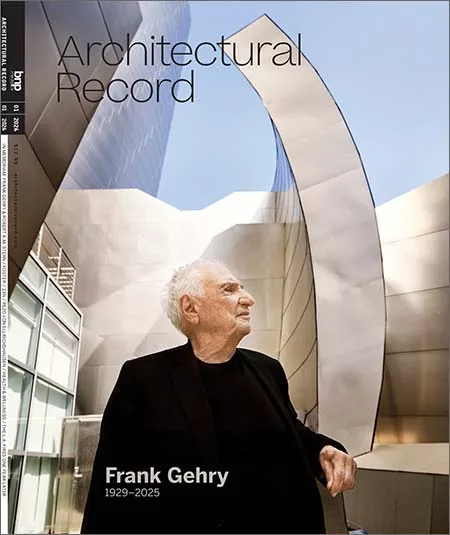
It may be the start of a new year, but it is also the end of an era. Thanksgiving morning, we learned of the death of Robert A.M. Stern, 86. Just eight days later, on December 5, as we were closing this issue, Frank Gehry died, at the age of 96. Both were titans of architecture, but they could not have been more different. For Stern, history was paramount, forming the foundation of what he taught and wrote, and of the buildings he designed—an attempt, one might say, to bring back the spirit of a much-loved (for Stern) but bygone age. Gehry, who achieved a level of fame rivaled only by that other Frank, was a radical. Rejecting what came before him, he embraced novel materials and advanced technology to produce forms we had never seen before. In this issue, we pay tribute to both architects, whose remarkable careers, matched by outsize personalities, will continue to characterize the work of their respective firms.
At 90, Norman Foster is still going strong as part of that industrious generation of architects. He followed yet another path—one exuberantly exemplified by his latest building, the Zayed National Museum of the United Arab Emirates in Abu Dhabi. It is among a cluster of museums in the capital’s Saadiyat Cultural District, including Gehry’s much-delayed but under-construction Guggenheim.
Since the Los Angeles area was the place Gehry called home for eight decades and where he has left his imprimatur with his own house, in Santa Monica (1978), and the Walt Disney Concert Hall (2003), it is poignant that this month also marks the one-year anniversary of the Palisades and Eaton fires that devastated vast swaths of the city. Our special continuing-education section looks at the challenges and opportunities to rebuild in their wake.
Building and preserving are part of the significant contributions that Stern, likewise, made to the fabric of his hometown, with 15 Central Park West and 220 Central Park South, among others. But Stern, the ultimate New Yorker, also chronicled the metropolis’s past. New York 2020: Architecture and Urbanism at the Beginning of a New Century, the nearly 1,500-page culmination of his six-volume New York series, was published just before his death and reviewed in last month’s issue. With that final tome, Stern had run out of history, but both he and Gehry have left behind impressive legacies of their own.
Looking for quick answers on architecture and design topics?
Try Ask RECORD, our new smart AI search tool.
Ask RECORD →
Looking for a reprint of this article?
From high-res PDFs to custom plaques, order your copy today!