RECORD Forum
Building Attractions: High-Rise Thrills
The famous observation decks of 20th-century buildings—the Empire State Building, Rockefeller Center, the World Trade Center—were low-tech but thrilling open-air platforms ringed by coin-operated telescopes and spiky iron fences. The formula was simple: wind in your hair, city at your feet. Vertigo addicts still chase stratospheric heights, but, in 2025, standing flat-footed at 1,000 feet doesn’t cut it. The thrill isn’t gone, it’s just higher-maintenance.
The next generation of sky-high, high-tech jungle gyms packs an adrenaline punch, sporting Ferris wheels, roller coasters, and glass elevators. Urban playgrounds like New York and Shanghai can absorb spectacles; skyscraper architects have always chased the show-stopper. But when designs integrate figure eight Ferris wheels, maybe the thrill has gone too far. Nobody asked for a Six Flags Skyline Park. At least, not yet.
It started innocently enough. From Berlin to Bangkok, revolving restaurants crowned towers and luxury hotels. Giant turntables in the sky revolutionized urban immersion, cocktails included. Developer-architect John Portman set the tone in 1967 with his blue-domed Hyatt Regency in Atlanta (1967). The East China Architectural Design & Research Institute rocketed the motif into retro-Jetsons parody with the Radisson Blu Hotel Shanghai New World (2003).
In the 1990s, casino maverick Bob Stupak punctuated the Las Vegas Strip with the 1,149-foot Stratosphere, then the country’s tallest observation tower. A revolving restaurant was just the appetizer; the real show was carnival rides bolted to the crown: step right up for Big Shot, a catapult blasting riders skyward; X-Scream, a seesaw hanging them over the neon abyss; and Insanity, a whirling arm flinging them face-down at the Strip. Even a rooftop roller coaster, the High Roller, had a brief, shaky run. SkyJump, a bungee-style leap off the tower’s flank, is the Stratosphere’s sole remaining hook for high rollers.
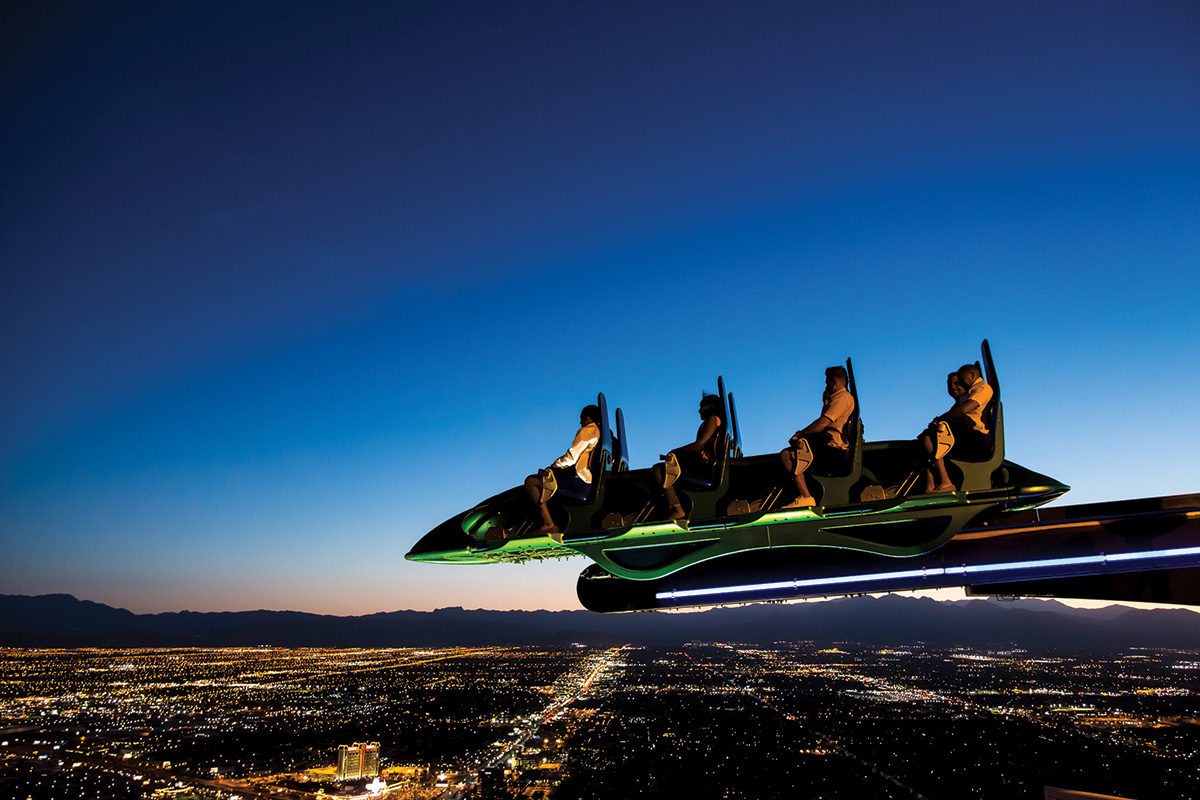
X-Scream dangled riders over the Strip in Las Vegas. Image Joao Carlos Medau, Wikimedia Commons, click to enlarge.
Learning from Las Vegas, developers took the skyscraper circus global. Guangzhou’s Canton Tower (2009), nearly 2,000 feet high, crowned itself with a necklace of orange “bubble cabs” creeping around the roof. Buildings in Dubai, Macau, and Melbourne joined the party, integrating drop rides and sliding glass cubes.
Observatories on the black SOM giants bookending the Chicago skyline—the John Hancock Center on Michigan Avenue and the Willis (formerly known as Sears) Tower in the Loop—also got facelifts. Willis’s Skydeck added The Ledge, four glass boxes jutting from the 103rd floor. Hancock countered with Tilt, a steel-and-glass bay hydraulically tipping eight riders 30 degrees out over the city from the 94th floor. Small protrusions barely visible from the sidewalk, but bolted onto classics of Modernism, they mark an increasingly cavalier attitude toward architectural integrity.
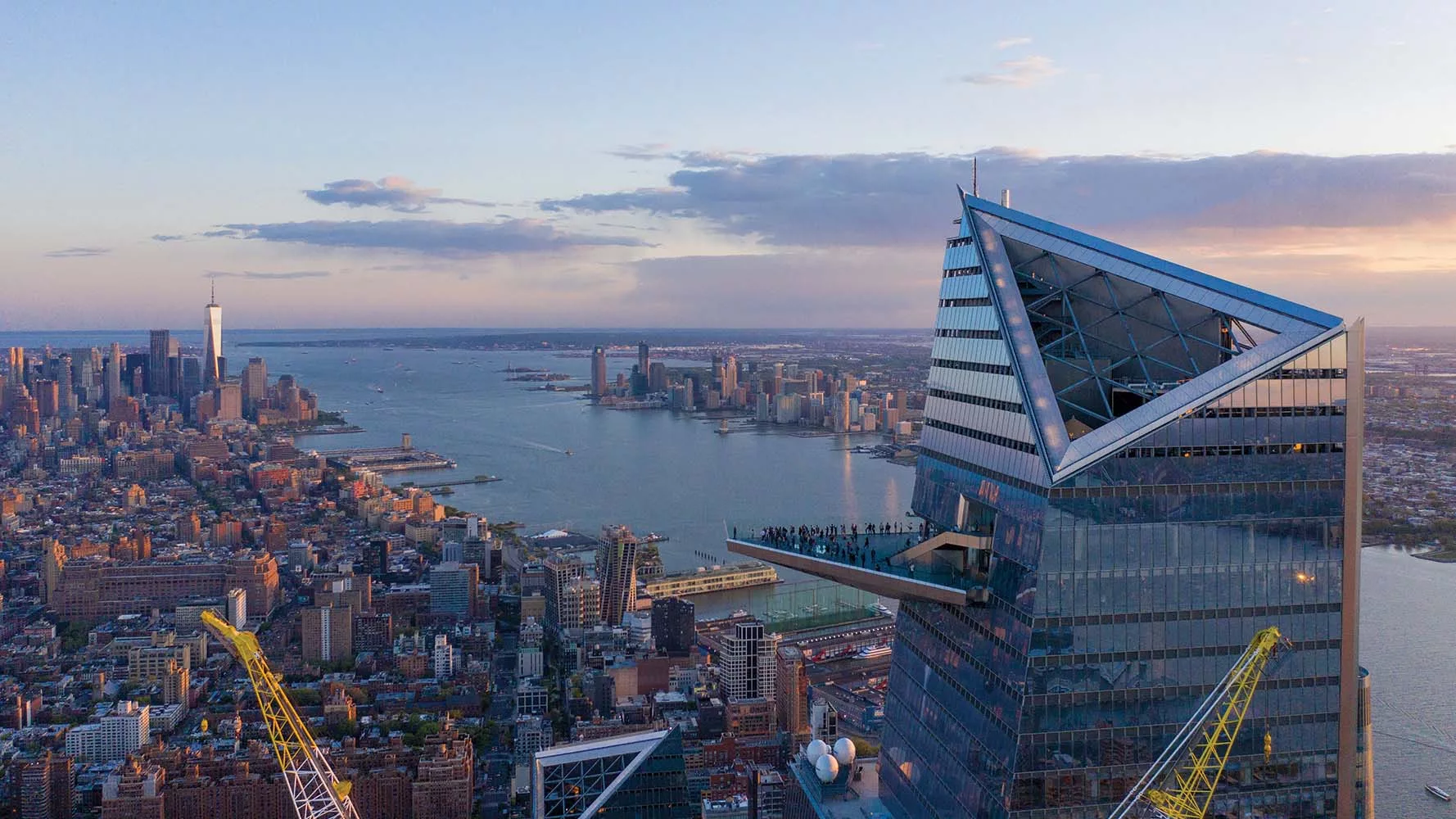
Meanwhile, the race to hook thrill-hungry Manhattan tourists kicked into high gear. Two Kohn Pedersen Fox (KPF) towers show how spectacle seeps into design—and how architects’ resistance yields mixed results. First came 30 Hudson Yards, the tallest tower in the $25 billion megaproject. From the 100th floor juts Edge, a triangular beak cantilevered off the southeast corner. James von Klemperer, KPF president and design principal, concedes the beak wasn’t in the original design. “We took it as a design challenge, rather than an obstacle,” he says. “There’s a geometric and structural integrity to harmonizing with the language of the building.”
Looking for quick answers on architecture and design topics?
Try Ask RECORD, our new smart AI search tool.
Ask RECORD →
Gimmicky or not, Edge has found a pulse with sunrise yoga and sunset raves—more life than the development’s sterile street level can muster. The tower’s pyramidal roof offered a more integrated opportunity: for $185 and a harness, visitors can scale a steel stairway to the building’s 1,200-foot peak.
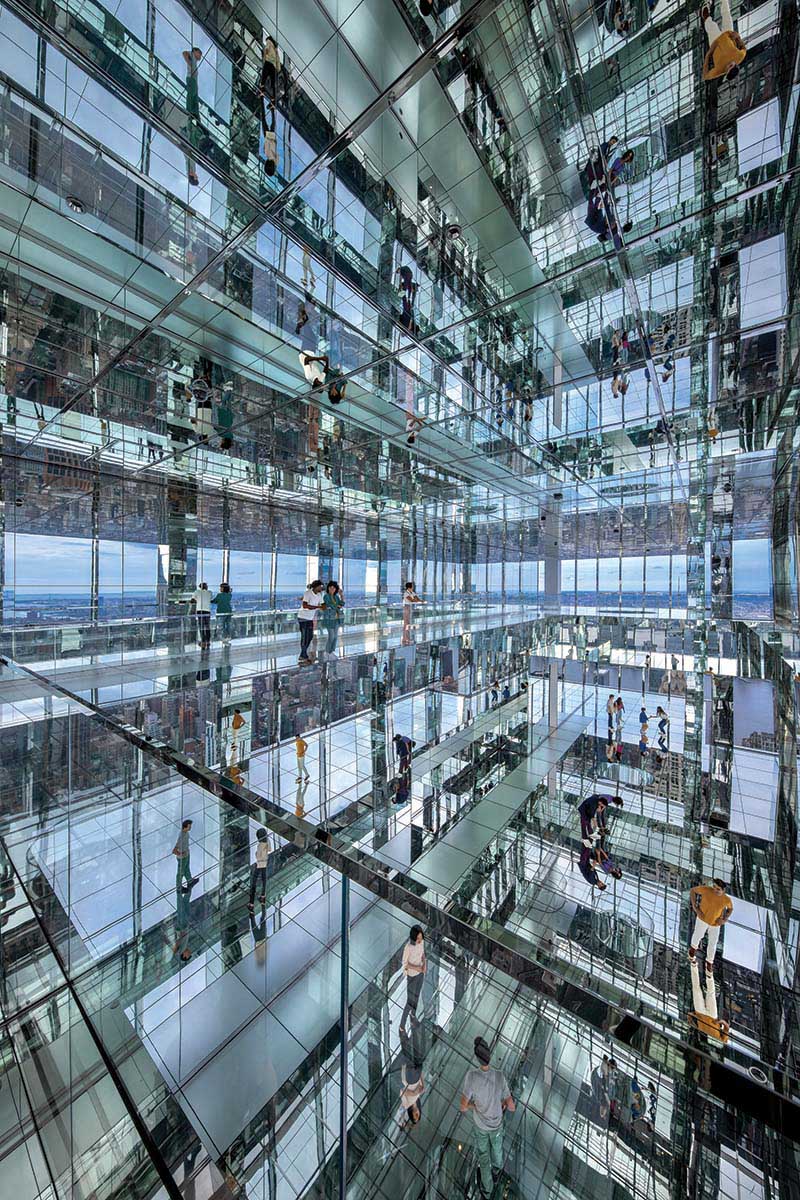
Artist Kenzo Digital added a mirrored installation to the two-story observation deck at One Vanderbilt. Photo © SL Green
KPF tried with Summit, the “view that changes you” at One Vanderbilt, which opened in 2021. One attraction tacks twin glass elevators onto the crown. Artist Kenzo Digital turned floors 91 through 93 into a mirrored fun house. “At first I wondered if those elevators would be a scar on the building,” von Klemperer says. “A pristine envelope doesn’t appreciate lots of extra bits.” He insists the lifts barely interrupt the form but concedes the fight was lost over the ultra-low-iron glass on the observation levels. The result: a multi-story mirrored scar, visible as far away as the Brooklyn Bridge. “We objected strenuously to the interruption of this clean form, but the owner felt very strongly the views must have maximum transparency,” he says. “Over time, I’ve come to appreciate it, like a piece of a machine uncovered.”
The intrusions are more disruptive still in Macau and in Batumi, Georgia—two cities bound by a thrill that debuted at Chicago’s 1893 World’s Fair: the Ferris wheel. Batumi Tower, a 660-foot building designed by Metal Yapi in 2012, holds eight golden cabs pinned 330 feet up, cutting into the facade in the world’s first attempt to jam a Ferris wheel into a skyscraper. The wheel has never worked, and the tower has changed hands multiple times. In Macau, developers doubled down with Studio City Hotel’s Golden Reel, a gondola ride sporting 17 steampunk-themed cabins circulating a figure eight cutout through the building. The number eight may promise luck in Chinese culture, but the design inspiration was Hollywood hokum: “Two flaming asteroids crashed through the building facade in tandem,” according to developers. The result is a summer popcorn blockbuster transformed into architecture, where form follows fantasy and function follows fear.
Even landmarked towers aren’t safe. At 30 Rock, a once-serene terrace is now crowded with multiple moving attractions, including Skylift, a glass pod rising above the roofline and The Beam, an elevating steel girder offering “lunch atop a skyscraper,” Depression-era cosplay. What’s next—a drop ride through the Empire State’s mooring mast? Not quite. Enter the Torch, a 1,067-foot-tall hotel/thrill ride mash-up, designed by ODA Architecture, rising west of Times Square. The clickbait concept marries a standard-issue glass box to a 240-foot structural stem, crowned by a multilevel observation platform wrapped in folded glass with canted crown.
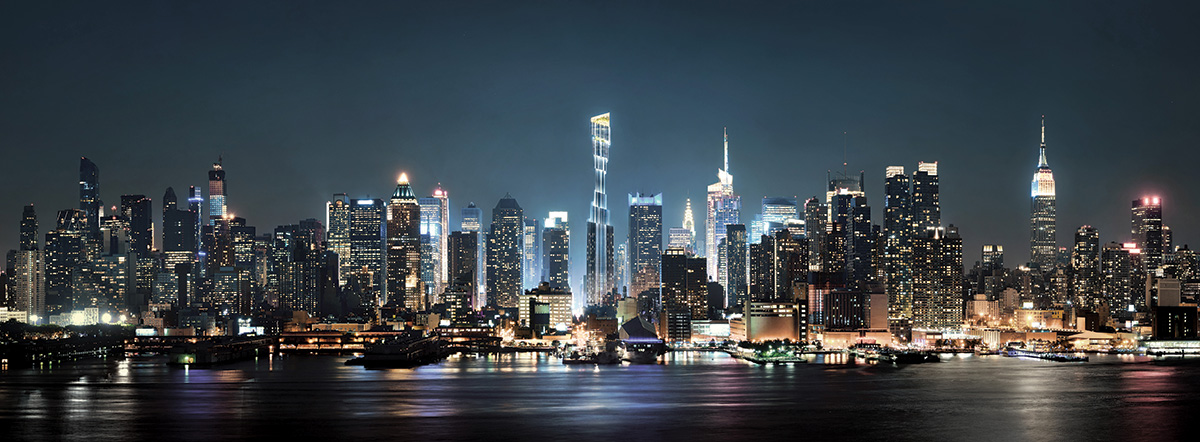
The Torch is in construction in Times Square. Image courtesy ODA
Plans call for a drop-ride plunging thrill seekers down the stem, cocooned by glass walls as the dizzying ambience of the Theater District accelerates toward them. Whether it survives the final build is anyone’s guess. ODA’s Eran Chen declined to comment; an Extell spokeswoman said it was “too early” to discuss (under-construction) building specifics. Delirious as it sounds, you can almost imagine Times Square’s sensory overload swallowing the spectacle—just a glass tube of screaming tourists sandwiched between 3D billboards, candy-stripe spires, and the intensifying electronic cacophony of the Great White Way-too-much.
In fact, modern high-rise thrills can serve up inspired pop architecture: KPF proved it with Shanghai World Financial Center, still the high bar. The 120-foot-long glass and steel skybridge suspended from the crown’s trapezoidal cutout is an enthralling fusion of form and heart-stopping function. Still, the unquenched desire to loop the ultimate loop persists, as well as the question: are we edging closer to that Six Flags Skyline Park?
“Making the city into a World’s Fair playground is kind of a natural development, where the structural potential is there,” von Klemperer says. “New York can withstand it.” With KPF firmly established among Earth’s collection of skyline thrillers, he’s bullish on their latest Shanghai project, a “cathedral in the air” atop a 1,574-foot sculptural high-rise. The silvery mixed-use tower, with a curved roofline of setbacks alluding to a magnolia—the city flower—will be Shanghai’s first all-electric supertall. “I think it will be the world’s most exciting experience,” he says.
Any roller coasters, drop rides, glass elevators? “No,” he admits, “but there is a helipad you can go out on. There’s still that element of ‘Can you top this?’”
Looking for a reprint of this article?
From high-res PDFs to custom plaques, order your copy today!