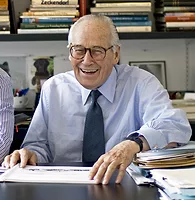
Robert A.M. Stern, Former Yale Dean and Exponent of Traditional Architecture, Dies at 86
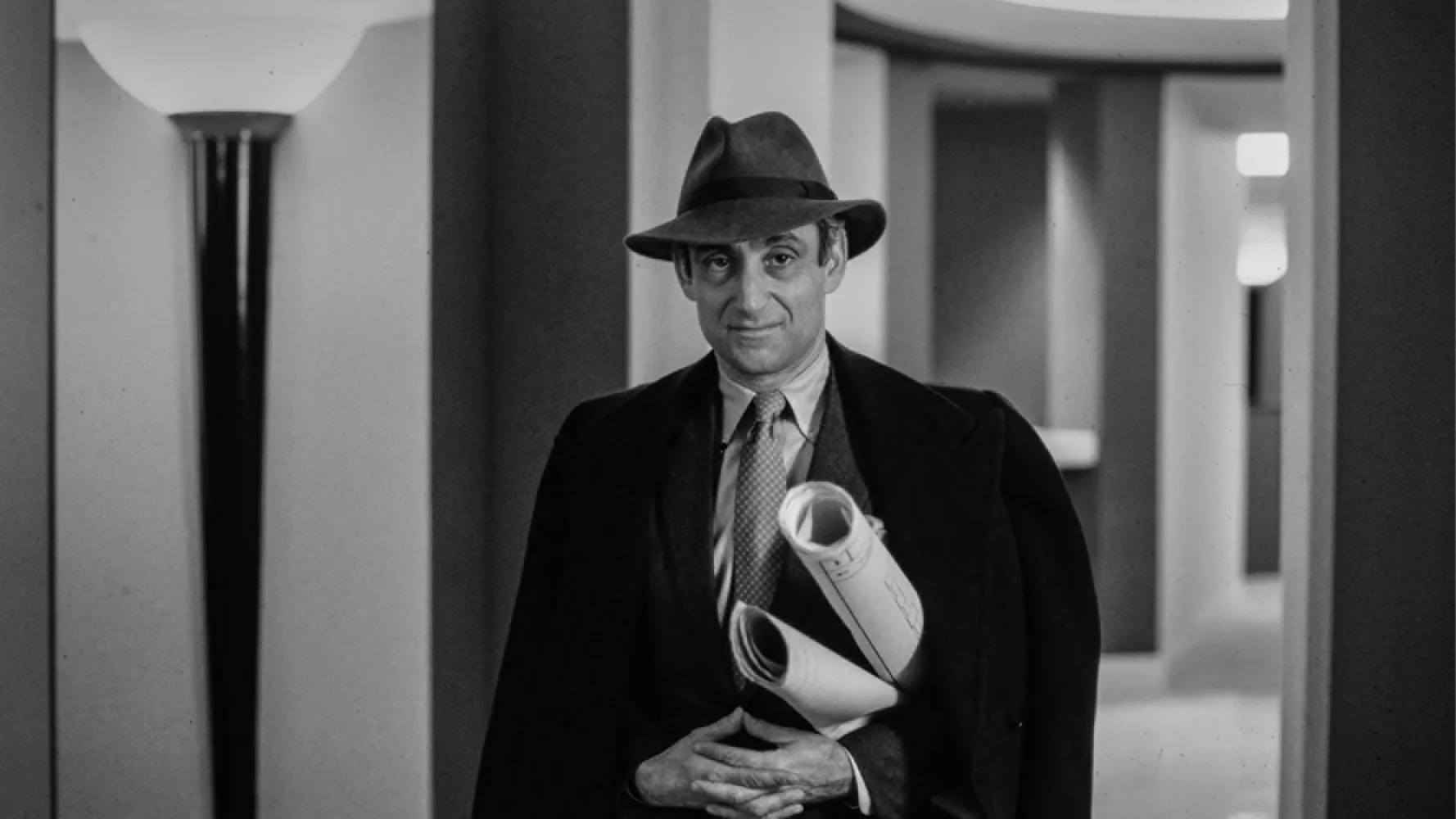
Robert A.M. Stern, founding partner of the firm now known as RAMSA and dean of the Yale School of Architecture from 1998 to 2016, died at his apartment in New York City on November 27, 2025, at the age of 86, following a respiratory illness. The architect first rose to prominence during the spirited stylistic debates of the 1970s, but it was his subsequent work for Disney and commercial developers that cemented Stern’s position on the international stage. Originally trained as a modernist, he became an outspoken champion of traditional architecture, buttressed by a parallel career as a historian and teacher. He had planned to retire from the firm in January, after 57 years of practice.
Through his architecture, Stern sought to embody the American dream—an interest perhaps spurred by his own journey. Born in 1939 to Sidney Stern and Sonya Stern (née Cohen), Robert grew up in a working-class household in the Windsor Terrace neighborhood of Brooklyn—a borough that he characterized as “a place to be from and get out of. ” Eyes set on Manhattan, he attended Columbia University from 1956 to 1960, where he studied American history and befriended Adolf Placzek at the school’s storied fine arts and architecture library. Placzek introduced the inquisitive student to prized archival holdings, including Beaux Arts–style renderings and I.N. Phelps Stokes’s six-volume Iconography of Manhattan Island, which would serve as a model for his own published series on New York City decades later.
Stern studied architecture at Yale University when such heroic form-makers wandered its halls as Paul Rudolph, who led the department of architecture from 1958 to 1965; Philip Johnson, who took an early interest in him and became a lifelong friend and mentor; and Ulrich Franzen, Henry N. Cobb, and John M. Johansen, who were frequent jurors at the school. Noted historian Vincent Scully tapped Stern to be his teaching assistant and introduced him to Louis Kahn, Robert Venturi, and Henry-Russell Hitchcock. Out in the world, however, modernism’s influence had begun to wane, while a forceful historic-preservation movement emerged. This context would greatly influence the architect.

The first house Robert A.M. Stern designed was in Montauk, New York. Photo by Hans Namuth, courtesy RAMSA
After graduating, he returned to his hometown to become the inaugural J. Clawson Mills fellow at the Architectural League of New York, where he mounted a series of small-scale exhibitions on a range of topics, as well as the larger 40 Under 40, which highlighted up-and-coming architects. This capstone to Stern’s initial stint at the League (he would return in 1973 as its youngest president and become a life trustee in 2013) became the first of many endeavors in which he sought to elevate new voices. While briefly working for the administration of former New York City mayor John V. Lindsay, Stern also designed his first house, in Montauk, on Long Island, partnering with the young engineer Robert Silman. With its shingled, billboard-like facade and arched cutout, this project—the Wiseman House—eschewed the modernism that Stern had been taught at Yale, portending a body of work to come.
In 1969, Stern and Yale-schoolmate John Hagmann founded Stern & Hagmann Architects. The duo completed several evocative projects that playfully reinterpreted historical forms and planning principles, including the Lang House (which appeared on the cover of Progressive Architecture) and the Beebe House (the guesthouse of which appeared on the cover of A+U). At this time, Stern became an outspoken figure in postmodern circles—an important “teenage phase,” he later observed, on his path toward modern traditionalism, which he described as an architecture intended for contemporary use but informed by time-tested precedent. Notably, he was one of the so-called Grays of the “Five on Five,” published in Architectural Forum in May 1973 and edited by Suzanne Stephens, RECORD’s former deputy editor. This controversial series of articles, in which five architects individually critiqued the work of five others (the Whites), propelled him to the forefront of discourse. These activities outside the office—as a provocateur and an increasingly dominant voice in the goings-on of New York—ultimately caused a rift with Hagmann, who left the practice in 1976.
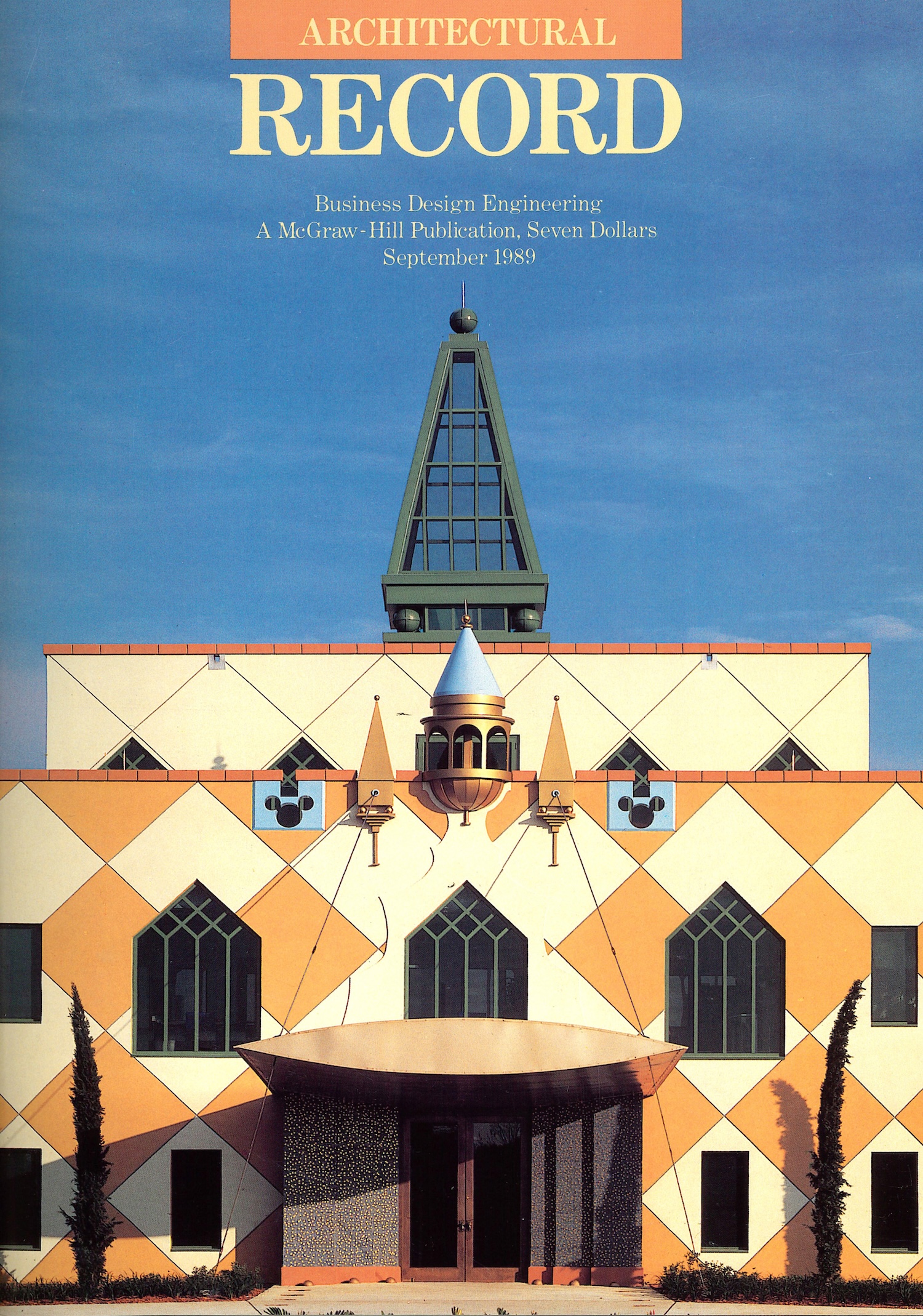
The Walt Disney World Casting Center in Lake Buena Vista, Florida, on the cover of the September, 1989 issue of RECORD. © Architectural Record
However, Stern’s networking efforts were not without benefit—especially in the long term. It was work for the Walt Disney Company, then led by Michael Eisner, that allowed the firm to grow from a small coterie of mostly former students to a larger practice. (Stern had previously renovated Eisner’s parents’ 66th Street apartment.) Joining the ranks of Frank Gehry, Michael Graves, and Arata Isozaki, Stern added to Disney’s imaginative parks with the Casting Center (on the September 1989 cover of RECORD), the Feature Animation Building, and many resort hotels. With Cooper Robertson, the firm master-planned the town of Celebration, Florida, for the company. And, close to home, after Disney had endeavored to renovate the derelict New Amsterdam Theatre in Manhattan, RAMSA worked with city and state agencies to revitalize 42nd Street and Times Square.
Unlike many of his peers, Stern embraced opportunities to collaborate with developers, which he saw as partners. For Gerald Hines, RAMSA designed 222 Berkeley (1991) in Boston and what became the Gap Headquarters (2001) in San Francisco, among other projects around the globe. For Liberty Property Trust, the firm realized Comcast Tower (2008), a sleek glass-clad obelisk on the Philadelphia skyline. But it was 15 Central Park West (2008), for brothers Arthur and William Zeckendorf, that set a new benchmark for luxury living by looking back at Manhattan’s interwar apartment houses.
Looking for quick answers on architecture and design topics?
Try Ask RECORD, our new smart AI search tool.
Ask RECORD →
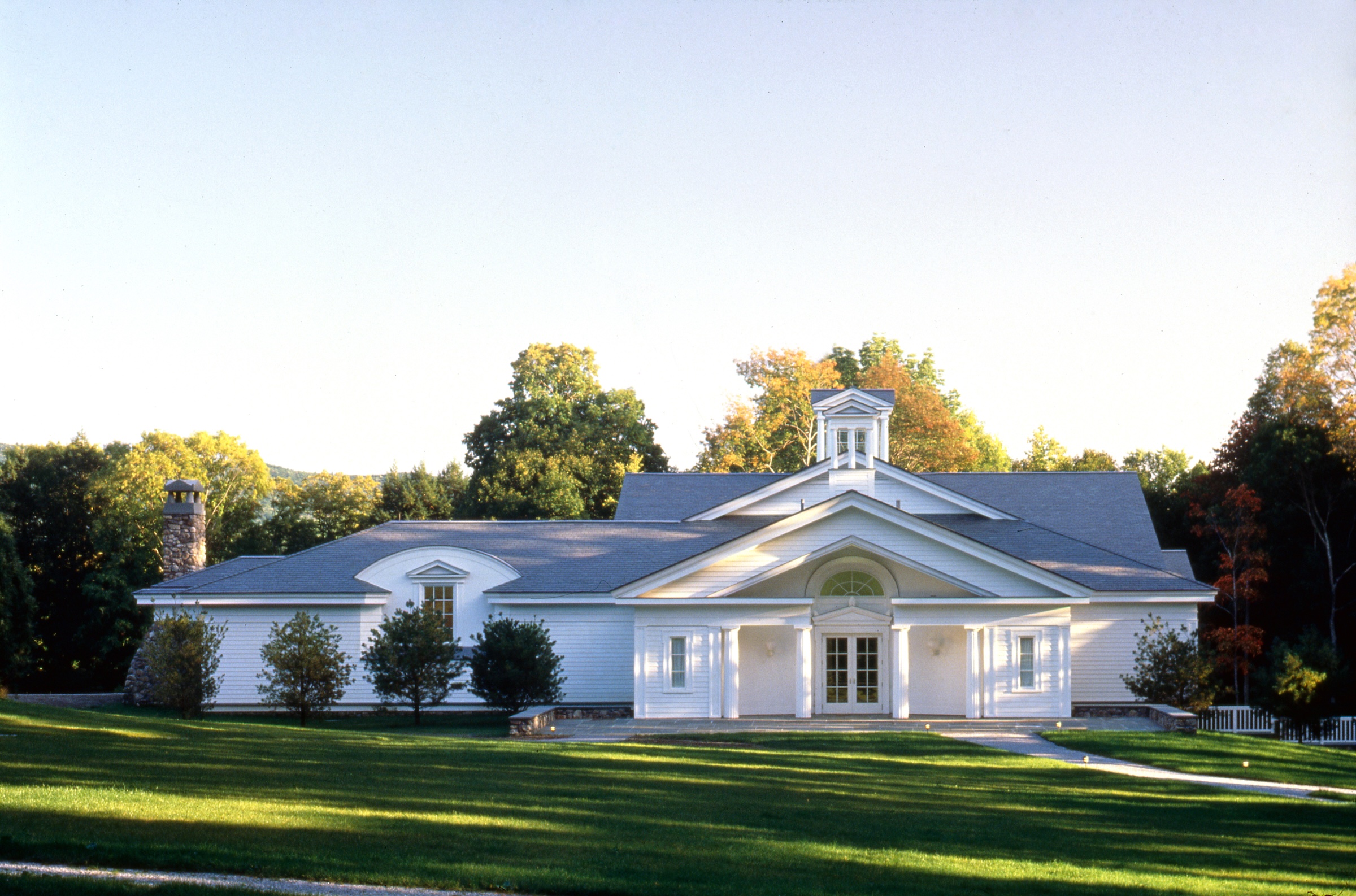
The Norman Rockwell Museum is located in Stockbridge, Massachusetts, where the eponymous artist lived. Photograph © Peter Aaron/OTTO
Although Stern’s arguably populist approach attracted a clientele of celebrities, political insiders, real-estate tycoons, and top-tier schools, this was only one side of his practice. The firm built prolifically on community college campuses and in American downtowns, designing public buildings, libraries, and museums, large and small. Reflecting his interest in U.S. history and its key figures, RAMSA completed the Norman Rockwell Museum (1993) in Stockbridge, Massachusetts, and the Museum of the American Revolution (2017) in Philadelphia. In 2007, the firm was commissioned to design the George W. Bush Presidential Library at Southern Methodist University, in Texas. Ignoring calls to drop the project and justifying it as a building for researchers and the public, Stern produced what might be the grandest of the 13 official presidential libraries overseen by the National Archives & Records Administration.
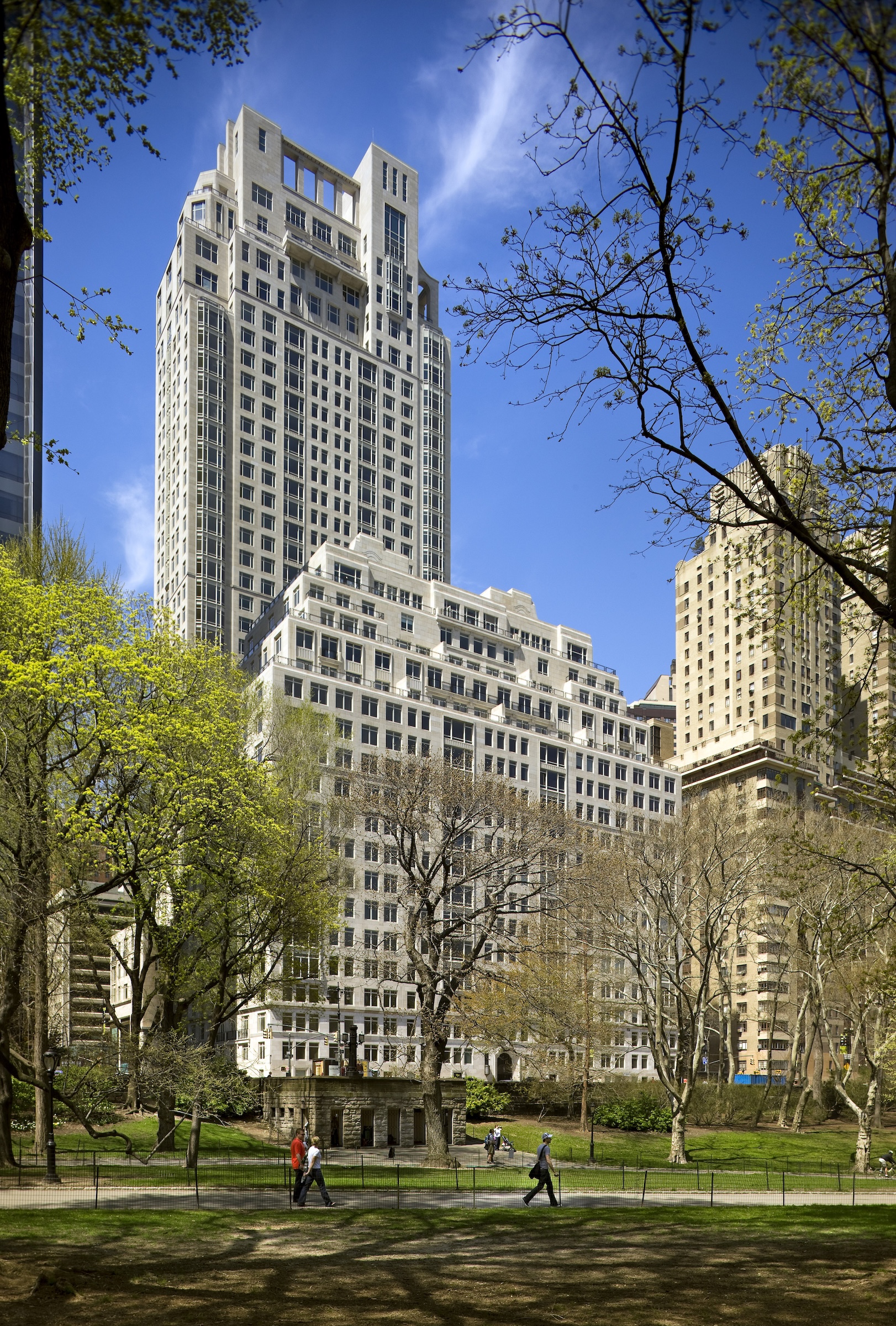
15 Central Park West marked a new benchmark for high-end living and garnered celebrity notoriety for Stern. Photo © Peter Aaron/OTTO
But perhaps more than for his buildings, Stern will be remembered for his contributions to architectural pedagogy—in the classroom and out. “Central to his legacy are the many ‘alumni’ of the firm—talented architects, writers, editors, and scholars who passed through and have been influenced by him and the firm’s culture,” says Graham Wyatt, a former student who became a partner at RAMSA in 1989. Indeed, Stern organized his office like a school, but he also spent nearly as much time in academia as he did in practice. He began teaching at Columbia University in 1970. Under the deanship of James Stewart Polshek, he instigated the creation of an undergraduate architecture-degree program at Columbia College and was integral to the formation of the Temple Hoyne Buell Center for the Study of American Architecture; he also served as its inaugural director. Around this time, Stern also undertook writing New York 1900, which became the first in a six-volume series documenting the titular metropolis’s built environment. “It is, without debate, the most comprehensive account of the city’s architecture,” wrote Mark Foster Gage in a review for RECORD. “But a case can also be made for its being one of the most significant works of architectural history ever produced.”
In every act—written or built—Stern sought to expound on the merits of American architecture in his search for the “usable past.” In 1986, he brought them directly to households across the country via PBS. As host of the eight-episode television series Pride of Place: Building the American Dream, directed by Murray Grigor, Stern blazed across the U.S. to interview guests about built marvels, old and new: Gehry outside his Loyola Law School in L.A.; Phyllis Lambert at Lever House in Midtown Manhattan, while the Seagram Building loomed large behind her; Jaque Robertson on the grounds of Thomas Jefferson’s Monticello; and J. Max Bond at the Lincoln Memorial, among many others.
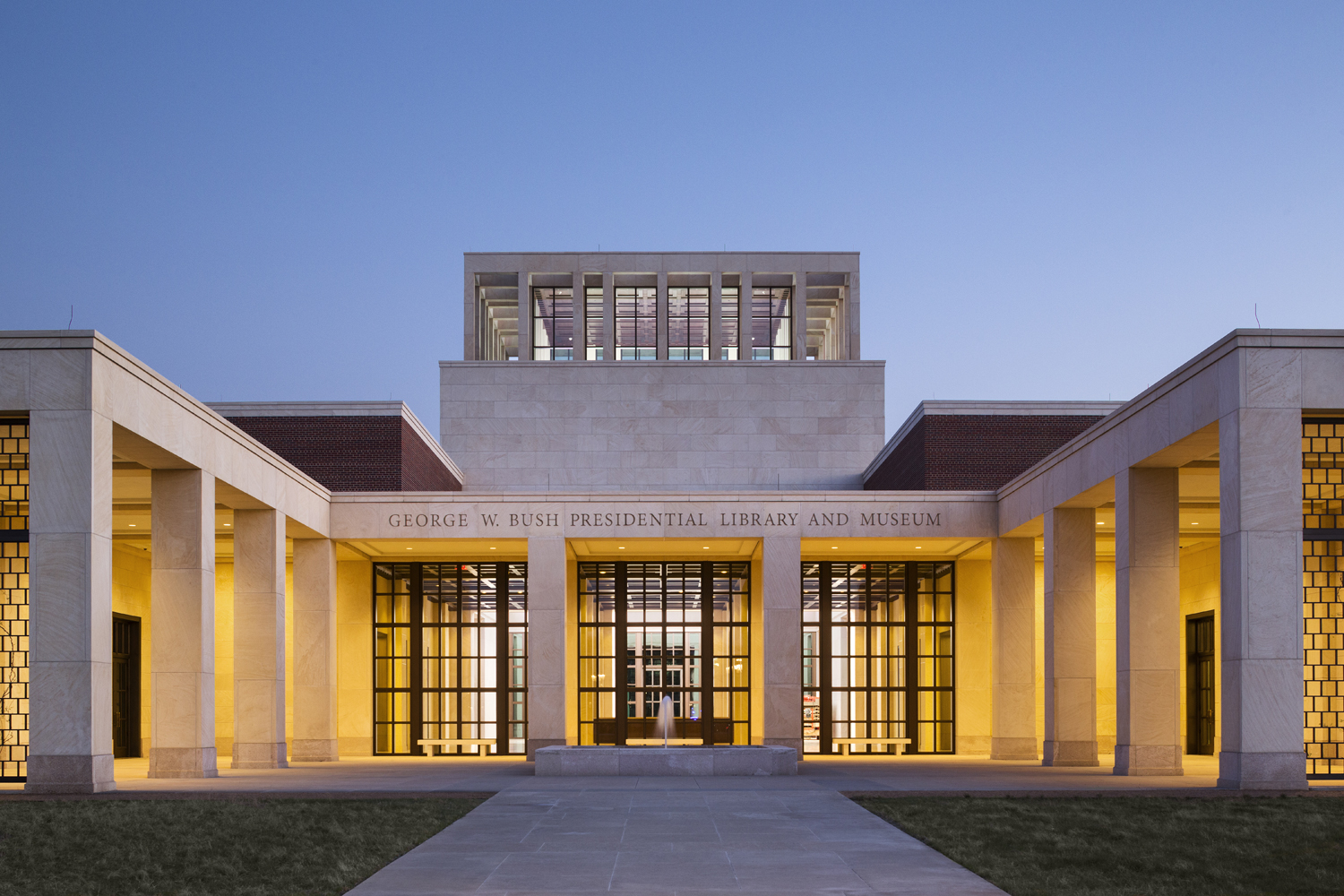
In 2007, RAMSA was commissioned to design the George W. Bush Presidential Library at Southern Methodist University. Photo © Peter Aaron/OTTO

Comcast Tower, visible on the Philadelphia skyline, connects to commuter transit at its base. Photo © Peter Aaron/OTTO
In 1998, Stern was tapped to succeed Fred Koetter as dean of the Yale School of Architecture. The appointment, fraught with controversy, followed a lengthy but unproductive search and prompted backlash from some, who feared that Stern, by this time an unabashed traditionalist, would turn the school into an incubator for classicists. But Stern proved critics wrong—he was a formidable fundraiser, a deft administrator, and an architectural impresario interested in a broader, more pluralistic approach to education, inviting such figures as Johnson, Gehry, Peter Eisenman, Cesar Pelli, Yvonne Farrell and Shelley McNamara, Glenn Murcutt, Brigitte Shim, Greg Lynn, and Bjarke Ingels. Most surprising was his close friendship with Zaha Hadid, invited by him to teach on several occasions. Stern sought to refashion Yale as it had been in the 1960s—as a revolving door for celebrated figures and emerging talents to intermingle and socialize with students. “He was absolutely energized by discourse and debate,” says Deborah Berke, his successor as dean and longtime faculty member. “And nothing was more fun than talking to him about design with a martini in hand.” During his tenure, Stern also championed the restoration and rededication of the school’s home—Rudolph’s Art & Architecture Building—as well as the adjacent expansion, Loria Hall, designed by alumnus Charles Gwathmey. “It is hard to overstate what he meant to Yale,” says former president Richard Levin. “He revived the greatness of the School of Architecture and, less visibly, kept us from innumerable errors as the behind-the-scenes consigliere of Yale’s architectural review process.”
In 1998, Stern was tapped to succeed Fred Koetter as dean of the Yale School of Architecture. The appointment, fraught with controversy, followed a lengthy but unproductive search and prompted backlash from some alumni, who feared that Stern, by this time an unabashed traditionalist, would turn the school into an incubator for classicists. But Stern proved critics wrong—he became a formidable fundraiser, a deft administrator, and an architectural impresario interested in a broader, more pluralistic approach to education, inviting such figures as Zaha Hadid, Philip Johnson, Peter Eisenman, Frank Gehry, Cesar Pelli, Yvonne Farrell and Shelley McNamara, Glen Murcutt, Brigitte Shim, and Tod Williams and Billie Tsien, Greg Lynn, and Bjarke Ingels. Stern sought to refashion the school as it had been in the 1960s—as a place for students to meet high-profile practitioners. As dean, Stern also championed the restoration and rededication of the school’s home—Paul Rudolph’s Art & Architecture Building—as well as the adjacent expansion, Loria Hall, designed by Yale alumnus Charles Gwathmey.

In 1998, Stern became dean of Yale's School of Architecture. Photo courtesy RAMSA
I first met Stern in 2015 and became well acquainted with his mannerisms, best summarized by an irrepressible love of storytelling, witty ripostes, and a certain zeal for Golden Age Hollywood, which would manifest in frequent quotation. (Relatedly, his uncanny ability to recall information and his encyclopedic knowledge of history were remarkable.) He always expected excellence and could be disarmingly frank. Over a period of nearly eight years, I spent countless hours with “Bob”—as many knew him—developing lectures, collaborating on essays, and traveling to events. But the culmination of our time together was his autobiography, Between Memory and Invention, published by Monacelli in 2022. Acting as amanuensis, I pored over a decades-spanning collection of letters, photographs, slides, ephemera, appointment books, drawings, and diaries—often with him by my side—while he recounted the many turns of his career.
Stoic by reputation, Stern shared many personal anecdotes and admissions in the book, to the surprise of many readers. But, true to form, Between Memory and Invention was not only a personal reflection on his life; it also chronicled the postwar American architectural scene and its key players, himself among them. It was a privilege to be entrusted with the task of helping him tell such a multifaceted story, and to get to know him as well as I did along the way. The profession has lost a towering voice—Stern’s commitment to both the project of architecture and its education was unrivaled.

1

2
Pauli Murray and Benjamin Franklin Colleges at Yale University are built in a collegiate Gothic style and clad in red brick (1); The Schwarzman Center at Yale is housed in the Bicentennial Buildings, near Beinecke Library (2). Photos © Peter Aaron/OTTO (1), Francis Dzikowski (2)
In addition to the New York series, Stern authored several books (and contributed to many more), including two collected writings (edited by Cynthia Davidson), New Directions in American Architecture (1969), George Howe: Toward a Modern American Architecture (1975), Paradise Planned: The Garden Suburb and the Modern City (with Jacob Tilove and David Fishman, 2013), and Pedagogy and Place: 100 Years of Architecture Education at Yale (with Jimmy Stamp, 2016). RECORD premiated Stern with two Record House awards—for both the Bozzi House in East Hampton, New York, and Points of View on Mt. Desert Island in Maine. In 1984, the American Institute of Architects inducted Stern into its College of Fellows and, in 2017, honored him with the Topaz Medallion, awarded jointly by the AIA and the Association of Collegiate Schools of Architecture for “outstanding contributions in architectural education.” The National Building Museum awarded Stern the tenth Vincent Scully Prize in 2008 and he was the 2011 Driehaus Prize laureate. He has been recognized by various institutions, including the Architectural League of New York, the Sir John Soane’s Museum Foundation, the Municipal Art Society, the American Academy in Rome, the New York Landmarks Conservancy, and the Institute of Classical Architecture & Art, among many others. He has been a fellow of the American Academy of Arts & Sciences since 2007 and a member of the American Academy of Arts & Letters since 2011.
He is survived by his son, Nicholas S.G. Stern; his ex-wife, Lynn; his brother, Elliot; and three grandchildren. RAMSA, today numbering 250, will continue to operate under the leadership of its 18 partners.
Looking for a reprint of this article?
From high-res PDFs to custom plaques, order your copy today!