For the fifth consecutive year, Gensler and Perkins&Will remain fixed at the highest positions on Architectural Record’s annual ranking of the Top 300 U.S. architecture firms by revenue.
The editors of Architectural Record are looking for the best emerging firms and practitioners to include in the next cohort of Design Vanguard. Each year, the award program recognizes 10 leading young firms and individuals from around the world who represent the promise of the next generation of architects.
Olayinka Dosekun-Adjei, cofounder and creative director of 2023 Design Vanguard firm Studio Contra, is one of nine featured speakers at RECORD’s upcoming Innovation Conference in New York.
Based in Brooklyn's Gowanus neighborhood, husband-and-wife partners Nicholas and Deirdre McDermott founded their firm “on the belief that the future provides us with opportunity to constantly improve on the past.”
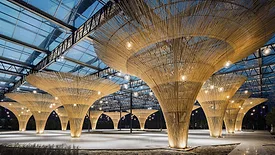
Founded in 2016 by Zhou Suning, Tang Tao, and Wu Ziye, the Nanjing-based practice got its start in rural China, where government investment aims to revitalize areas that have long suffered from lagging economic development and depopulation.
For the fourth consecutive year, Gensler, Perkins&Will, and HDR remained fixed at the highest positions on Architectural Record’s annual ranking of the Top 300 American architecture firms by revenue.
These 10 emerging practices from across the U.S., Mexico, Germany, China, Japan, Nigeria, and Australia represent the promise of the next generation of architects.
With a “farm-to-shelter” mentality, BLDUS founders Andrew Linn and Jack Becker have taken a hands-on approach to designing structures with a sustainable aesthetic that challenge mainstream stick-built construction.
A decade into their shared practice, Mexico City–born Ingrid Moye and Berlin-born Christoph Zeller use their bicontinental arrangement to execute projects in both Latin America and Europe, allowing their experiences to inform one another.
Based in Hong Kong and Shanghai, Briar Hickling and Alex Mok of Linehouse build site-sensitive projects around knowledge of local materials and Chinese craftsmanship.