Editor’s Letter July 2026
American Dreaming

As the United States of America turns 250 this month, we asked architects and scholars to share their thoughts on the most important buildings and places throughout the country’s history. Selections run the gamut from buildings that represent American institutions, culture, or companies to individual houses—the ownership of which has epitomized the American Dream for the last century. There are of course some predictable responses, and some real surprises—the prize for that goes to David Rifkind’s choice of Cinderella Castle at Walt Disney World in Orlando, Florida, citing its very American tale of reinvention, imagination, and entertainment.
Perhaps it’s no surprise, however, that at least one architect selected his childhood home. That architect is Michael Maltzan, and that home was Levittown, on New York’s Long Island, widely considered to be America’s first mass-produced suburb. Built by Levitt & Sons starting in 1947 for returning World War II veterans, thousands of inexpensive residences of similar design filled endless looping streets and cul-de-sacs on what had been potato fields. “I found order and connective threads in the subtly shifting patterns across the facades of the tract houses, the calculated variations of shingle types, the periodic blooms of wild weeds in the storm sumps, the intense light in a place with immature trees, and the landscape of the in-between,” Maltzan has written about his time growing up there.
But today, in an all-too-familiar scenario playing out across America, those modest Cape-style houses that originally sold for $7,900 in 1947—about $120,000 when adjusted for inflation—are now going for $700,000. And, worse, many have been torn down and replaced with so-called McMansions that cost over $1 million, completely altering that once archetypal landscape of suburban America and provoking the ire of longtime Levittown residents. Following heated debates, the town board voted this spring on a zoning change that limits the permitted building area on a residential lot to 27.5 percent, down from 30 percent.
In this issue, we look at mass housing of a different kind, from social housing to replace favela-like dwellings in Paraguay to an over-the-top, amenity-rich building in yet another gentrifying neighborhood in Brooklyn, and to a downtown Winnipeg project that incorporates the adaptive reuse of a warehouse and new construction. In Los Angeles, Lorcan O’Herlihy took up the project of housing at a time when it was not so fashionable to do so. Over the last three decades, the work of his firm has had a profound impact on his city. We feature two of the office’s most recent student-housing projects, and pay tribute to O’Herlihy following his untimely death.
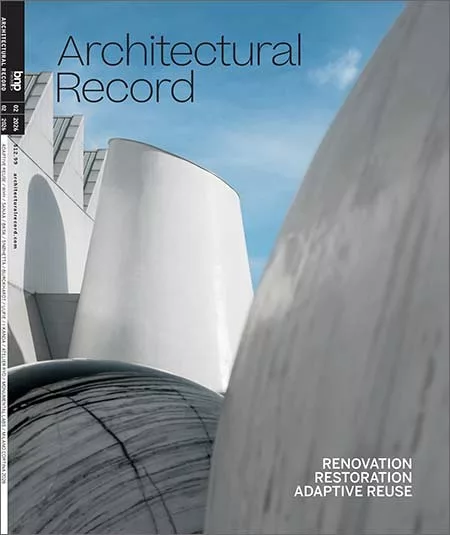
On the cover is a project outside Toulouse, France, that emphasizes the value of outdoor space. Not unlike Sou Fujimoto’s L’Arbre Blanc in nearby Montpelier, Home Spirit’s distinctive silhouette is defined by oversized balconies, but in a mid-market multifamily block. That, and its unique arrangement of duplexes, floor-through apartments, and rooftop maisonettes make it a prototype worth emulating. But, according to its architect, Pierre-Louis Taillandier, the project could not have been realized even a year after it was completed due to price hikes brought on by the war in Ukraine.
Levitt & Sons was considered the General Motors of the housing industry, by 1950 producing a four-room house every 16 minutes. Can a one-off project like Home Spirit, or any examples we feature this month, move the needle in terms of providing well-designed affordable housing? Not according to architect and educator Emmett Zeifman, who writes in this month’s Forum, “We valorize individual projects, and we proceed by infilling one lot at a time, almost always with enormous regulatory and financial complexity.”
Your home is your castle, but, as the country turns 250 years old, owning one of your own is becoming for many as far from reality as Cinderella’s is.
Looking for quick answers on architecture and design topics?
Try Ask RECORD, our new smart AI search tool.
Ask RECORD →
Looking for a reprint of this article?
From high-res PDFs to custom plaques, order your copy today!